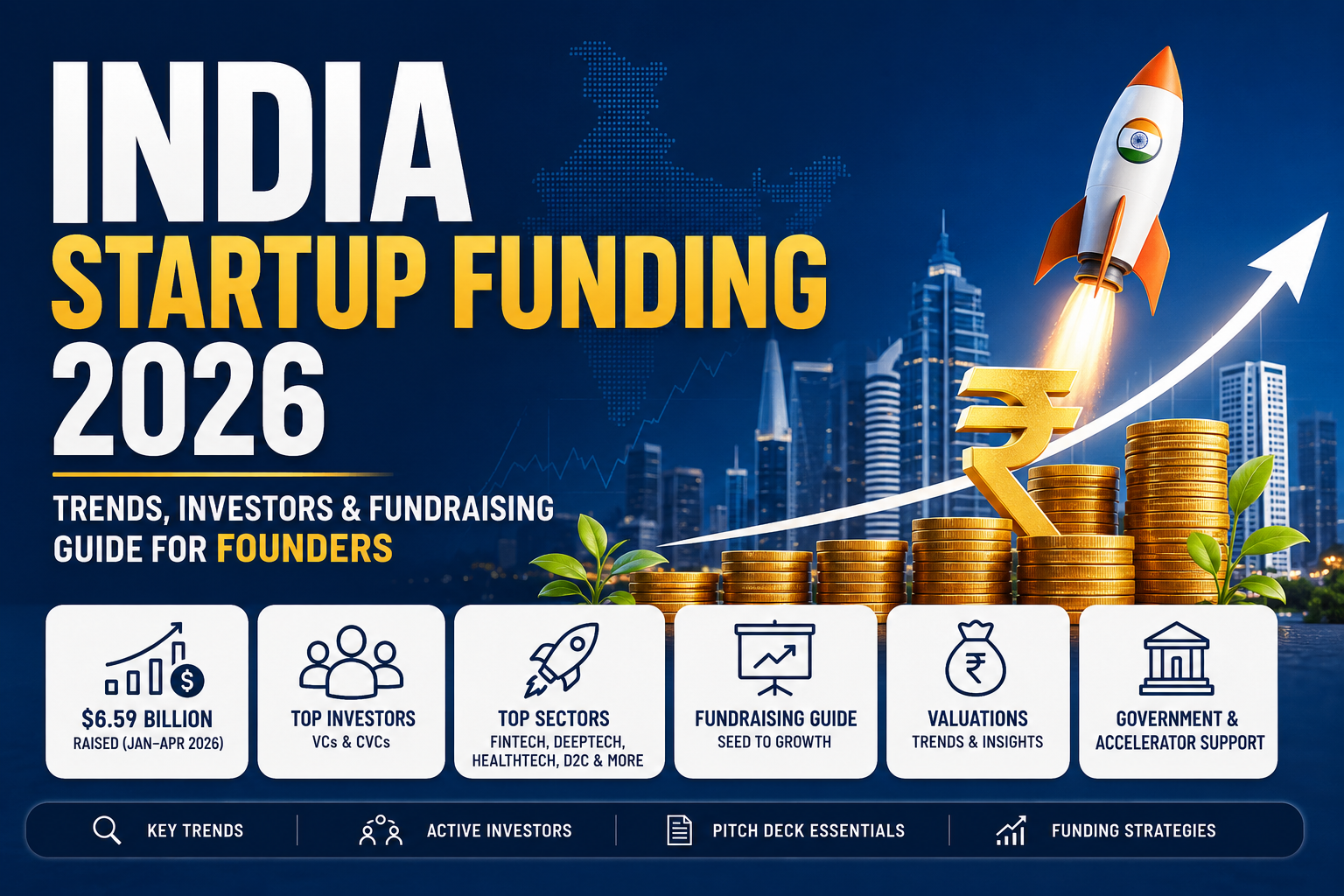
India Startup Funding 2026 has returned to healthy, selective growth after the painful correction of 2022-2024. Indian startups raised approximately $6.59 billion across 640 equity funding rounds in the first four months of 2026 — a pace that signals investor confidence without the irrational exuberance of the 2021 peak. The shift from ‘growth at all costs’ to ‘profitable growth’ has made investors more selective but also more thoughtful — backing startups with genuine business models rather than compelling narratives alone.
For founders building startups in India in 2026, understanding the funding landscape — which sectors are getting money, who the active investors are, what they look for, and how to navigate the fundraising process — is as important as building a great product. This comprehensive guide covers everything a first-time or early-stage Indian startup founder needs to know about raising capital in 2026.
India Startup Funding 2026: The Landscape
Key Funding Statistics
- Total funding raised (Jan-April 2026): $6.59 billion across 640 rounds
- Top deal of Q2 2026: Snabbit raised $56 million Series D (home services)
- Acko Insurance preparing $2-2.5 billion IPO — largest planned InsurTech listing
- IPOs (Jan-April 2026): 54 companies listed — healthy public market activity
- Average deal size increase: Investors doing fewer deals but larger average ticket sizes
- Most active stage: Series A and Series B — seed and early growth remain active
What Changed From 2021 to 2026
India Startup Funding 2026, The funding environment has fundamentally changed in ways founders must understand:
- Valuation discipline: Investors are applying strict comparable analysis — valuations relative to revenue and growth, not just growth alone
- Path to profitability: Every investor asks about profitability timeline from Series A — not just Series C
- Unit economics first: Customer acquisition cost, lifetime value, payback period — these must be favourable before raising
- Revenue quality: Recurring revenue, high gross margins, and revenue diversification are prized over raw GMV
Sectors Getting Most Funding in India 2026
FinTech — Still the Leader
FinTech continues to attract the most venture capital in India — approximately $1.6 billion in H1 2026. Sub-sectors:
- Lending tech: Kissht, KreditBee, and digital NBFC platforms raising significant capital
- Wealth management: Zerodha, Groww, and challengers competing for India’s expanding investor base
- Insurance tech: Acko, Digit leading; multiple smaller InsurTechs raising seed and Series A
- B2B payments: Invoice financing, supply chain finance, and merchant payment infrastructure
Deep Tech — The Breakout Sector
2026 is being called deep tech’s breakout year in India. Defence tech alone raised $311 million in 2025 and the trend continues:
- Space tech: Skyroot Aerospace, Agnikul Cosmos, Pixxel — India’s private space sector is growing rapidly
- Defence tech: Apollyon Dynamics, multiple unmanned systems and sensors startups
- AI and ML: Indian AI startups building models and applications for Indian market realities
- Semiconductor design: Chip design startups finding investors as India builds semiconductor ambitions
HealthTech — Resilient Growth
- Digital pharmacy: TrueMeds raised $85 million Series C
- Diagnostics: AI diagnostics startups including Qure.ai growing internationally
- Women’s health: Period care, fertility, and maternal health startups attracting capital
- Mental health: Wysa, YourDOST and digital mental health platforms finding funding momentum
D2C Consumer Brands
India’s D2C brands are entering a more mature phase — investors backing brands with proven product-market fit and positive contribution margins:
- Skincare and beauty: CHOSEN raised $5 million; multiple premium-positioned D2C beauty brands
- Ethnic wear: Kisah raised Rs 35.9 crore; premium sustainable fashion attracting capital
- Food and nutrition: Health-focused food brands with clinical validation receiving disproportionate investor interest
Top Investors in India’s Startup Ecosystem 2026
Tier 1 VCs
- Peak XV Partners (formerly Sequoia India): Still the most prestigious and founder-sought VC; backed Zomato, Meesho, Groww
- Lightspeed India: Active across sectors; known for founder-friendly partnership approach
- Accel India: Long track record; backed Flipkart, Freshworks; strong B2B SaaS portfolio
- Nexus Venture Partners: Specialist in SaaS, FinTech, and consumer; strong follow-on support
- Matrix Partners India: Consumer and SaaS focus; operational support for portfolio companies
Active CVC (Corporate Venture Capital)
- Reliance Jio Platforms: Strategic investments in tech startups aligned with Jio ecosystem
- Tata Capital: Diverse investment portfolio across sectors
- SBI, HDFC, ICICI bank venture arms: Primarily FinTech and InsurTech investments
Government Funds
- SIDBI Fund of Funds: Invests in SEBI-registered AIFs that then invest in startups
- Startup India Seed Fund: Direct seed funding for early-stage DPIIT-recognised startups
- BIRAC: For life sciences and biotech startups — grants and equity investments
How to Raise Your First Round: Seed and Pre-Seed
When Are You Ready to Fundraise?
India Startup Funding 2026, Many founders make the mistake of raising too early — before having enough evidence to support a valuation. Investors at pre-seed and seed stage look for:
- Problem validation: Evidence that the problem you are solving is real, significant, and consistent
- Initial traction: Some customers — even 10-20 — who are willing to pay or engage regularly
- Team: Founder(s) with relevant expertise, complementary skills, and evidence of execution ability
- Market: A credible path to a large market — typically USD 1 billion+ total addressable market
Building Your Investor Funnel
Fundraising is a sales process — you need a pipeline of potential investors and a systematic approach:
- Step 1: List target investors — research who has invested in similar companies, stage, and sector
- Step 2: Get warm introductions — from founders they have backed, advisors, or accelerator networks
- Step 3: Reach out with a concise teaser email — 3-4 sentences describing problem, solution, traction, ask
- Step 4: First meeting is a pitch — have a clear, well-practiced 15-minute deck presentation
- Step 5: Follow-up with data room — financial model, customer references, competitive analysis
What Your Pitch Deck Must Cover
- Problem: The specific pain you are solving — with evidence it is real and significant
- Solution: How you solve it — simply and clearly, with product demo or screenshots
- Market size: TAM, SAM, SOM — bottom-up estimation is more credible than top-down
- Traction: Whatever you have — customers, revenue, users, pilots, letters of intent
- Business model: How you make money, unit economics, and path to profitability
- Team: Relevant experience, why this team can win
- The Ask: How much you are raising, what you will use it for, expected milestone
Valuation at Seed Stage
India Startup Funding 2026, Indian seed stage valuations in 2026 are typically in the Rs 10-50 crore range (pre-money) for pre-revenue or early-revenue startups with a compelling team and market. The standard structure is:
- Equity round: Issue new shares at an agreed valuation — simple share subscription agreement
- SAFE (Simple Agreement for Future Equity): Increasingly common at pre-seed — converts at the next priced round
- Convertible note: Debt that converts to equity at next round — used when valuation is difficult to agree
Accelerators and Incubators in India 2026
Accelerator programmes can provide funding, mentorship, and investor access for early-stage startups:
- Y Combinator: The global standard — Indian startups regularly participate; provides $500,000 for 7% equity
- Surge (Peak XV Partners): India and Southeast Asia-specific accelerator — 3-4 cohorts per year
- 100X.VC: India-specific accelerator investing SAFE structures at pre-seed
- IIM/IIT incubators: Multiple university incubators with government grant support and mentorship
- Atal Innovation Mission: Government accelerators in Atal Incubation Centres across India
Read More: Indian Startup Failures: Lessons from BYJU’S, Paytm, OYO & Quikr
Conclusion
India Startup Funding 2026, Fundraising is a means, not an end. The goal is to build a company that creates genuine value — for customers, employees, and eventually investors. The best-funded Indian startups of 2026 raised because they had built something real, not because they had a compelling narrative. Build first. Raise when the evidence supports the valuation you need. And use the capital to achieve the milestones that support the next round. Taza Newsz covers India’s startup ecosystem, funding news, founder stories, and investment policy.