
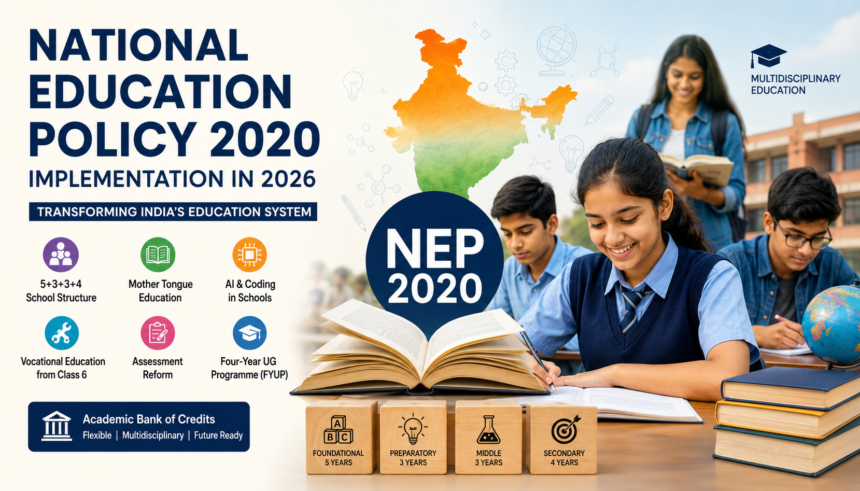
The National Education Policy 2020 — India’s most ambitious education reform since the Kothari Commission of 1966 — is now moving from policy documents into classrooms and universities across the country. In 2026, implementation is accelerating, although progress varies significantly from one state to another.
After years of consultations, committee reviews, and pilot programmes, schools and higher education institutions are beginning to apply NEP’s core reforms in practical ways. Consequently, parents, students, teachers, and educational institutions must now understand what NEP means not just in theory, but in day-to-day educational practice.
This guide explains the most important NEP 2020 reforms being implemented in 2026, including the new school structure, curriculum changes, assessment reforms, language policy, vocational education, AI integration, and higher education restructuring. It also examines the major implementation gaps and challenges that continue to affect the policy’s rollout.
NEP 2020: Understanding the Core Framework
The New 5+3+3+4 School Structure
One of NEP 2020’s biggest structural reforms is the replacement of India’s old 10+2 system with a developmental 5+3+3+4 framework.
The structure is designed around different stages of child development:
Foundational Stage (5 Years)
- Ages 3 to 8
- Includes:
- 3 years of pre-primary education in Anganwadis or preschools
- Classes 1 and 2 in primary school
This stage focuses heavily on play-based learning, language development, foundational literacy, and numeracy.
Preparatory Stage (3 Years)
- Classes 3 to 5
- Ages 8 to 11
At this stage, experiential and discovery-based learning becomes central. Students are encouraged to understand concepts through activity-based methods instead of rote memorisation.
Middle Stage (3 Years)
- Classes 6 to 8
- Ages 11 to 14
Students are introduced to:
- Subject-specialist teachers
- Critical thinking
- Coding
- Arts integration
- Experiential learning
This stage also marks the beginning of vocational exposure under NEP.
Secondary Stage (4 Years)
- Classes 9 to 12
- Ages 14 to 18
The secondary stage promotes:
- Multidisciplinary learning
- Flexible subject combinations
- Greater student choice
- Skill-oriented education
Students are no longer expected to remain restricted within rigid arts, science, or commerce streams.
Importantly, NEP formally recognises early childhood education as part of the school system for the first time. This reflects growing research showing that ages 3 to 6 are critical for cognitive and emotional development.
Mother Tongue Education Policy
Regional Language as the Medium of Instruction
One of the most debated provisions of NEP 2020 is its recommendation that children should study in their mother tongue or regional language at least until Class 5, and preferably until Class 8.
This marks a major shift away from the overwhelming preference for English-medium education among many urban Indian families.
However, educational research strongly supports mother-tongue learning in early childhood. Children generally understand concepts faster and more deeply when taught in a language they already speak at home. Later, they can transfer that conceptual understanding more effectively to second languages, including English.
Therefore, the fear that mother-tongue education permanently disadvantages children is not supported by developmental research.
At the same time, implementation remains difficult. India’s linguistic diversity creates a massive challenge in producing:
- Quality textbooks
- Teaching materials
- Teacher training programmes
- Digital learning resources
across dozens of languages and dialects.
Major NEP Changes Being Implemented in Schools
Curriculum and Textbook Reforms
National Education Policy 2020, NCERT is gradually introducing new textbooks aligned with NEP’s principles. These books place greater emphasis on:
- Critical thinking
- Experiential learning
- Indian knowledge systems
- Conceptual understanding
- Reduced rote memorisation
The rollout is happening in phases.
New NEP-aligned NCERT textbooks for Classes 3, 4, 6, and 7 were introduced during 2024–25. Meanwhile, textbooks for higher classes are expected to continue rolling out through 2026–27.
As a result, many students are already experiencing noticeable changes in classroom teaching methods and learning material.
Assessment Reform: Moving Beyond Rote Learning
NEP proposes a major transformation in India’s examination system.
Traditionally, Indian exams have focused heavily on memorisation and repetitive learning. Under NEP, assessments are supposed to measure:
- Understanding
- Application
- Analytical ability
- Problem-solving
- Competency development
The National Assessment Centre, known as PARAKH, is developing new frameworks for competency-based assessments.
Additionally, board examinations are being redesigned to:
- Include more choice-based questions
- Reduce pressure
- Test conceptual clarity instead of factual recall
The Ground Reality in 2026
National Education Policy 2020, Despite policy changes, board exams in 2026 still remain broadly recognisable compared to the pre-NEP era.
True assessment reform requires:
- Massive teacher retraining
- New question banks
- Revised pedagogy
- Cultural shifts among parents and students
Therefore, the transition away from rote learning will likely take several more years.
Vocational Education from Class 6
NEP mandates vocational education exposure from Class 6 onwards.
Students are expected to learn practical skills through hands-on activities involving:
- Carpentry
- Electrical work
- Agriculture
- Pottery
- Coding
- Digital literacy
The broader objective is to reduce the social stigma surrounding vocational careers while helping students explore multiple career pathways.
However, implementation quality varies widely.
Some schools have developed meaningful vocational programmes with strong industry engagement. Others, meanwhile, treat vocational education as a formal requirement without substantial learning outcomes.
AI and Coding in Schools
Artificial Intelligence education is becoming a major focus area under both NEP and Budget 2026 priorities.
In 2026:
- Coding is increasingly being introduced from Class 6
- AI-related subjects are being implemented from Class 8 onwards in many CBSE schools
The educational focus is gradually shifting toward:
- Computational thinking
- Problem-solving
- Digital literacy
- Real-world application
instead of merely teaching coding syntax.
Nevertheless, teacher preparedness remains a serious bottleneck. Many schools still lack adequately trained faculty capable of teaching AI concepts effectively.
To address this issue, CBSE and other agencies have expanded teacher training initiatives in digital education and AI pedagogy.
NEP and Higher Education: Major Structural Reforms
Four-Year Undergraduate Programme (FYUP)
NEP introduces a flexible four-year undergraduate degree structure with multiple exit options.
Students can now exit:
- After 1 year with a Certificate
- After 2 years with a Diploma
- After 3 years with a Bachelor’s Degree
- After 4 years with a Bachelor’s Degree with Research or Honours
Importantly, students who exit early can later return and continue their studies.
Implementation Status
National Education Policy 2020, IITs and many central universities began implementing FYUP in 2022–23. Most state universities are now rolling out the system through 2025–26.
The flexibility is especially valuable for students pursuing:
- Entrepreneurship
- Family businesses
- Employment opportunities
- Alternative career paths
without permanently losing academic progress.
Academic Bank of Credits (ABC)
The Academic Bank of Credits allows students to digitally store and transfer academic credits earned from multiple institutions.
Under this system, students can combine credits from:
- Universities
- Online courses
- SWAYAM platforms
- Other approved institutions
toward completing a degree.
This model encourages:
- Lifelong learning
- Flexible education pathways
- Career transitions
- Interdisciplinary learning
Multidisciplinary Education
NEP strongly promotes multidisciplinary education.
This means:
- Engineering students can study humanities
- Arts students can take science electives
- Commerce students can explore technology subjects
The traditional separation between arts, science, and commerce streams is gradually weakening.
The broader goal is to produce graduates who possess:
- Deep specialised knowledge
- Intellectual flexibility
- Broader analytical capability
This represents one of the most significant philosophical shifts in Indian higher education.
The Three-Language Formula Controversy
Political Resistance and Regional Concerns
NEP reaffirms the three-language formula, under which students are expected to learn three languages, including at least two Indian languages.
However, this remains politically controversial, particularly in Tamil Nadu.
Critics argue that the policy indirectly promotes Hindi at the expense of regional languages. Consequently, Tamil Nadu has resisted several aspects of NEP implementation.
The NEP document itself states that:
- No language will be imposed
- States retain flexibility
- Language choices should remain voluntary
Even so, the political interpretation differs significantly across states.
This controversy highlights a larger reality: education is a concurrent subject under the Indian Constitution, meaning state governments play a crucial role in implementation.
Without state cooperation, national education reforms face practical limitations.
The Biggest Challenges in NEP Implementation
Teacher Training: The Critical Bottleneck
The success of NEP ultimately depends on teachers.
India has approximately 9.5 million school teachers. Training them in:
- Competency-based pedagogy
- AI education
- Digital learning
- Experiential teaching
- New assessment systems
is an enormous undertaking.
The government’s NISHTHA programme has trained millions of teachers online. However, training quality and long-term retention remain inconsistent.
Without strong teacher capacity building, NEP’s classroom impact will remain limited.
Uneven State-Level Implementation
NEP implementation varies dramatically between states.
States such as:
- Gujarat
- Maharashtra
- Karnataka
have moved relatively faster.
Meanwhile, states facing infrastructure shortages and administrative limitations, including Bihar and Uttar Pradesh, continue to struggle with implementation speed.
Tamil Nadu’s political resistance has created additional constitutional and policy complications.
As a result, the quality of NEP implementation differs substantially across India.
What Parents Should Know About NEP in 2026
National Education Policy 2020, Parents should pay attention to several practical developments:
New NCERT Textbooks
Students in Classes 3, 4, 6, and 7 are already using NEP-aligned textbooks in many schools.
Four-Year Undergraduate Degrees
Students entering college in 2026 are increasingly enrolling in FYUP systems with flexible exit options.
Board Exam Changes
Board exams are changing gradually, not suddenly. Therefore, students should still prepare seriously for conventional examination patterns.
Vocational Education
Vocational learning is becoming more important and may increasingly influence assessments and skill development.
Language Medium
Regional-language instruction in early years is an intentional educational strategy supported by research. Parents should not assume it automatically disadvantages children academically.
Read More: NEET UG 2026 Cancelled After Paper Leak Allegations, NTA Announces Fresh Exam
Conclusion
National Education Policy 2020 remains a major work in progress.
The policy direction is ambitious and broadly aligned with global educational thinking. India’s education system is gradually moving toward:
- Competency-based learning
- Flexible education pathways
- Multidisciplinary education
- Skill development
- Digital and AI integration
However, the gap between policy vision and classroom reality remains substantial.
Teacher shortages, uneven infrastructure, political resistance, and varying state capacity continue to slow implementation.
Even so, NEP represents the most significant attempt in decades to modernise Indian education. Parents, teachers, students, and institutions that understand these reforms will be better positioned to adapt successfully to the changing educational landscape in India.