India Stack 2026, India has built something that no country in the world has previously achieved at this scale: a comprehensive, interoperable digital public infrastructure that gives 1.4 billion people digital identity, digital payments, digital documents, and digital commerce — built on open-source, publicly available technology that any private company can plug into. This is India Stack — and in 2026, it is being recognised by the World Bank, the G20, and dozens of developing nations as the most sophisticated model for digital government transformation ever built.
Prime Minister Modi’s government has been actively exporting the India Stack model — helping countries like Sierra Leone, Namibia, Trinidad and Tobago, and multiple others build their own Aadhaar equivalents and UPI-like payment systems. The United Nations, the IMF, and the Bill and Melinda Gates Foundation have all highlighted India’s digital public infrastructure as a global exemplar. This guide explains what India Stack is, how its components work together, and why it matters for India’s development and global influence.
What Is India Stack?
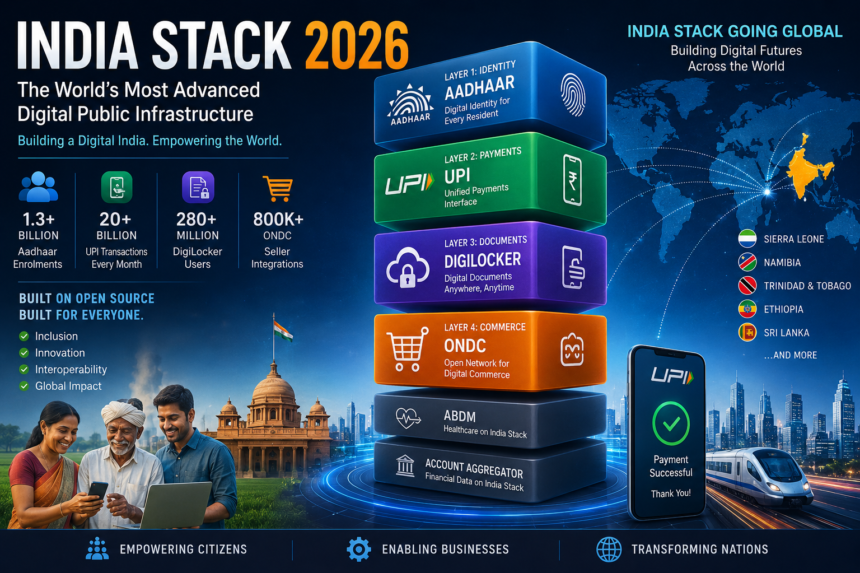
India Stack refers to the layered architecture of interoperable digital public goods built by the Indian government and its ecosystem partners. The key layers, from foundation to application:
Layer 1: Identity — Aadhaar
Aadhaar is the biometric identity system that assigns a unique 12-digit number to every Indian resident, linked to fingerprints and iris scans. With 1.3+ billion Aadhaar enrolments in 2026, it is the world’s largest biometric identity database. Aadhaar enables:
- eKYC: Instant identity verification — open a bank account, get a mobile SIM, or register for a government scheme in minutes instead of days
- Aadhaar-based authentication: Log in to government services securely using biometrics or OTP
- Direct Benefit Transfer (DBT): Welfare payments sent directly to the Aadhaar-linked bank account of beneficiaries — eliminating intermediary corruption
- e-Sign: Legally valid digital signature using Aadhaar authentication
Layer 2: Payments — UPI
The Unified Payments Interface is India’s real-time payment rail — connecting all bank accounts and digital wallets through a common interface. As of 2026:
- Monthly transactions: 20+ billion — more than VISA and Mastercard combined in India
- Transaction value: Rs 20+ lakh crore per month
- International: Operational in UAE, Singapore, France, UK (partially), Maldives, and 10+ countries
- Innovations in 2026: UPI Circle (delegated payments), conversational UPI, UPI Lite for offline
Layer 3: Documents — DigiLocker
DigiLocker is India’s national digital document repository — allowing citizens to store, access, and share digitally signed copies of official documents. Linked to Aadhaar, DigiLocker eliminates the need to carry physical documents for most purposes:
- Documents stored: Aadhaar, PAN, driving licence, vehicle registration, educational certificates, birth certificates, bank statements
- Acceptance: Courts, universities, employers, banks, and government agencies accept DigiLocker documents
- Users: 280+ million DigiLocker accounts in 2026
- 2026 expansion: Health records, property documents, and professional licences being added
Layer 4: Commerce — ONDC
The Open Network for Digital Commerce is India’s most ambitious recent addition to the India Stack — a decentralised e-commerce infrastructure that allows any buyer app to transact with any seller app through a common protocol. Unlike Amazon or Flipkart (proprietary platforms), ONDC is open — a small kirana store in Indore can list its products on any ONDC-enabled buyer app and reach customers across India without paying Amazon’s commission rates.
- Sellers: 800,000+ seller-side integrations across food, grocery, fashion, electronics
- Buyer apps: Paytm, Mystore, Meesho, Magicpin, Craftsvilla — all ONDC-enabled
- Impact: Creating alternative to marketplace duopoly for millions of small sellers
ABDM: Healthcare on India Stack
India Stack 2026, The Ayushman Bharat Digital Mission (ABDM) applies the India Stack model to healthcare — creating a federated health data infrastructure:
- ABHA ID: 50+ crore health accounts — unique health identity for every Indian
- Health locker: Digital storage of prescriptions, test reports, discharge summaries
- Doctor and facility registry: Verified digital register of all licensed practitioners
- Health claims exchange: Insurance claims flowing electronically — faster settlement
Account Aggregator: Financial Data on India Stack
The Account Aggregator (AA) framework allows individuals to securely share their financial data — bank statements, investment portfolios, insurance policies — with authorised financial service providers for loan applications, wealth management, and insurance. The consent-based framework ensures individuals control who sees their data. This creates a level playing field where a small business owner can easily share verified financial data with a lender — making credit more accessible.
- Banks and NBFCs live on AA: SBI, HDFC, ICICI, Axis, Kotak, and 100+ others
- Use cases: Small business loan underwriting, personal loan, mutual fund portfolio sharing
- Transformative potential: Reducing credit cost for small borrowers who lack traditional credit history
India Stack Going Global: The Export Story
G20 and Digital Public Infrastructure
India’s G20 Presidency in 2023 positioned Digital Public Infrastructure (DPI) as a global development priority — leading to the G20 DPI Roadmap that commits member nations to support DPI development in developing countries. India has committed USD 25 million to a G20 DPI Fund and has provided technical assistance to multiple nations for Aadhaar and UPI-equivalent system development.
Countries Adopting India Stack Models
- Sierra Leone: Building a digital ID system based on Aadhaar architecture with Indian technical assistance
- Namibia: Digital payments infrastructure modelled on UPI
- Trinidad and Tobago: Digital identity and government services platform
- Ethiopia: Digital ID programme with India Stack influence
- Sri Lanka: UPI-equivalent payment system being developed
The Business Opportunities in India Stack
India Stack 2026, India Stack creates enormous business opportunities for private companies:
FinTech
UPI infrastructure enables FinTech companies to build payment, lending, insurance, and investment products without building payment rails from scratch. The Account Aggregator framework enables data-driven underwriting models. India’s FinTech ecosystem — Razorpay, PhonePe, Paytm, Slice, Freo — is built on India Stack foundations.
HealthTech
ABDM’s open health data architecture allows HealthTech companies to build applications that access patient health records (with consent), provide telemedicine, analyse population health data, and streamline insurance claims. Companies like Practo, 1mg, and mFine are building on ABDM infrastructure.
AgriTech
The Unified Farmer Service Interface — an AgriTech layer being added to India Stack — will give farmers digital access to soil health data, weather forecasts, input subsidies, crop insurance, and market price information through a single platform linked to their Aadhaar and land records.
Challenges and Criticism of India Stack
Privacy and Surveillance Concerns
Critics — particularly privacy advocates — have raised concerns about the surveillance potential of a system that links identity, payments, health, and documents. If all these data layers are combined without robust privacy protections, the state could track an individual’s movements, spending, health, and associations with unprecedented granularity. The Digital Personal Data Protection Act 2023 provides legal protections — but implementation and enforcement remain subjects of ongoing scrutiny.
Digital Exclusion
India Stack assumes digital access — smartphones, internet connectivity, and digital literacy. For the significant portion of India’s population that lacks one or more of these, India Stack’s benefits are inaccessible. Bridging this digital divide is essential for India Stack to deliver on its promise of universal inclusion.
Read More: Best Digital Bank Accounts India 2026: Top Zero Balance Savings Accounts Compared
Conclusion
India Stack 2026, represents India’s greatest contribution to global development thinking — a demonstration that a developing country can build world-class digital infrastructure through public investment and open architecture, not through proprietary platforms and corporate concentration. For India, it has delivered financial inclusion, government efficiency, and economic dynamism at unprecedented scale. For the world, it is a template for how governments can harness technology for inclusive development. Taza Newsz covers India’s digital economy, policy, and technology developments comprehensively.