
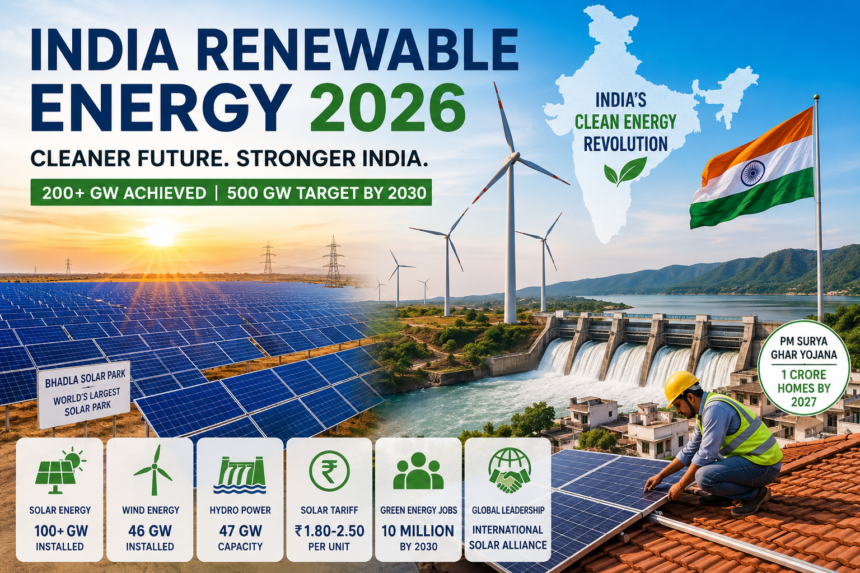
India Renewable Energy 2026, India has achieved a historic milestone in renewable energy. the country crossed 200 gigawatts (GW) of installed renewable energy capacity across solar, wind, hydro, and other clean energy sources. This achievement has made India the world’s third-largest renewable energy producer after China and the United States.
At the same time, the cost of solar electricity in India has fallen nearly 90% since 2010. Today, solar power tariffs in competitive auctions are among the lowest in the world, often below Rs 2 per unit. As a result, renewable energy is no longer viewed only as an environmental solution. It has become a major economic and strategic advantage for the country, accelerating the India Clean Energy Revolution at an unprecedented pace.
India is now rapidly moving toward its ambitious target of 500 GW of non-fossil fuel electricity capacity by 2030. A target that once appeared unrealistic is now increasingly achievable because of large-scale investments, technological progress, and supportive government policies.
This clean energy transformation is one of the most significant economic and environmental shifts of the 21st century. From massive solar parks in Rajasthan to rooftop panels in Ahmedabad and offshore wind plans along India’s coastline, the country is building a renewable energy ecosystem on a continental scale.
India Renewable Energy: Key Numbers in 2026
India’s renewable energy sector has expanded at an extraordinary pace over the last decade. The country now ranks among the global leaders in both solar and wind power generation.
Major Renewable Energy Statistics
- Total renewable energy capacity: 200+ GW
- Solar energy capacity: 100+ GW installed
- Wind energy capacity: 46 GW installed
- Hydro power capacity: 47 GW
- 2030 target: 500 GW non-fossil fuel capacity
- Solar electricity cost: Rs 1.80–2.50 per unit in recent auctions
- Annual solar installation pace required: 25–30 GW per year
India is already the world’s fourth-largest solar market and the fourth-largest wind energy market globally. Furthermore, the country’s rapidly falling renewable energy costs are attracting global investors, manufacturers, and clean energy developers.
Mega Solar Projects Driving India’s Energy Revolution
India Renewable Energy 2026, Large-scale solar parks have become the backbone of India’s renewable energy growth strategy. These projects are producing enormous amounts of clean electricity while also transforming local economies.
Bhadla Solar Park — The World’s Largest Solar Farm
Located in Rajasthan’s Thar Desert, the Bhadla Solar Park is the world’s largest solar power plant. The park has an installed capacity of more than 2,245 MW (2.2 GW).
The project benefits from Rajasthan’s exceptional solar irradiation, with more than 325 sunny days every year. In addition, declining solar panel prices helped turn the desert landscape into one of India’s most productive energy assets.
Bhadla also became globally famous for setting record-low solar tariffs during its development phase. Even today, it continues to supply affordable and clean electricity to India’s northern power grid.
Pavagada Solar Park — Karnataka’s Solar Success Story
Pavagada Solar Park is India’s second-largest solar park with an installed capacity of around 2,050 MW.
What makes Pavagada unique is its innovative land lease model. Instead of permanently acquiring land, the project allows farmers to lease dry and less-productive land to the solar park. In return, farmers receive stable rental income regardless of weather conditions or crop performance.
This model has created a win-win situation. Farmers receive predictable earnings, while the country gains large-scale clean electricity generation capacity. Because of its success, several other renewable energy projects across India are now adopting similar approaches.
Ultra Mega Renewable Energy Parks in Rajasthan and Gujarat
India is also developing massive hybrid renewable energy zones in Rajasthan and Gujarat. These projects combine solar and wind generation capacity on a gigantic scale.
The Ultra Mega Renewable Energy Power Parks are expected to generate nearly 30 GW of renewable electricity. Moreover, these projects are being designed as integrated clean energy hubs capable of producing green hydrogen using surplus renewable energy.
This combination of solar, wind, storage, and hydrogen production could position India as one of the world’s leading green hydrogen exporters in the coming decade.
Wind Energy India 2026: The Offshore Wind Push
India Renewable Energy 2026, While solar power has dominated headlines, wind energy continues to play a critical role in India’s clean energy transition.
Growth of Onshore Wind Energy
India’s onshore wind energy sector has grown steadily in states such as Tamil Nadu, Gujarat, Rajasthan, Maharashtra, and Karnataka.
Modern wind turbines now use hub heights exceeding 120 metres. These taller turbines can access stronger and more consistent wind speeds, improving electricity generation efficiency and lowering overall power costs.
India’s total onshore wind potential is estimated to exceed 1,000 GW. However, many of the best onshore wind sites are already heavily utilized. Consequently, offshore wind has emerged as the next major opportunity.
Offshore Wind: India’s Next Clean Energy Frontier
Unlike Europe, where offshore wind already supplies a large share of electricity, India’s offshore wind sector is still in its early stages.
Nevertheless, the government’s target of 30 GW offshore wind capacity by 2030 is beginning to gain momentum. Potential offshore wind zones have been identified along the coasts of Tamil Nadu, Gujarat, and Maharashtra.
Several major developments are already underway:
- Adani Green Energy and ReNew Power have secured offshore wind development rights
- European companies from Denmark and Germany are partnering with Indian firms
- India has received offshore wind financing support from institutions including the World Bank and the Asian Infrastructure Investment Bank
However, important challenges remain. Offshore wind projects require advanced marine engineering, expensive infrastructure, and strong coastal grid connectivity. Even so, policymakers and private companies are steadily addressing these obstacles.
Rooftop Solar and India’s Distributed Energy Revolution
India’s residential solar market has expanded rapidly under the PM Surya Ghar Yojana.
The government subsidy scheme has dramatically accelerated rooftop solar adoption across urban and semi-urban India. Falling solar equipment prices, combined with subsidies of up to Rs 78,000 per installation, have made rooftop solar one of the most attractive long-term household investments in the country.
Rooftop Solar Progress in 2026
- Applications received: 50+ lakh
- Installation pace: Rapidly accelerating
- Target: 1 crore rooftop solar homes by 2027
- Monthly electricity bill savings: Rs 1,200–2,500 for many households
In addition, net metering systems allow households to export excess electricity back to the grid and receive credits from electricity distribution companies.
As a result, rooftop solar is no longer limited to environmentally conscious consumers. It is increasingly becoming a financially smart decision for middle-class Indian households.
India’s Green Energy Job Market Is Expanding Rapidly
India Renewable Energy 2026, Renewable energy is also becoming one of India’s largest employment generators.
According to industry estimates, India’s clean energy sector already supports hundreds of thousands of jobs across manufacturing, construction, installation, engineering, operations, and maintenance.
Current Employment Estimates
- Solar sector employment: 500,000+ workers
- Wind sector employment: 120,000+ workers
- Green hydrogen sector jobs: 50,000+ and growing
- Overall clean energy employment target by 2030: 10 million direct and indirect jobs
Skills in High Demand
India’s renewable energy expansion is creating strong demand for technical and engineering talent, including:
- Solar photovoltaic installation technicians
- Wind turbine maintenance engineers
- Grid integration specialists
- Battery storage engineers
- Green hydrogen process engineers
- Renewable energy project finance professionals
The National Skill Development Corporation and the Ministry of New and Renewable Energy have launched specialized training programs to support workforce development.
Today, ITI graduates with renewable energy certifications are increasingly being recruited by solar EPC companies and clean energy developers.
Challenges Still Facing India’s Energy Transition
India Renewable Energy 2026, Despite remarkable progress, India’s clean energy transition still faces several major challenges.
Grid Stability and Energy Storage
Integrating 500 GW of intermittent renewable energy into the national electricity grid will require enormous investments in battery storage, transmission infrastructure, and smart grid systems.
Managing electricity supply fluctuations from solar and wind power remains one of the country’s biggest engineering challenges.
Land Acquisition Issues
Large renewable energy projects require significant land areas. Balancing solar park expansion with agricultural use, environmental protection, and local community interests remains politically sensitive in several regions.
Financing Requirements
India’s clean energy transition requires massive capital investment. Estimates suggest that more than Rs 30 lakh crore may be needed through 2030 to achieve the country’s renewable energy targets.
Mobilizing both domestic and international financing will therefore remain critical.
Domestic Manufacturing Dependence
India still imports many solar panel components and clean energy materials from China. As a result, strengthening domestic solar manufacturing and supply chains has become a strategic national priority.
Managing the Coal Transition
Coal continues to support millions of jobs across mining, transportation, and thermal power generation.
Therefore, India must carefully manage the shift toward renewable energy to avoid economic disruption in coal-dependent regions and communities.
India’s International Leadership in Clean Energy
India Renewable Energy 2026, India is no longer just a participant in the global energy transition. It is increasingly shaping the direction of international climate and renewable energy policy.
International Solar Alliance
India co-founded the International Solar Alliance, which now includes more than 120 member countries.
Headquartered in Gurugram, the ISA promotes solar adoption in developing nations, particularly across Africa, Asia, and island economies. Through financing partnerships and technical cooperation, India has helped multiple countries accelerate renewable energy deployment.
The ISA has also strengthened India’s reputation as a major clean energy leader in the Global South.
Mission LiFE and Global Climate Diplomacy
India’s Mission LiFE initiative encourages environmentally sustainable lifestyles and responsible consumption habits.
The programme gained global visibility after being promoted by Prime Minister Narendra Modi at international climate forums and the United Nations.
During India’s G20 presidency in 2023, the country also played a key role in securing global commitments to triple renewable energy capacity by 2030.
Because India is combining policy ambition with large-scale implementation, its credibility in global clean energy diplomacy has increased significantly.
Read More: India Nuclear Energy 2026: How the SHANTI Act Is Transforming India’s Power Sector
Conclusion
India Renewable Energy 2026, India’s renewable energy transformation represents one of the world’s most important economic and environmental success stories.
From the deserts of Rajasthan to offshore wind corridors along the Arabian Sea, the country is building clean energy infrastructure at unprecedented scale. Solar parks, rooftop installations, green hydrogen projects, and modern wind farms are reshaping India’s economy while reducing dependence on fossil fuels.
Most importantly, India’s 500 GW clean energy target is no longer viewed as unrealistic. Instead, it is increasingly seen as both achievable and necessary for the country’s economic growth, energy security, and climate leadership.
As renewable energy costs continue to fall and investments accelerate, India is positioning itself not only as a major clean energy consumer, but also as one of the defining clean energy powers of the 21st century.