
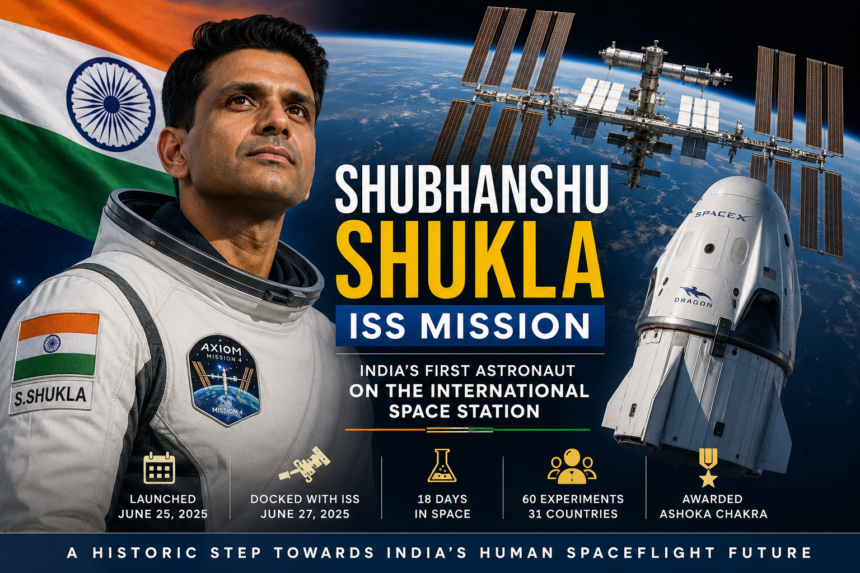
Shubhanshu Shukla ISS Mission, SpaceX Dragon spacecraft lifted off from Kennedy Space Center Launch Complex 39A at NASA’s Kennedy Space Center in Florida. Among the four astronauts onboard was Group Captain Shubhanshu Shukla of the Indian Air Force — a fighter pilot from Lucknow, Uttar Pradesh, who was about to create history for India.
By May 2026, Shukla had become one of India’s most celebrated national heroes. The Government of India awarded him the Ashoka Chakra in the Republic Day 2026 Gazette Notification. His mission also delivered critical operational experience for Indian Space Research Organisation’s Gaganyaan programme, India’s first indigenous human spaceflight mission.
More importantly, his journey — from a middle-class family in Lucknow to becoming India’s first astronaut aboard the ISS — inspired millions of young Indians to dream bigger.
Who Is Shubhanshu Shukla?
Early Life and Background
Shubhanshu Shukla was born on October 10, 1985, in Lucknow, Uttar Pradesh. Notably, he became the first person in his family to join the armed forces.
In June 2006, he was commissioned into the fighter stream of the Indian Air Force. Over the next several years, he built an impressive flying career by accumulating nearly 2,000 hours of flight experience across multiple advanced aircraft platforms.
His operational experience included aircraft such as:
- MiG-21
- MiG-29
- Sukhoi Su-30 MKI
- Jaguar
- Hawk
- Dornier
- An-32
Because of his exceptional performance, he eventually earned two of the most elite designations in the Indian Air Force — Fighter Combat Leader and Experimental Test Pilot.
Selection for Gaganyaan and ISS Mission
In 2019, Shukla was selected through the Indian Air Force’s highly rigorous astronaut selection programme for India’s ambitious Gaganyaan mission.
Between 2020 and 2021, he underwent astronaut training at the Yuri Gagarin Cosmonaut Training Center in Star City, Russia. The training prepared him for long-duration human spaceflight operations, emergency procedures, and survival protocols.
Later, in August 2024, ISRO officially announced that Shukla would serve as the mission pilot for Axiom Mission 4. This announcement made him the first Indian astronaut selected for a mission to the International Space Station.
Following the announcement, he trained at NASA Johnson Space Center alongside:
- Commander Peggy Whitson
- Mission Specialist Slawosz Uznanski-Wisniewski
- Mission Specialist Tibor Kapu
Axiom Mission 4: India’s Historic Return to Space
Launch and Docking
Shubhanshu Shukla ISS Mission, Axiom Mission 4 launched on June 25, 2025, at 06:31 UTC aboard a SpaceX Dragon spacecraft named Grace, which debuted during the mission.
The four-member international crew successfully entered low Earth orbit before docking autonomously with the International Space Station on June 26, 2025, at 10:31 UTC.
A few hours later, at 12:14 UTC, the astronauts officially entered the ISS. Subsequently, a formal welcome ceremony was conducted at 14:00 UTC.
During the ceremony, Commander Peggy Whitson presented Shubhanshu Shukla with the astronaut pin, officially designating him as the 634th human being to travel into space.
His emotional message to India was broadcast live across the country:
“Namaskar, my dear countrymen! What a ride! We are back in space once again after 41 years. It is an amazing ride. The Tiranga embossed on my shoulders tells me that I am with all of you. This journey of mine is not a beginning to the International Space Station but to India’s Human Space Programme.”
18 Days Aboard the International Space Station
The Ax-4 crew remained aboard the ISS for approximately 18 days before safely splashing down on July 15, 2025.
During the mission, Shukla became the primary operational link between ISRO and the international crew for scientific payload activities. He led seven ISRO-designed microgravity experiments covering multiple advanced scientific disciplines.
These experiments included:
Space Agriculture Research
Scientists studied the effects of microgravity on plant growth and seed germination. The findings could eventually help future long-duration missions develop sustainable food systems in space.
Human Physiology Studies
Researchers examined muscle loss, bone density reduction, and other physiological effects caused by prolonged exposure to microgravity. These findings are especially important for future Gaganyaan missions and long-duration space habitation.
Advanced Materials Science
ISRO collaborated with institutions such as:
- Indian Institute of Science Bangalore
- Indian Institute of Technology Dharwad
These institutions designed materials science experiments aimed at understanding how advanced materials behave in space environments.
Biotechnology Experiments
Shubhanshu Shukla ISS Mission, Additional biotechnology studies were coordinated through:
- International Centre for Genetic Engineering and Biotechnology
- National Institute of Plant Genome Research
In total, the Ax-4 crew conducted nearly 60 microgravity science experiments involving contributions from 31 countries. Consequently, the mission highlighted the growing maturity of India’s scientific and international space collaboration capabilities.
The Ashoka Chakra: India’s Highest Peacetime Honour
In the Republic Day 2026 Gazette Notification, Group Captain Shubhanshu Shukla received the Ashoka Chakra, India’s highest peacetime gallantry honour.
The official citation praised his “conspicuous bravery” during the historic ISS mission.
Importantly, the Ashoka Chakra carries prestige equivalent to the Param Vir Chakra, which is awarded for wartime gallantry.
The recognition acknowledged not only the personal courage required for human spaceflight but also the immense national significance of India’s successful return to crewed space missions.
What Axiom Mission 4 Means for Gaganyaan
Operational Experience for ISRO
One of the most important outcomes of the mission was the direct operational experience gained by ISRO for the Gaganyaan programme.
Before Axiom Mission 4, no Indian astronaut had experienced:
- Long-duration microgravity exposure
- Spacecraft operations in orbit
- Real-time ISS systems management
- The psychological and physiological challenges of extended space missions
As a result, Shukla’s mission provided India with invaluable practical knowledge.
ISRO gained:
- First-hand crew experience from an Indian astronaut in space
- Validated data from Indian microgravity experiments
- International mission coordination experience
- Emergency procedure exposure alongside NASA astronauts
- Better operational planning for future Gaganyaan missions
Gaganyaan Timeline and India’s Future in Space
With the successful integration of lessons learned from Ax-4 and the completion of unmanned precursor missions, India’s first crewed Gaganyaan mission is currently targeted for 2026–2027.
The four astronauts selected for the programme continue their mission-specific preparation:
- Prashanth Balakrishnan Nair
- Angad Pratap
- Ajit Krishnan
- Shubhanshu Shukla
Once completed successfully, Gaganyaan will make India the fourth country in history capable of independently launching humans into space.
Inspiring India’s Next Generation
Beyond the scientific and strategic achievements, Shubhanshu Shukla’s journey deeply resonated with India’s youth.
Following the launch of Axiom Mission 4, Google searches for “how to become an astronaut in India” reportedly surged by nearly 400%. Schools across the country organised live watch parties for the docking event, while ISRO experienced record levels of outreach requests from educational institutions.
Importantly, Shukla’s story feels relatable to millions of Indians.
He did not come from extraordinary privilege. He did not study abroad. Instead, he followed a disciplined and conventional Indian military career path, excelled at every stage, and earned his place in space through merit, preparation, and perseverance.
That relatability transformed him into a national icon.
India’s Expanding Space Economy
The success of Axiom Mission 4 has also accelerated India’s commercial space ambitions.
Private Indian space startups such as:
- Skyroot Aerospace
- Agnikul Cosmos
- Pixxel
have benefited from increased investor confidence and stronger government support for the space sector.
Furthermore, the India Space Policy 2023 has opened the sector to private participation, creating the foundation for an Indian space economy projected to reach USD 44 billion by 2033.
In many ways, Shubhanshu Shukla’s mission became one of the strongest public demonstrations of India’s long-term seriousness about becoming a major global space power.
Read More: India Nuclear Energy 2026: How the SHANTI Act Is Transforming India’s Power Sector
Conclusion
Shubhanshu Shukla ISS Mission, to the International Space Station marked India’s definitive return to human spaceflight — not as a symbolic one-time achievement, but as the beginning of a long-term national programme.
With Gaganyaan approaching, plans for an Indian space station between 2028 and 2035, and rapid growth in the commercial space sector, India’s human spaceflight ambitions are entering a transformative new era.
For millions of Indians, Shubhanshu Shukla’s journey proved that space is no longer a distant dream. It is now part of India’s future.