
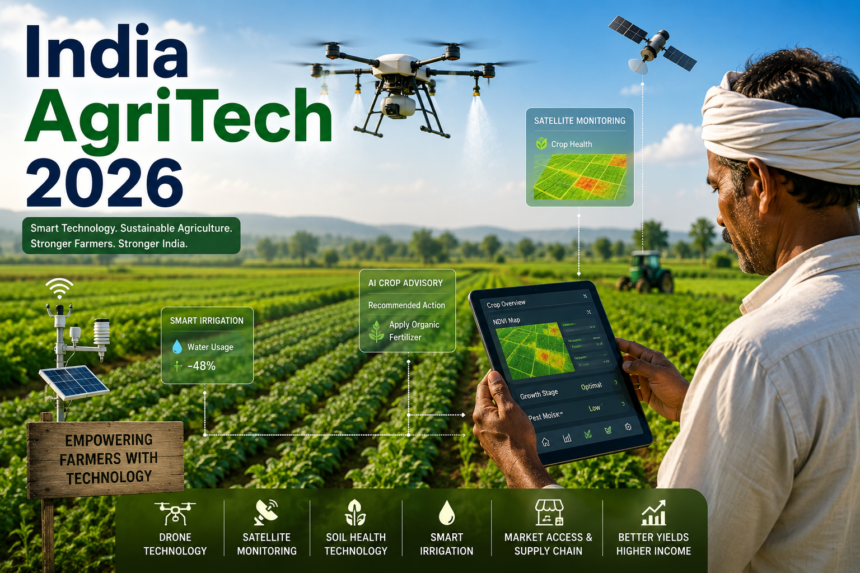
India AgriTech 2026, India feeds 1.4 billion people from approximately 170 million hectares of farmland — one of the most demanding agricultural challenges in human history. Yet the average Indian farmer faces a combination of water stress, climate unpredictability, input cost pressure, post-harvest losses, and market linkage challenges that make farming a precarious livelihood for the 600+ million Indians who depend on agriculture.
Technology is beginning to change this. In 2026, India’s AgriTech sector — backed by government investment (Rs 500 crore AI for agriculture in Budget 2026), strong venture capital interest, and India’s deep talent pool in software and data science — is deploying solutions that are genuinely improving farmer incomes, crop yields, and agricultural sustainability. This guide covers the key AgriTech innovations transforming Indian farming and the companies leading the charge.
Key AgriTech Technologies in Indian Farming 2026
1. Drone Technology for Precision Agriculture
Agricultural drones are one of the fastest-growing AgriTech segments in India. The Namo Drone Didi scheme — under which the government is providing drones to women SHG (Self Help Groups) across India — has dramatically increased drone adoption at the farm level. Drones are being used for:
- Crop spraying: Precision spraying of pesticides and fertilisers reduces chemical use by 20-30% while improving coverage
- Crop monitoring: Aerial imagery identifies stressed crops, pest infestations, and irrigation gaps before they become visible at ground level
- Crop health mapping: Multispectral cameras on drones create NDVI (Normalized Difference Vegetation Index) maps showing crop health variation across large fields
- Seed spreading: Drones can spread seeds in difficult terrains including waterlogged fields and steep slopes
Garuda Aerospace and IdeaForge are India’s leading agricultural drone manufacturers. The government’s Namo Drone Didi programme has created a network of women drone pilots in rural India, generating both employment and agricultural productivity benefits.
2. AI and Satellite-Based Crop Monitoring
India’s space capabilities (ISRO’s remote sensing satellites) are being combined with AI to create powerful crop monitoring tools accessible to Indian farmers through mobile apps. Platforms like CropIn, SatSure, and Fasal use satellite imagery combined with AI algorithms to:
- Predict crop yields 30-60 days before harvest — valuable for farmers, commodity traders, and government planning
- Identify areas of pest and disease stress using spectral analysis
- Monitor soil moisture levels across large geographic areas
- Provide personalised crop advisories based on location-specific data
3. Smart Irrigation: Saving India’s Most Precious Resource
Water is India’s most critical agricultural input and its most endangered one. Overextraction of groundwater through indiscriminate flood irrigation has depleted aquifers across Punjab, Haryana, Rajasthan, Gujarat, and parts of Maharashtra. SmartIrrigation technology — IoT soil moisture sensors, weather data integration, and AI-powered irrigation scheduling — is being deployed to dramatically reduce agricultural water consumption.
The PM Krishi Sinchayee Yojana subsidises drip and sprinkler irrigation systems for Indian farmers. In 2026, the scheme has helped over 5 million farmers switch from flood irrigation to more efficient water delivery systems. The result: water savings of 30-70% per crop cycle with equal or better yields.
4. Soil Health Technology
India’s Soil Health Card scheme has mapped the nutrient status of agricultural soils across India. In 2026, the next generation of soil health technology goes further — portable soil testing devices, AI-powered nutrient recommendation systems, and real-time soil moisture and pH monitoring are giving farmers granular, actionable data about their specific soil conditions.
- SoilSens (IIT Bombay spin-off): Real-time soil moisture and temperature sensors connected to cloud platform
- Fasal: Microclimate and soil sensors with AI-powered crop advisory for high-value crops
- Kisan Suvidha app (government): Free soil health, market price, and weather advisory for farmers
5. Market Linkage and Post-Harvest Technology
India wastes approximately 16% of its total food production due to post-harvest losses — spoilage during storage, transportation, and handling. AgriTech companies are addressing this through:
- Cold chain infrastructure: Companies like Coldex and Tessol are building affordable cold storage networks in rural India
- Farmer-to-buyer platforms: Ninjacart, DeHaat, and AgriBazaar connect farmers directly to retailers and processors — eliminating middlemen
- Quality grading technology: AI-powered computer vision systems grade produce quality — ensuring consistent standards
- Commodity trading platforms: Digital agricultural commodity exchanges are giving farmers transparent price discovery
Government Support for AgriTech in 2026
- Budget 2026: Rs 500 crore for AI-powered precision agriculture tools
- Namo Drone Didi: Providing drones to women SHG clusters across India
- PM Kisan increased to Rs 7,000: Direct income support to 110 million farmer families
- PM Fasal Bima Yojana: Subsidised crop insurance using satellite and drone data for faster claim settlement
- eNAM (National Agriculture Market): Online trading platform linking farmers to buyers across states
Challenges Facing Indian AgriTech
- Digital literacy: Many smallholder farmers have limited smartphone skills — last-mile adoption remains a challenge
- Connectivity: Rural internet connectivity, while improving, still limits real-time data applications in remote areas
- Smallholder fragmentation: India’s average farm size is 1.1 hectares — making per-farmer technology ROI challenging
- Trust building: Farmers are cautious about new technology — demonstrations and community champions are essential for adoption
- Data privacy: Concerns about farm data being used against farmers’ interests in credit and insurance applications
Top AgriTech Startups in India 2026
Ninjacart — Supply Chain Leader
India AgriTech 2026, Ninjacart is India’s largest fresh produce supply chain platform, connecting farmers directly to retailers and quick commerce platforms. By aggregating farm-gate supply and matching it with retailer demand through proprietary technology, Ninjacart eliminates multiple layers of intermediaries, reducing food waste and improving farmer price realisation.
DeHaat — Full-Stack Farm Services
DeHaat provides end-to-end agricultural services — inputs (seeds, fertilisers, pesticides), crop advisory, and market linkage — through a network of micro-entrepreneurs (DeHaat Centers) in rural India. Its AI-powered advisory system provides personalised recommendations to over 2 million farmers. DeHaat is particularly strong in Bihar, Uttar Pradesh, and Odisha.
CropIn — AI and Data Platform
CropIn’s SmartFarm platform digitises farm management and uses AI and satellite data to provide crop intelligence to agribusinesses, banks, and insurance companies across 45 countries. India-founded but globally operating, CropIn represents the export potential of India’s AgriTech capabilities.
Read More: India Defence Technology 2026: Operation Sindoor, Missiles, Rafale & Military Modernisation
Conclusion
India AgriTech 2026 revolution is not replacing the Indian farmer — it is empowering them with information, market access, and precision tools that previous generations could not have imagined. The combination of government support, venture capital, India’s deep software talent, and ISRO’s space infrastructure creates a uniquely Indian opportunity to transform agricultural productivity while reducing environmental impact.
Taza Newsz covers India’s agricultural sector — monsoon updates, AgriTech news, government farm scheme notifications, and farmer success stories. Follow us for comprehensive coverage of rural India’s economic transformation.