
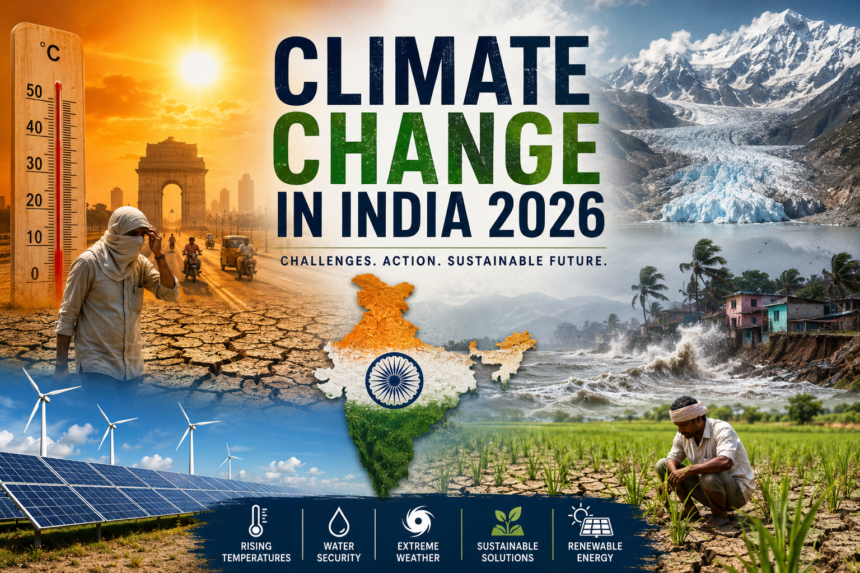
Climate Change in India 2026, India is on the front lines of climate change. In 2026, the evidence is everywhere: temperatures in Delhi and Rajasthan touching 46°C in April, more than a month before summer typically peaks. Himalayan glaciers retreating at rates that threaten the long-term water security of hundreds of millions of people in North India. Coastal communities in Odisha, West Bengal, and Tamil Nadu watching their land disappear into the Bay of Bengal. Unseasonal rainfall destroying rabi crops ready for harvest.
Yet India is also one of the world’s most ambitious actors on climate — with net zero by 2070 pledged, 500 GW renewable energy capacity targeted by 2030, and the world’s largest expansion of solar energy underway. This guide covers the reality of climate change in India in 2026 — the impacts, the causes, the government’s response, and what every Indian citizen can do.
How Climate Change Is Affecting India in 2026
Record-Breaking Heatwaves
The 2026 pre-monsoon heatwave is among the most severe India has experienced. North India, the east coast, Gujarat, and Maharashtra are simultaneously under heatwave alerts, with Delhi recording temperatures above 44-46°C for extended periods in April-May. The combination of rising baseline temperatures (India’s average temperature has risen approximately 0.7°C since 1901, with the pace accelerating) and urban heat island effects in Indian cities creates conditions that are genuinely dangerous for outdoor workers, the elderly, and children.
- Record demand: National power demand hit 256 GW in early May 2026 — an all-time high driven by air conditioning
- Coal stress: A 9.7% drop in coal production has strained the power grid during peak cooling hours
- Heat-related illness: Hundreds of heat stroke cases reported across north and central India in April-May
- Agricultural impact: Early heat stress on wheat crops in Punjab and Haryana has reduced yields
Himalayan Glacier Retreat: A Slow-Motion Catastrophe
India’s Himalayan glaciers are retreating at alarming rates. The Gangotri Glacier — source of the Ganges — has retreated approximately 22 km since 1780, with the pace accelerating in recent decades. Siachen, Zemu, and hundreds of smaller glaciers across the Hindu Kush Himalaya are all shrinking.
The immediate impact is counterintuitive — glacial melt is currently increasing river flows. But as glaciers diminish, river flows will decline, particularly during the summer months when millions of North Indians depend on glacial meltwater for drinking water and irrigation. The Ganga, Brahmaputra, and Indus river systems — sustaining over a billion people — are all at risk from long-term glacial retreat.
Intensifying Monsoon: Flood and Drought Simultaneously
Climate Change in India 2026, Climate change is not reducing India’s monsoon rainfall — it is making it more erratic and intense. India is experiencing more extreme rainfall events (flooding) alongside longer dry spells between rain events (drought stress). The result is a pattern of flooding during monsoon peaks and water stress between events — a challenging combination for farmers, urban infrastructure, and disaster management.
- Kerala floods (2018): Climate scientists linked the extreme rainfall to warming Arabian Sea temperatures
- Assam and Bihar flooding: Annual events becoming more severe and lasting longer
- Cyclone intensification: Arabian Sea cyclones — historically rare — are becoming more frequent as sea surface temperatures rise
Coastal Erosion and Sea Level Rise
India has a coastline of 7,516 km, and an estimated 40% of it is experiencing erosion — a figure that is worsening as sea levels rise and storm surges become more intense. Sundarbans in West Bengal — home to the Bengal tiger and millions of people — is particularly vulnerable, with several inhabited islands already partially submerged. Tamil Nadu’s Kanyakumari and Odisha’s Kendrapara are experiencing significant coastal land loss.
India’s Climate Goals: Ambition and Progress
Net Zero by 2070: India’s Long-Term Commitment
India committed to achieving net zero greenhouse gas emissions by 2070 at COP26 in Glasgow in 2021. This is 20 years later than the 2050 target for developed nations — a position India defends on grounds of its right to development and the historical responsibility of wealthy nations for accumulated emissions. In 2026, progress toward this long-term target is measured by near-term milestones.
500 GW Renewable Energy by 2030
India’s 500 GW renewable energy target by 2030 is one of the world’s most ambitious energy transition commitments. As of early 2026, India has approximately 200 GW of installed renewable capacity — with solar energy growing fastest. The trajectory needs to accelerate significantly to meet the 2030 target, but India’s solar sector is growing at extraordinary speed.
- Solar energy: Over 100 GW installed capacity — cost of solar power has fallen 90% since 2010
- Wind energy: Approximately 46 GW installed — significant offshore wind development planned
- Green hydrogen: National Green Hydrogen Mission — Rs 19,744 crore budget — developing hydrogen production from renewable energy
India’s International Solar Alliance
India co-founded the International Solar Alliance (ISA) with France — an intergovernmental organisation based in Gurugram promoting solar energy deployment globally. The ISA now has 120+ member countries and has become a powerful vehicle for India’s climate diplomacy, mobilising solar investments particularly in developing nations across Africa and South Asia.
How Climate Change Is Affecting Indian Agriculture
Climate Change in India 2026 — which employs 45% of the workforce and supports 600+ million people — is climate change’s most immediate victim in India. The impacts are complex and regionally varied:
- Wheat yield decline: Every 1°C of warming reduces wheat yields by approximately 4-6% in India
- Rice sensitivity: Extreme heat during flowering stages causes significant yield losses
- Changed pest patterns: New pests and diseases are appearing in areas previously too cool for them
- Water stress: Groundwater depletion combined with erratic monsoon creating irrigation crises
- Changed cropping calendars: Farmers are shifting sowing dates and crop varieties to adapt — sometimes successfully, sometimes not
What Indian Individuals and Businesses Can Do About Climate Change
Rooftop Solar
Installing rooftop solar through PM Surya Ghar Yojana reduces your carbon footprint while saving money on electricity bills. A 3 kW system prevents approximately 3 tonnes of CO2 equivalent emissions per year. This is one of the most impactful individual climate actions available to Indian homeowners.
Switch to Electric Vehicles
India’s transport sector is a major source of greenhouse gas emissions and local air pollution. Switching to an electric scooter or car — particularly when charged from renewable energy — significantly reduces your transport carbon footprint. FAME III subsidies make EV adoption financially attractive in 2026.
Reduce Food Waste
India wastes approximately 67 million tonnes of food annually. Food waste in landfills generates methane — a greenhouse gas 25 times more potent than CO2. Reducing food waste at home — planning meals, using leftovers, composting organic waste — directly reduces your climate impact.
Read More: India Water Crisis 2026 Cities Running Out of Water: Full State-by-State Report
Conclusion
Climate Change in India 2026 — it is India’s present crisis. From the heatwaves killing workers on the streets of Delhi to the glaciers disappearing above Kedarnath to the coastlines dissolving in Odisha, the impacts are here and worsening. India’s response — ambitious renewable energy targets, solar diplomacy, electric vehicle push — represents the right direction. The pace must accelerate.
Taza Newsz covers India’s climate crisis, renewable energy developments, environmental policy, and practical sustainability guidance. Follow us for regular updates on one of the defining issues of our time.