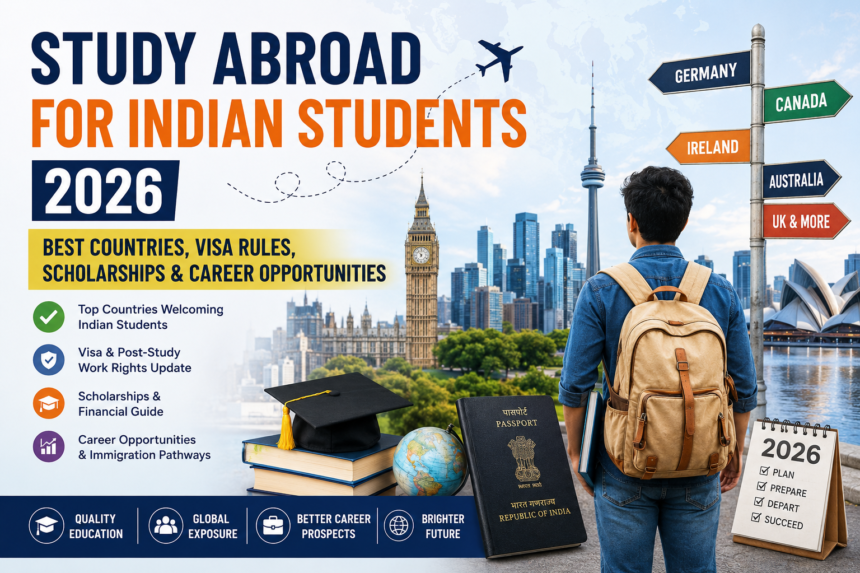
Study Abroad for Indian Students 2026, Over 1.3 million Indians study outside India — making Indian students the second-largest group of international students globally, behind China. From computer science at a Canadian university to medicine in Russia to MBA at a UK business school, Indian students are pursuing education across virtually every country and discipline. In 2026, this outflow continues — driven by the gap between demand and supply in quality higher education in India, the aspiration for international experience, and the career and immigration pathways that overseas education can unlock.
Countries Most Welcoming to Indian Students in 2026
Germany — Free Education, Growing Opportunity
Germany remains the top destination for Indian students seeking high-quality, low-cost education. Public German universities charge minimal or zero tuition fees for international students — you pay only a semester contribution of approximately EUR 200-350. The quality of German engineering, natural sciences, computer science, and business education is world-class. Germany’s job market — particularly in engineering and technology — is actively seeking international graduates.
- Post-study work: 18-month job seeker visa after graduation — generous and well-structured
- Language: Many Master’s programmes in English; some require German — invest in B2 level German for more options
- Scholarships: DAAD scholarships offer full funding for eligible Indian applicants
- Indian student growth: Growing rapidly — Germany is now one of India’s top study destinations
Canada — Challenged But Still Viable
Canada has historically been India’s top study destination, and despite significant policy changes in 2023-2024 (reduced international student permit caps, PGWP restrictions for certain colleges), it remains a highly sought destination in 2026. The key change is that college-level diplomas from certain private colleges no longer lead to post-graduate work permits — students must choose universities or designated colleges carefully.
- What has changed: Cap on student permits — applications more competitive
- PGWP: Still available for university graduates — up to 3 years post-graduation
- Top universities: University of Toronto, UBC, McGill, Waterloo — still excellent ROI
- Risk: Many predatory private colleges sold PGWP-eligible programs that no longer qualify — verify before applying
Ireland — Europe’s English-Language Gateway
Ireland has emerged as an excellent alternative for Indian students seeking English-medium education in Europe with strong post-study work rights. The Irish economy — home to European headquarters of Google, Meta, Apple, LinkedIn, and dozens of other tech companies — offers excellent employment opportunities for graduates in technology and business.
- Post-study work: 2-year ‘stay back’ option after graduation — excellent
- Language: English medium — no language barrier
- Tuition: Higher than Germany but lower than UK — EUR 12,000-20,000 per year
- Strong sectors: Technology, pharmaceuticals, finance — aligned with Indian student strengths
Australia — Recovered But Changed
Australia implemented caps on international student numbers in 2024 following concerns about housing pressure in major cities. This has made admission more competitive — but Australia remains a high-quality destination for Indians willing to navigate the tighter entry. The 2-year post-study work visa remains, and Australia’s economy continues to absorb STEM and healthcare graduates readily.
Countries Where Indian Students Face Risks in 2026
UK — Tightening Rules and Higher Costs
Study Abroad for Indian Students 2026, The UK tightened its international student policy significantly in 2023-2024. The most impactful change for Indian students: international students can no longer bring dependents (spouse and children) to the UK unless they are at PhD level or government-sponsored. This is a major shift that has materially reduced the attractiveness of UK postgraduate programmes for married Indian students.
- Graduate Route: Still available — 2-year post-study work visa
- Dependent ban: Applies to most taught Master’s programmes — major policy change
- Tuition fees: GBP 18,000-30,000 per year — among the highest globally
- Recommendation: UK remains excellent for quality and prestige — but factor in the dependent restriction and high cost
Certain Canadian Private Colleges — Student Loan Trap
A significant risk for Indian students studying in Canada is the predatory private college sector. Hundreds of private colleges across Ontario, British Columbia, and other provinces aggressively marketed to Indian students — often through agents — promising PGWP eligibility and Canadian immigration pathways. Many of these programmes no longer qualify for PGWP under new rules, leaving students with large student loan debts and no work pathway.
- Warning signs: Private colleges with very high international student ratios; recruiters who guarantee immigration outcomes; programmes priced significantly lower than university programmes
- Protection: Verify PGWP eligibility on Canada’s IRCC (Immigration, Refugees and Citizenship Canada) official designated learning institution list before paying any fees
Certain Eastern European Medical Schools — Quality Risk
Thousands of Indian students pursue MBBS at universities in Ukraine, Russia, Kyrgyzstan, Kazakhstan, and Georgia — attracted by lower fees. The major risks:
- NMC recognition: Not all foreign medical degrees are recognised by India’s National Medical Commission — verify each university’s NMC recognition before enrolling
- FMGE pass rate: Foreign Medical Graduate Examination pass rates for students from some countries are extremely low — indicating inadequate preparation for Indian medical practice
- Conflict zones: Ukraine-Russia situation — students who were studying in Ukraine in 2022 experienced forced displacement; geopolitical risk must be assessed
- Clinical training quality: Clinical exposure at foreign medical schools varies enormously — ensure adequate patient contact hours
Student Loan Crisis for Indian Students Abroad
The Scale of the Problem
Study Abroad for Indian Students 2026, Indian students who travel abroad take out significant education loans — often Rs 30-60 lakh or more for programmes in Canada, UK, Australia, or the US. The expectation is that post-graduation work abroad will provide the income to repay these loans. But when students cannot find jobs post-graduation — due to changed work regulations, economic slowdowns, or choosing low-demand fields — they return to India with massive debt and no foreign income.
Protecting Yourself
- Research employment outcomes: Ask universities for graduate employment statistics — specifically for international students in your field
- Understand post-study work rights: Verify current post-study work visa rules directly from official government sources — not agents
- Loan-to-expected-income ratio: Your first-year foreign income should be able to cover loan EMIs comfortably — if not, the financial case for that programme is questionable
- Verify employer demand: Research actual job openings in your field in your destination country — talk to recent Indian graduates there
New Destinations Emerging for Indian Students
- Netherlands: International programmes in English; strong post-study work rights; EU market access; growing Indian student community
- France: Government-sponsored scholarships; excellent engineering schools (Grandes Ecoles); improving English programme availability
- Japan: Cultural richness, technology leadership, scholarship availability; Japanese language investment required for full opportunity
- South Korea: Technology and business programmes; Indian student-friendly; scholarship opportunities
- UAE: Several international universities in Dubai and Abu Dhabi; proximity to India; growing business hub
How to Choose the Right Country for Your Overseas Education
- Employment outcome data: What percentage of graduates in your field find jobs within 6 months? At what salary?
- Post-study work rights: How long can you work after graduation? Can your spouse accompany you?
- Immigration pathway: Does graduation lead to a credible pathway to permanent residency if you want to stay?
- Financial viability: Total cost of education + living vs expected earning power in destination country — calculate the real ROI
- Academic quality: Is the university ranked well in your specific field? Talk to alumni, not just agents
Read More: Study Abroad from India 2026: Best Countries for Indian Students Guide
Conclusion
Study Abroad for Indian Students 2026, International education remains one of the most powerful investments an Indian student can make — in knowledge, networks, perspective, and career opportunity. But the risks are real, the decisions are complex, and the financial stakes are high. Research thoroughly, rely on official sources (not agents), talk to recent graduates, and make decisions based on evidence rather than aspiration. Taza Newsz covers international education news, visa policy changes, and study abroad guidance for Indian students. Follow us for the latest updates.