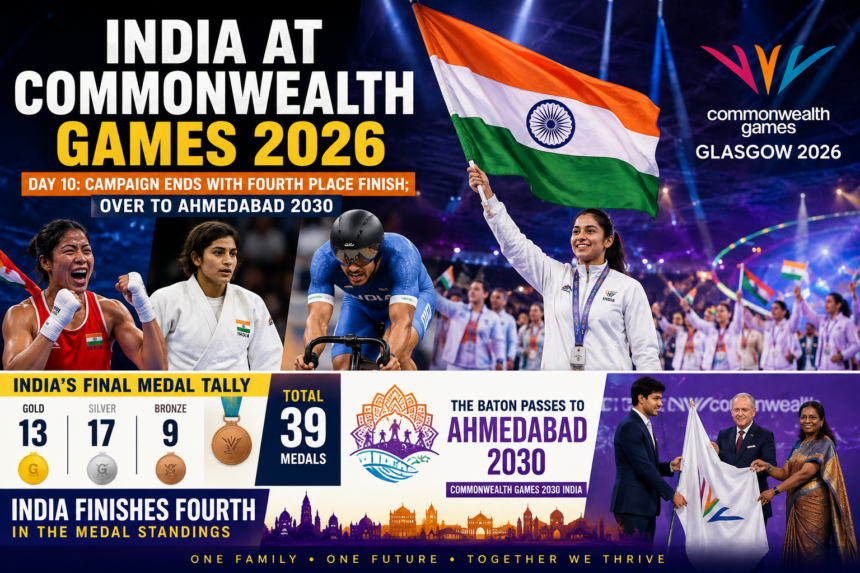
India Commonwealth Games 2026 Medal Tally, India brought the curtain down on its Commonwealth Games 2026 campaign in Glasgow with a fourth-place finish in the overall medal standings, ending an eventful competition with 39 medals — 13 gold, 17 silver and nine bronze.
There was no final-day addition to the medal cabinet, despite opportunities in judo, track cycling and para cycling. Ishroop Narang came agonisingly close to earning a judo bronze, while India’s cyclists completed their events without reaching the podium.
Yet Day 10 was about much more than medals.
As the sporting action ended, attention shifted to the closing ceremony, where boxing gold medallist Jaismine Lamboria proudly carried the Indian Tricolour during the athletes’ parade.
Then came a moment carrying significance far beyond Glasgow. The Commonwealth Flag was officially handed over to India, shifting the spotlight towards Ahmedabad and marking the beginning of preparations for the Commonwealth Games 2030 India, the next edition of the prestigious multi-sport event.
With performances led by Shankar Mahadevan and Manushi Chhillar, India’s segment of the closing ceremony offered the world a colourful preview of what it can expect when the Commonwealth sporting community arrives in India four years from now.
Glasgow had hosted the competition. Now, the baton was India’s.
India Finishes Commonwealth Games 2026 With 39 Medals
India ended the Glasgow Commonwealth Games in fourth place on the medal table, collecting 39 medals across the competition.
The final breakdown stood at:
- 13 gold medals
- 17 silver medals
- 9 bronze medals
- 39 medals overall
The final total represented a substantial campaign for India, particularly within the context of Glasgow 2026’s reduced sports programme.
India arrived on the last day knowing that climbing significantly higher in the standings would be difficult. Nevertheless, several athletes still had the opportunity to provide one final medal-winning moment.
Those opportunities ultimately slipped away.
There was disappointment, particularly in judo, but the final medal table only tells part of the story. India’s Glasgow campaign featured breakthrough performances, emerging athletes and historic achievements that could influence the country’s plans heading towards Ahmedabad 2030.
In other words, Glasgow was not simply the finish line. It may also have been the starting block for India’s next Commonwealth Games chapter.
Ishroop Narang Comes Agonisingly Close to Judo Bronze
India Commonwealth Games 2026 Medal Tally, Among India’s biggest hopes on the final day was judoka Ishroop Narang, competing in the women’s -78kg category.
Her competition began positively.
Narang defeated Scotland’s Nicole Wood by Yuko in Golden Score to secure her place in the quarter-finals. That victory set up a difficult encounter with England’s Emma Reid.
Reid proved too strong in the quarter-final and defeated Narang by Ippon.
However, the loss did not immediately end the Indian judoka’s medal hopes.
The repechage system gave Narang another route towards the podium, and she made full use of that second chance.
Facing Cameroon’s Georgika Wesly Djengue Moune, Narang produced a comeback performance and secured victory through Waza-ari.
Suddenly, a bronze medal was within touching distance.
Canada’s Coralie Godbout stood between Narang and the podium in the bronze medal contest. It was a tight battle, but Godbout eventually prevailed by Yuko.
For Narang, it was a painful way to finish.
Coming fourth can sometimes feel harsher than finishing much further down the standings. The podium is right there. You can almost touch it, yet you leave without the medal.
Still, Narang’s run through the competition demonstrated resilience. After losing her quarter-final, she recovered immediately, won her repechage contest and fought her way into a bronze medal match.
The medal did not arrive, but the performance gave India another encouraging sign from its developing judo programme.
Avtar Singh and Yash Ghanghas Exit Judo Competition
There was less success for India’s other heavyweight judokas on the final day.
Olympian Avtar Singh competed in the men’s -100kg category but was eliminated in the round of 16.
He faced Cyprus’ Aristos Michael in a contest that went into Golden Score. Michael eventually secured the victory by Ippon, ending Singh’s Glasgow campaign.
In the men’s +100kg category, Yash Ghanghas faced Wales’ Joshua Whitehouse in his opening round-of-16 contest.
Ghanghas was defeated by Yuko and consequently exited the tournament.
While the final day did not deliver another judo medal, India could still look back on a significant breakthrough in the sport during Glasgow 2026.
One of the defining achievements came from Asmita Dey, who won the women’s 48kg title and became the first Indian judoka to claim Commonwealth Games gold.
That landmark victory could prove more important than a single entry in the medal table. Historic firsts often change expectations. Once one athlete breaks through a barrier, the next generation knows the barrier can be broken.
For Indian judo, that could be one of Glasgow 2026’s lasting legacies.
Ronaldo Singh Laitonjam Finishes 20th in 1000m Time Trial
India Commonwealth Games 2026 Medal Tally, India also entered the final day hoping to make history in track cycling.
Ronaldo Singh Laitonjam was one of the athletes carrying those expectations as he competed in the men’s 1000m time trial.
Laitonjam recorded a time of 1:04.191, which placed him 20th in the final standings.
The result meant India would have to continue waiting for its breakthrough Commonwealth Games track cycling medal.
Track cycling is an unforgiving sport. Tiny differences in acceleration, positioning, aerodynamics and pacing can translate into major differences on the results sheet.
There is almost nowhere to hide.
For Indian cycling, competing against nations with deeply established track programmes provides a useful measure of where the country’s athletes currently stand.
The result in Glasgow may not have delivered a medal, but international competitions of this level can provide valuable benchmarks as India develops towards future Olympic and Commonwealth targets.
And with Ahmedabad 2030 approaching, the incentive to close that gap has rarely been greater.
Dinesh Kumar and Harshveer Singh Sekhon Bow Out of Points Race
India’s challenge in the men’s 40km points race also ended during qualification.
Harshveer Singh Sekhon was the first Indian rider in action. His race ended in the opening qualification heat, where he recorded a -40 DNF.
That left Dinesh Kumar to carry India’s hopes in the second qualifying heat.
Dinesh finished with four points but failed to progress, bringing India’s men’s track cycling campaign at Glasgow 2026 to a close.
The outcome was disappointing for a team searching for a landmark result on the velodrome.
However, cycling development is rarely a sprint. It is more like climbing a long mountain stage — progress comes through infrastructure, coaching, competition exposure, sports science and years of consistent investment.
Ahmedabad 2030 could provide a powerful deadline around which India can accelerate that development.
A home Commonwealth Games naturally increases expectations. It also creates an opportunity to invest in disciplines where India has historically had room to improve.
Track cycling is clearly one of them.
Lisha Das Completes India’s Para Cycling Campaign
India Commonwealth Games 2026 Medal Tally, India’s final competitive appearance at Glasgow 2026 came through teenage para cyclist Lisha Das.
At just 16 years old, Das was the youngest athlete in India’s Glasgow contingent.
She competed in the women’s C4-C5 1000m time trial final and clocked 1:34.410, finishing sixth.
Her ride officially completed India’s competitive programme at the 2026 Commonwealth Games.
No medal arrived, but the significance of her appearance should not be overlooked.
Competing at a major international multi-sport event as a 16-year-old offers experience that cannot easily be recreated in training. The pressure, atmosphere and quality of opposition provide an education of their own.
For a young athlete, Glasgow may therefore be remembered less as an ending and more as the beginning of a much longer journey.
By the time Ahmedabad 2030 arrives, Das will still be only 20.
That alone demonstrates why India’s younger performers could become such an important part of the country’s preparations for the next Games.
Jaismine Lamboria Carries the Tricolour at Closing Ceremony
Once the final events were completed, sporting competition gave way to celebration.
The focus moved to the closing ceremony at the Hydro, where athletes from the participating Commonwealth nations gathered for one final time.
For India, Jaismine Lamboria had the honour of carrying the national flag during the athletes’ parade.
It was a fitting recognition for the boxer, who had won gold in the women’s 57kg category during the Games.
Carrying the Tricolour at a major international sporting event is one of those moments that goes beyond an athlete’s individual result.
The flag represents the entire delegation.
As athletes entered alongside their national flags, Australian singer-songwriter Delta Goodrem performed Born to Try, adding to the celebratory atmosphere.
The ceremony also acknowledged the thousands of volunteers whose work helped deliver the Games.
Volunteers are often the invisible machinery of major sporting events. Athletes receive the applause and television coverage, but large competitions cannot function without the people working at venues, transport hubs, information desks and behind the scenes.
Glasgow’s closing ceremony made sure that contribution received recognition.
Glasgow Celebrates an 11-Day Commonwealth Sporting Festival
India Commonwealth Games 2026 Medal Tally, The ceremony also provided an opportunity to revisit some of the defining moments from the Games.
A special video presentation looked back at the competition, while Scottish performers helped ensure the event retained a strong sense of local identity.
Elephant Sessions and Primal Scream were among the musical acts involved, with the latter’s famous track Loaded accompanied by bagpipes.
It was an appropriately Scottish farewell.
Closing ceremonies occupy a strange space in international sport. They are part concert, part celebration and part goodbye.
For athletes, there is often relief mixed with nostalgia. Years of preparation can disappear in seconds once competition begins, and suddenly everyone is standing together at the closing ceremony wondering where the time went.
For Glasgow, the moment represented the completion of another major international sporting event.
For India, however, something very different was happening.
The countdown to 2030 was beginning.
Commonwealth Flag Handed Over to India
One of the most important moments of the evening came with the official transfer of Commonwealth Games hosting responsibilities.
The Commonwealth Flag was handed over to India, formally signalling the transition from Glasgow 2026 to Ahmedabad 2030.
The occasion featured prominent Indian sporting figures, including Neeraj Chopra, the Tokyo 2020 Olympic champion, and PT Usha, president of the Indian Olympic Association.
The symbolism was difficult to miss.
India had spent the previous days competing for medals. Now it was being presented to the Commonwealth not merely as a competitor but as the next host.
George Black, Chair of Glasgow 2026, wished Ahmedabad success as the Indian city begins preparing for the centenary edition of the Commonwealth Games.
The connection between the two host cities was framed around Glasgow and Ahmedabad as two great river cities.
It was a ceremonial handover, of course, but behind the pageantry sits a huge organisational challenge.
Hosting a multi-sport competition involves venues, athlete accommodation, transportation, security, broadcasting, technology, ticketing, volunteers and thousands of smaller operational details.
The flag may be light.
The responsibility that comes with it certainly isn’t.
Shankar Mahadevan and Manushi Chhillar Lead India’s Cultural Showcase
India used the closing ceremony to give international audiences an early taste of what could await them in 2030.
Singer and composer Shankar Mahadevan and former Miss World Manushi Chhillar were among the leading figures in India’s cultural presentation.
Their performance of Vande Mataram formed part of a larger showcase featuring traditional dance, colourful costumes and representations of India’s cultural diversity.
The segment centred around the philosophy of Vasudhaiva Kutumbakam, commonly translated as “the world is one family.”
It was an appropriate message for an international sporting gathering.
Major multi-sport events have always tried to be more than collections of competitions. At their best, they create temporary communities in which athletes from vastly different backgrounds share venues, villages and experiences.
India’s cultural presentation tapped directly into that idea.
The challenge was to introduce a country of extraordinary cultural scale within a relatively short performance.
How do you compress India’s languages, music, traditions, geography and history into minutes?
You cannot — at least not completely.
Instead, the showcase acted like a movie trailer: enough colour, rhythm and symbolism to introduce what might come next without attempting to tell the entire story.
Ahmedabad 2030 Takes Centre Stage
India Commonwealth Games 2026 Medal Tally, An audiovisual presentation then shifted attention explicitly towards Ahmedabad 2030.
The presentation highlighted India’s sporting journey while looking forward to the centenary Commonwealth Games.
That centenary status gives the next edition additional historical weight.
The Commonwealth Games trace their origins to the British Empire Games held in Hamilton, Canada, in 1930. Ahmedabad 2030 will therefore arrive 100 years after that inaugural competition.
Hosting the centenary Games gives India an opportunity to present not only Ahmedabad but also its evolving identity as a major international sporting destination.
India has increasingly expressed ambitions to host bigger global sporting events, and successfully delivering the 2030 Commonwealth Games would provide another major test of its organisational capabilities.
The next four years will consequently matter enormously.
Infrastructure must be ready. Competition venues must meet international standards. Transport networks need to function under heavy demand. Athletes require world-class training and accommodation facilities.
But there is another challenge too: performance.
A host nation does not simply want to organise a successful Games. It wants its athletes to thrive in front of the home crowd.
That means India’s preparations for Ahmedabad must happen on two parallel tracks — one organisational and one sporting.
Prince Edward Officially Declares Glasgow 2026 Closed
The final formal moment arrived when Prince Edward, Duke of Edinburgh, officially declared the 2026 Commonwealth Games closed.
He invited athletes from across the Commonwealth to meet again in India in 2030.
And with that, Glasgow 2026 was over.
Eleven days of competition, victories, defeats, records and celebrations had reached their conclusion.
For India, the scoreboard stopped at 39 medals.
But almost immediately, the conversation moved from what had happened in Scotland to what will happen in Gujarat.
That transition gave India’s final day an unusual character.
It was simultaneously an ending and a beginning.
What India’s Fourth-Place Finish Means
Finishing fourth provides India with reasons for satisfaction but also plenty to analyse.
Thirteen gold medals represent substantial success, while 17 silver medals show how frequently Indian athletes reached medal-deciding contests.
At the same time, those silver medals may provide one of the clearest areas for performance analysis.
How many can become gold by 2030?
That is the kind of question coaches, federations and performance directors are likely to ask.
Margins at elite level can be tiny. A fraction of a second, one tactical decision or one scoring action can separate champion from runner-up.
Turning near-misses into victories requires detailed preparation rather than simply greater effort.
India will also have to look beyond its traditional strengths.
If Ahmedabad 2030 is to produce a major home performance, expanding competitiveness across a wider variety of sports could be critical.
Glasgow’s cycling results, for example, illustrate the distance still to travel in some disciplines.
Meanwhile, breakthroughs such as Asmita Dey’s historic judo gold demonstrate what becomes possible when athletes cross previously untouched frontiers.
From Glasgow 2026 to Ahmedabad 2030: India’s Next Challenge Begins
For Indian sport, the four-year journey towards Ahmedabad has effectively started.
Hosting a Commonwealth Games can transform the relationship between athletes and the public.
Home crowds bring energy, but they also bring expectations.
Every medal contender suddenly competes under a brighter spotlight. Athletes who might otherwise operate outside mainstream attention can become household names overnight.
That makes athlete development between 2026 and 2030 particularly important.
Some of India’s established champions will remain central figures. Others may make way for a younger generation currently progressing through junior and senior international competition.
Athletes such as Lisha Das provide a glimpse of that future.
The teenagers and emerging competitors of Glasgow 2026 could be reaching their competitive prime when the Commonwealth Games arrive in Ahmedabad.
India therefore has four years to turn potential into podium performances.
Glasgow Leaves India With Lessons and Momentum
Medal totals are the simplest way to measure a sporting campaign, but they are rarely the complete measurement.
India’s 39 medals matter.
So do the athletes who finished fourth, sixth or 20th.
Why?
Because hosting the next edition changes the value of experience gained today.
That is why India’s final day should not be judged solely by its failure to add another medal.
Day 10 delivered something different: perspective.
The competitions ended, the medal table became final and India’s role changed almost instantly.
Competitor became host-in-waiting.
Read More: Mirabai Chanu Commonwealth Games 2026: India Wins First Gold as Weightlifting Star Creates History
Conclusion
India Commonwealth Games 2026 Medal Tally, India’s Commonwealth Games 2026 journey ended without a medal on the final day, but the overall campaign still produced 39 medals — 13 gold, 17 silver and nine bronze — and a fourth-place finish in the standings.
Ishroop Narang came closest to adding one final medal when she reached the women’s -78kg judo bronze contest, while Ronaldo Singh Laitonjam, Dinesh Kumar, Harshveer Singh Sekhon and Lisha Das completed India’s cycling programme.
Then competition gave way to ceremony.
Jaismine Lamboria carried the Tricolour, Shankar Mahadevan and Manushi Chhillar helped showcase India’s cultural identity, and sporting icons including Neeraj Chopra and PT Usha were present as the Commonwealth Flag passed into Indian hands.
Prince Edward’s declaration officially closed Glasgow 2026, but for India, the night carried the feeling of a new beginning.
The next Commonwealth Games will be different.
India will not be arriving merely as another participating nation. It will welcome the Commonwealth to its own soil for the centenary edition in Ahmedabad.
Glasgow provided the medals, memories and lessons.
Now comes the bigger challenge.
The road to Ahmedabad 2030 has officially begun.