
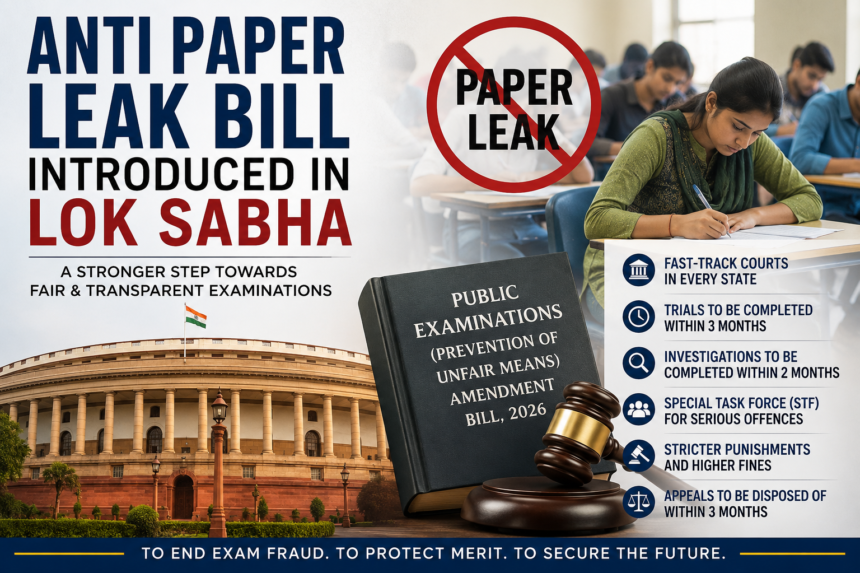
Anti Paper Leak Bill, The integrity of India’s public examination system has once again taken centre stage as the Central Government introduced the Public Examinations (Prevention of Unfair Means) Amendment Bill, 2026 in the Lok Sabha. The proposed legislation aims to significantly strengthen the country’s legal framework against examination malpractices, particularly paper leaks, which have repeatedly shaken the confidence of millions of students.
Introduced during the Monsoon Session of Parliament by Minister of State for Personnel, Public Grievances and Pensions, Dr. Jitendra Singh, the Bill seeks to amend the Public Examinations (Prevention of Unfair Means) Act, 2024 by introducing faster investigations, special courts, harsher penalties, and a dedicated investigation mechanism.
The move comes amid growing public anger following allegations surrounding the NEET-UG paper leak controversy and other examination irregularities that triggered widespread protests across the country. Students, parents, education experts, and opposition parties have consistently demanded a stronger Paper leak law India framework to prevent organised examination fraud, enhance accountability, and ensure fairness in recruitment and entrance examinations. The proposed amendments are expected to reinforce the Paper leak law India by introducing faster investigations, special courts, and stricter penalties for those involved in examination-related offences.
Here’s a detailed look at what the proposed legislation means, why it has become necessary, and how it could reshape India’s examination system.
Why the Government Introduced the Amendment Bill
India conducts hundreds of public examinations every year for university admissions and government recruitment. These exams determine the future of millions of students and job aspirants.
However, repeated incidents of question paper leaks, organised cheating syndicates, impersonation, and digital fraud have exposed serious weaknesses in the examination system.
The controversy surrounding the alleged NEET-UG paper leak became one of the biggest education-related issues in recent years. Students across multiple states protested, questioning the transparency of the examination process and demanding accountability from authorities.
Although Parliament enacted the Public Examinations (Prevention of Unfair Means) Act, 2024, the government now believes stronger enforcement mechanisms are required to effectively deter organised exam fraud.
The 2026 Amendment Bill therefore focuses on making investigations faster, trials quicker, and punishments more severe.
Background: The 2024 Anti-Paper Leak Law
Anti Paper Leak Bill, The Public Examinations (Prevention of Unfair Means) Act, 2024 was introduced to curb unfair practices in examinations conducted by central authorities.
The law criminalised offences such as:
- Paper leaks
- Organised cheating
- Tampering with answer sheets
- Unauthorised access to confidential examination material
- Manipulation of examination systems
- Use of technology for examination fraud
While the legislation established strict legal provisions, implementation challenges soon emerged, especially in handling large-scale organised criminal networks involved in examination fraud.
The proposed amendment aims to address those gaps.
Key Highlights of the Public Examinations Amendment Bill 2026
The new Bill introduces several important changes intended to strengthen enforcement and improve the speed of justice.
Some of the major proposals include:
- Special Fast Track Courts in every State
- Mandatory completion of trials within three months
- Completion of investigations within two months
- Creation of a Special Task Force (STF)
- Appointment of Special Public Prosecutors
- Enhanced prison terms and monetary penalties
- Faster appeals before High Courts
Each of these measures targets delays that have often allowed accused persons to avoid timely prosecution.
Fast-Track Courts to Handle Paper Leak Cases
Anti Paper Leak Bill, Perhaps the most significant proposal in the amendment is the establishment of Special Fast Track Courts.
Under the Bill, State Governments and Union Territory Administrations will have the authority to designate any Court of Session as a Special Fast Track Court specifically for offences under the Act.
This is expected to substantially reduce delays that have historically affected criminal cases related to examination fraud.
Instead of waiting years for trials, paper leak cases could now receive priority treatment.
Trials Must Be Completed Within Three Months
The amendment introduces strict timelines for judicial proceedings.
According to the proposal:
- Court proceedings must be conducted daily whenever possible.
- Trials should conclude within three months from the filing of the charge sheet.
This provision is intended to ensure swift justice while preventing prolonged legal battles that often reduce public confidence in the justice system.
Quick trials may also discourage criminal groups that currently exploit delays in legal proceedings.
Investigation Deadline Fixed at Two Months
Another major reform concerns the investigation process.
The Bill directs investigating agencies to complete paper leak investigations within two months.
Delays in investigations have often weakened prosecution by allowing evidence to deteriorate or disappear over time.
A fixed investigation timeline could help preserve evidence, identify organised networks more efficiently, and accelerate prosecution.
However, experts note that investigative agencies will require adequate staffing, forensic capabilities, and digital investigation tools to consistently meet this deadline.
Special Task Force to Investigate Serious Cases
Anti Paper Leak Bill, Recognising that many paper leak cases involve interstate criminal syndicates, the amendment also empowers the Central Government to establish a Special Task Force (STF) whenever necessary.
The STF would investigate complex cases involving:
- Organised examination fraud
- Interstate criminal networks
- Digital hacking
- Technology-enabled cheating
- Large-scale paper leak conspiracies
Such specialised investigative teams may improve coordination between central agencies and state police departments.
This could prove particularly useful in cases where examination scams extend across multiple states.
Special Public Prosecutors to Strengthen Prosecution
The Bill also authorises State Governments and Union Territories to appoint Special Public Prosecutors exclusively for offences under the Act.
These prosecutors would possess expertise in handling complex examination fraud cases.
Dedicated prosecutors may improve conviction rates by ensuring that technical evidence, digital records, financial transactions, and organised criminal activities are presented effectively before the courts.
Stricter Punishments for Offenders
One of the central objectives of the amendment is increasing deterrence.
The proposed legislation seeks to enhance both:
- Terms of imprisonment
- Financial penalties
Although the Bill introduced in Parliament specifies stronger punishments, the broader objective is clear—raising the cost of organised examination fraud so that criminal networks think twice before attempting paper leaks.
The government believes harsher penalties will discourage organised rackets that profit from selling leaked question papers.
New Appeal Mechanism for Faster Justice
The amendment also proposes a dedicated appeal process.
Appeals against any judgment, sentence, or order passed under the Act would lie before a Division Bench of the respective High Court.
Importantly, the Bill proposes that such appeals should also be disposed of within three months of admission.
This ensures that cases continue moving quickly even after trial, preventing years of litigation.
The NEET-UG Controversy That Triggered the Reforms
Anti Paper Leak Bill, The timing of the amendment is closely linked to the nationwide uproar surrounding the alleged NEET-UG paper leak.
The controversy sparked weeks of protests involving:
- Medical aspirants
- Student organisations
- Parents
- Civil society groups
- Opposition political parties
Demonstrators demanded:
- Transparent investigations
- Accountability of examination authorities
- Cancellation or re-examination where necessary
- Stronger anti-paper leak laws
- Structural reforms in examination administration
The government’s amendment appears to be a legislative response aimed at restoring public confidence.
How Paper Leaks Affect Students
Paper leaks create consequences far beyond cancelled examinations.
For honest students, months—or even years—of preparation can suddenly become meaningless.
The emotional impact includes:
- Anxiety
- Stress
- Depression
- Loss of confidence
- Uncertainty regarding admissions or employment
Financial costs are equally significant.
Families often invest heavily in coaching classes, accommodation, travel, books, and examination fees.
When examinations are compromised, these investments are effectively placed at risk.
For many students from economically weaker backgrounds, a cancelled examination can delay educational or career opportunities by an entire year.
Organised Crime Behind Examination Fraud
Modern paper leak cases are no longer isolated incidents involving a handful of individuals.
Investigations over recent years have revealed sophisticated criminal networks that utilise:
- Encrypted messaging applications
- Digital payment systems
- Insider access
- Identity fraud
- Cybercrime techniques
- Interstate logistics
Some syndicates reportedly earn substantial illegal profits by selling leaked examination papers to candidates before exams.
The government’s emphasis on Special Task Forces reflects growing recognition that paper leaks are increasingly organised criminal enterprises rather than isolated acts of misconduct.
Challenges in Implementing the New Law
Anti Paper Leak Bill, While the proposed amendments are ambitious, implementation will determine their success.
Several practical challenges remain.
Court Capacity
Fast-track courts require adequate judges, infrastructure, and administrative support.
Without additional resources, achieving three-month trial deadlines may prove difficult.
Police Resources
Completing investigations within two months will require specialised investigators trained in digital forensics and financial intelligence.
Technology Upgrades
Examination authorities must continue investing in secure digital systems to prevent leaks before they occur.
Inter-Agency Coordination
Effective coordination between central agencies, state police, examination bodies, and prosecutors will be essential.
Without seamless information sharing, organised networks may continue exploiting jurisdictional gaps.
Government’s Broader Strategy Against Examination Fraud
The Amendment Bill appears to form part of a broader strategy aimed at improving examination security.
Experts expect additional reforms may include:
- Stronger cybersecurity measures
- AI-powered monitoring systems
- Enhanced encryption of question papers
- Better logistics tracking
- Biometric verification
- Improved digital surveillance during examinations
Together, legislative and technological reforms could significantly reduce opportunities for organised cheating.
Political Reactions and Parliamentary Debate
The Bill enters Parliament during a politically sensitive period.
The Monsoon Session has witnessed repeated disruptions over the NEET controversy, with opposition parties demanding accountability and systemic reforms.
Supporters of the amendment argue that stronger laws are necessary to restore public trust in competitive examinations.
Opposition leaders, meanwhile, are expected to scrutinise whether stricter legal provisions alone are sufficient without broader institutional reforms in examination administration and governance.
As parliamentary debates continue, lawmakers are likely to discuss both enforcement mechanisms and preventive measures.
What the Amendment Means for Students and Recruitment Exams
If enacted, the legislation could reshape the way examination-related offences are handled across India.
Students may benefit from:
- Faster investigations
- Quicker prosecution of offenders
- Greater accountability
- Increased confidence in examination systems
- Better protection against organised fraud
Recruitment agencies and examination bodies may also face greater pressure to strengthen internal security protocols and improve transparency.
Ultimately, the effectiveness of the law will depend not only on stricter punishments but also on consistent enforcement.
Read More: Bank of Baroda Data Leak: 1TB of Customer and Banking Records Allegedly Exposed
Conclusion
Anti Paper Leak Bill, The introduction of the Public Examinations (Prevention of Unfair Means) Amendment Bill, 2026 marks another important step in India’s effort to safeguard the credibility of public examinations. By proposing fast-track courts, time-bound investigations, dedicated prosecutors, Special Task Forces, and stronger punishments, the government aims to send a clear message that organised examination fraud will face swift and serious legal consequences.
The reforms come at a time when public confidence in competitive examinations has been tested by high-profile paper leak allegations and widespread student protests. While legislation alone cannot eliminate every vulnerability, it can establish a stronger legal foundation for protecting merit-based education and recruitment. If implemented effectively, supported by technological safeguards and institutional reforms, the amendment could play a significant role in restoring trust in India’s examination system and ensuring that honest students are rewarded fairly for their hard work.