
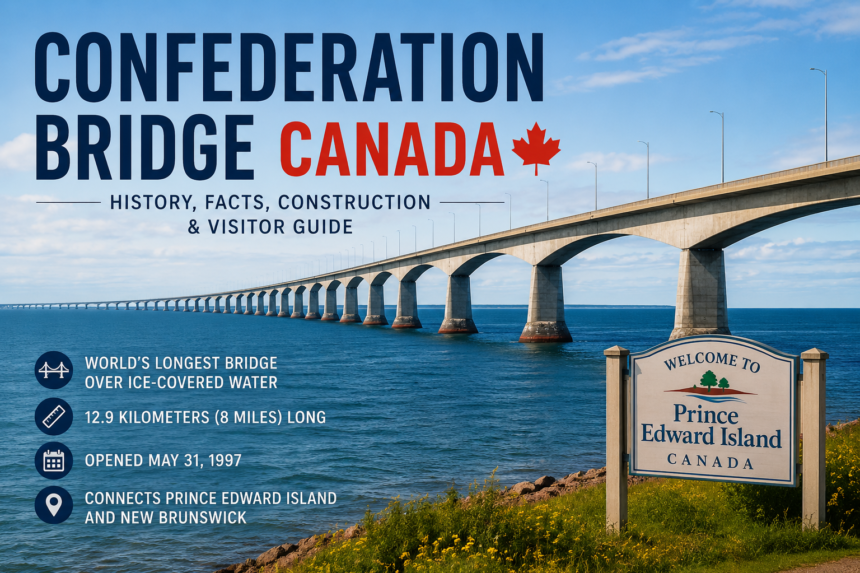
Confederation Bridge Canada, The Confederation Bridge is one of Canada’s greatest engineering achievements and a symbol of innovation and connectivity. Stretching across the Northumberland Strait, the bridge links Prince Edward Island (PEI) with New Brunswick, providing a permanent transportation route between the island and mainland Canada. Since opening in 1997, it has transformed travel, boosted tourism, and strengthened economic ties throughout Atlantic Canada.
At 12.9 kilometers (8 miles) long, the Confederation Bridge is recognized as the world’s longest bridge crossing ice-covered water, making it a remarkable feat of civil engineering. The Confederation Bridge history reflects decades of planning, engineering innovation, and determination, culminating in the bridge’s opening in 1997. Every year, millions of travelers cross this iconic structure while enjoying spectacular ocean views and experiencing one of Canada’s most famous landmarks, making it both a vital transportation link and a celebrated Canadian attraction.
History of the Confederation Bridge
Before the bridge was built, access to Prince Edward Island depended mainly on ferry services that crossed the Northumberland Strait. While the ferry system served residents for decades, harsh winter weather often caused delays and disrupted transportation.
Throughout the 1980s, discussions intensified regarding the construction of a permanent link. Farmers, fishermen, tourism operators, and local residents held differing opinions about how the project would affect the island’s economy and lifestyle. After extensive debate, a provincial plebiscite was held in 1988, where approximately 59.4% of voters supported the fixed-link proposal.
Construction officially began in 1993 and required approximately four years to complete. More than 5,000 workers contributed to the ambitious project before the bridge officially opened to traffic on May 31, 1997.
Engineering Excellence
Confederation Bridge Canada, The Confederation Bridge is widely regarded as one of the most impressive infrastructure projects ever completed in Canada.
Some notable engineering specifications include:
- Length: 12.9 km (8 miles)
- Bridge Type: Multi-span box girder bridge
- Maximum Clearance: Approximately 60 meters (197 feet) above sea level
- Number of Piers: 62
- Construction Material: High-strength reinforced concrete
- Designed Lifespan: 100 years
The bridge’s distinctive curved design is intentional rather than purely aesthetic. Engineers incorporated a slight curve to reduce the visual effect of driving across a long, uninterrupted structure while also helping the bridge better withstand strong winds and environmental stresses.
Perhaps its most remarkable engineering feature is its ability to withstand the harsh ice conditions found in the Northumberland Strait. Massive cone-shaped pier bases break apart drifting ice sheets before they can exert dangerous pressure on the structure.
Construction Challenges
Building the Confederation Bridge presented extraordinary engineering challenges.
The Northumberland Strait experiences:
- Heavy sea ice during winter
- Powerful tidal currents
- Strong Atlantic winds
- Freezing temperatures
To address these conditions, many bridge sections were manufactured on land before being transported into position using specialized marine equipment. Massive cranes lifted pre-cast concrete segments into place with remarkable precision.
Environmental protection was also a major priority. Engineers designed construction methods that minimized disruption to marine ecosystems while ensuring the bridge would remain durable for generations.
Economic Impact
Confederation Bridge Canada, the Confederation Bridge has dramatically improved transportation throughout Atlantic Canada.
Some of its economic benefits include:
Tourism Growth
Prince Edward Island has experienced increased visitor numbers thanks to easier access. Travelers can now reach the island year-round without relying solely on ferry schedules.
Faster Commercial Transport
Businesses benefit from:
- Lower transportation costs
- Reliable year-round shipping
- Improved supply chain efficiency
- Better market access
Employment
Construction created thousands of jobs, while ongoing maintenance and operations continue to support employment in the region.
The bridge remains an important economic asset that strengthens trade and tourism across eastern Canada.
Driving Across the Confederation Bridge
Crossing the bridge is an unforgettable experience.
The drive typically takes about 10 to 12 minutes, depending on traffic conditions. During the journey, travelers enjoy panoramic views of:
- Northumberland Strait
- Fishing boats
- Coastal landscapes
- Atlantic wildlife
The bridge is designed primarily for motor vehicles.
Pedestrians and cyclists are not permitted to cross independently due to safety considerations. However, shuttle services are available for cyclists and pedestrians wishing to travel between Prince Edward Island and New Brunswick.
Safety Features
Safety has always been a primary consideration in the bridge’s design.
Key safety measures include:
- Continuous weather monitoring
- Wind detection systems
- Ice management design
- Emergency response patrols
- Regular structural inspections
High winds occasionally require temporary restrictions for motorcycles, high-sided vehicles, and vehicles towing trailers. Complete closures are relatively rare because the bridge was specifically engineered to withstand challenging weather conditions.
Environmental Considerations
Confederation Bridge Canada, The Confederation Bridge was designed with environmental sustainability in mind.
Engineers conducted extensive environmental studies before construction to minimize impacts on:
- Fish habitats
- Marine mammals
- Water circulation
- Ice movement
- Coastal ecosystems
Modern monitoring programs continue to evaluate environmental conditions surrounding the bridge, ensuring its long-term compatibility with the surrounding ecosystem.
Interesting Facts About the Confederation Bridge
Here are some fascinating facts:
- It is the longest bridge in the world crossing ice-covered water.
- Construction required over 44,000 pre-cast concrete components.
- The bridge was designed to last 100 years.
- It crosses the Northumberland Strait at a maximum height of approximately 60 meters.
- Around 5,000 workers participated during construction.
- It officially opened on May 31, 1997.
- The bridge curves gently, reducing driver fatigue and enhancing structural performance.
- It serves as an essential transportation link for residents, businesses, and tourists.
Tourism Around the Bridge
Visitors often combine their bridge crossing with nearby attractions.
Popular destinations include:
Prince Edward Island
- Charlottetown
- Cavendish Beach
- Green Gables Heritage Place
- PEI National Park
New Brunswick
- Cape Jourimain Nature Centre
- Fundy Coastal Drive
- Sackville
- Moncton
Observation points on both sides of the bridge provide excellent photography opportunities, especially during sunrise and sunset.
Maintenance and Longevity
Confederation Bridge Canada, Maintaining a bridge in such a demanding marine environment requires continuous attention.
Routine maintenance includes:
- Structural inspections
- Concrete repairs
- Ice monitoring
- Road surface maintenance
- Weather system monitoring
Modern inspection technologies help engineers identify minor issues before they become significant problems, helping ensure the bridge remains safe for decades to come.
Why the Confederation Bridge Matters
Beyond its engineering significance, the Confederation Bridge symbolizes Canada’s commitment to innovation and regional connectivity.
It has transformed life for residents of Prince Edward Island by providing reliable year-round access to the mainland. Businesses enjoy improved logistics, tourists benefit from convenient travel, and emergency services can respond more efficiently when needed.
The bridge also stands as an international example of successful large-scale infrastructure designed to operate in one of the world’s most challenging marine environments.
Conclusion
The Confederation Bridge Canada is much more than a transportation link—it is one of Canada’s greatest engineering accomplishments. Connecting Prince Edward Island and New Brunswick across the Northumberland Strait, the bridge has revolutionized travel, strengthened regional commerce, and become a must-see landmark for visitors from around the world.
Its innovative design, resilience against harsh weather, and impressive scale continue to inspire engineers and travelers alike. Whether you’re interested in civil engineering, Canadian history, or planning a scenic road trip through Atlantic Canada, the Confederation Bridge remains an unforgettable destination and a lasting symbol of Canadian ingenuity.