
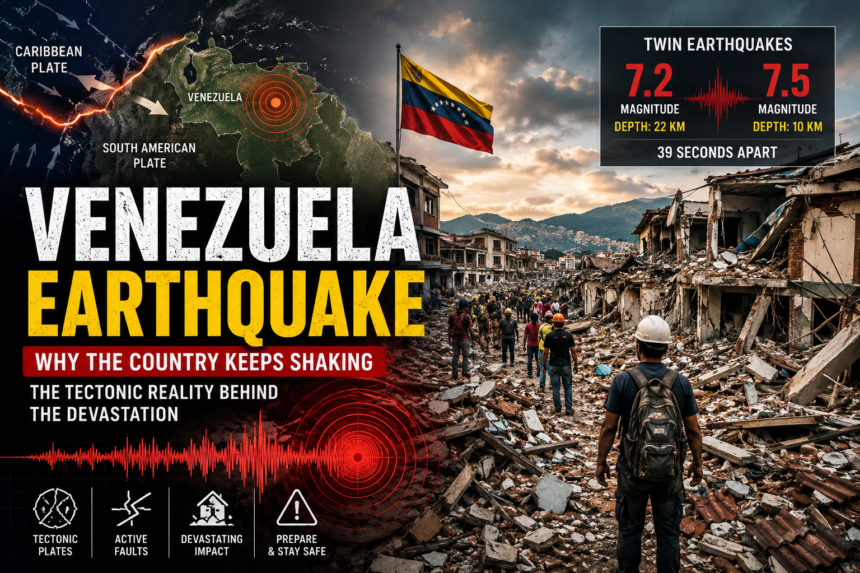
Venezuela Earthquake, If you’ve been following the news lately, you’ve probably seen the shocking images coming out of Venezuela. Two massive earthquakes — magnitudes 7.2 and 7.5 — rocked the country within just 39 seconds of each other, leaving behind collapsed buildings, crumbled roofs, and terrified families scrambling for safety. The state of emergency has been declared, and global agencies are painting a pretty grim picture.
But here’s the real question: Why does Venezuela keep getting hit so hard? The answer lies in the movement of the Venezuela tectonic plates, where the Caribbean Plate and South American Plate constantly grind against each other. And more importantly, are these earthquakes connected to the ones hitting Japan and California at almost the same time? Let’s break it all down in simple terms.
The Twin Quakes That Shook a Nation
Imagine sitting at home on a public holiday, enjoying a quiet evening, and then the ground beneath you splits open — not once, but twice within a minute. That’s exactly what happened to Venezuelans on Wednesday night. The first quake, a 7.2 magnitude, struck at a depth of 22 km. Less than a minute later, a stronger 7.5 magnitude tremor hit even closer to the surface, at just 10 km deep.
The United States Geological Survey (USGS) didn’t sugarcoat the situation either. They warned that “high casualties and extensive damage are probable.” According to the latest estimates, there’s a 39% chance that fatalities could be between 1,000 and 10,000, and a 37% chance that the death toll could even touch 100,000. Even U.S. President Donald Trump noted that these quakes, some of the strongest the region has seen in over a century, have caused “a devastating number of deaths.”
The timing made things even worse. Wednesday was a public holiday marking a decisive 1821 battle in Venezuela’s war of independence from Spain, meaning most people were at home when the earth started to move.
The Tectonic Tug-of-War in Venezuela
So, why is Venezuela such a hotspot for earthquakes? The answer lies deep beneath our feet — literally.
Venezuela sits on the northern coast of South America. While most of its mainland rests on the relatively stable South American Plate, its northern coast and the Caribbean islands just offshore sit right on top of one of the most active tectonic boundaries on Earth. Think of it like two massive conveyor belts grinding past each other in opposite directions.
Venezuela Earthquake, The Caribbean Plate and the South American Plate are constantly pushing, pulling, and sliding against each other. This slow but incredibly powerful movement creates enormous underground pressure that has to go somewhere. When it finally releases, you get earthquakes — often devastating ones.
Here’s a staggering fact: approximately 80% of Venezuela’s population lives in these active seismic zones. That means a huge number of people are sitting ducks when these tremors hit.
The Boconó Fault, one of the most notorious geological features in the region, is a major culprit. It’s responsible for triggering many of the powerful earthquakes that have struck Venezuela over the years. The Caribbean Plate moves eastward by about 20 millimeters every year relative to the South American Plate. To put that into perspective, researchers discovered that a single slipping fault on the nearby island of Trinidad handles about 70% of this intense motion. That’s a lot of stress building up underground!
The Hidden Danger of “Shallow” Earthquakes
Venezuela Earthquake, here’s something that many people don’t realize: not all earthquakes are created equal. The depth at which an earthquake occurs makes a huge difference in how destructive it is at the surface.
Many of Venezuela’s earthquakes are what’s called “shallow-focus,” meaning they happen less than 15 to 20 kilometers below the ground. Why does that matter? Well, think of it like this: if someone drops a bowling ball onto a wooden floor, the impact is going to be a lot more intense than if the same ball was dropped from much higher up — wait, actually, let me reframe that. If an earthquake is shallow, the seismic energy travels a shorter distance to reach the surface. There’s less rock and earth to absorb and weaken that energy. So by the time it hits your house, it’s still packing a massive punch.
This is exactly why the twin quakes in Venezuela were so devastating. The second one, at just 10 km deep, essentially hit the surface almost at full force.
What Actually Causes an Earthquake?
Let’s take a step back and understand the basics. Our Earth’s solid outer crust isn’t one solid piece — it’s broken up into massive slabs of rock called tectonic plates. There are about 15 major and minor ones, and they’re all floating on a semi-fluid, incredibly hot layer of rock beneath them called the mantle.
Now, these plates aren’t just sitting there peacefully. They’re constantly shifting, bumping into each other, and sometimes pulling apart. It might happen at a snail’s pace — we’re talking centimeters per year — but the forces involved are absolutely mind-boggling. It’s this slow but powerful movement that builds mountains over millions of years and, unfortunately, triggers violent earthquakes and volcanic eruptions.
Venezuela Earthquake, Think of tectonic plates like giant puzzle pieces floating on a pot of thick, hot soup. They bump, they grind, and sometimes they get stuck — until the pressure becomes too much and they slip suddenly. That sudden slip? That’s your earthquake.
The Pacific Ring: The World’s Most Active Earthquake Zone
If you really want to understand where most of the world’s biggest earthquakes happen, look no further than the circum-Pacific seismic belt, also known as the Pacific Ring of Fire. This horseshoe-shaped zone runs along the rim of the Pacific Ocean and is responsible for about 81% of the world’s largest earthquakes. Yes, you read that right — over 80%!
Why is it so active? Because this belt perfectly aligns with the boundaries where oceanic crust is sinking (or subducting) beneath other plates. When massive sections of rock suddenly slip or rupture under this kind of pressure, you get some of the most intense earthquakes ever record.
Some of history’s most catastrophic tremors happened right here:
- The magnitude 9.5 Chilean Earthquake in 1960 — the strongest earthquake ever recorded
- The magnitude 9.2 Alaska Earthquake in 1964
- The devastating Tohoku earthquake in Japan in 2011
A Look Back at Devastating Global Earthquakes
Venezuela Earthquake, Nature’s fury has left deep scars on our planet, especially over the last two decades. Here’s a sobering look at some of the deadliest earthquakes in recent memory:
Turkiye and Syria (February 2023)
A massive 7.8 magnitude earthquake in southern Turkiye killed over 55,000 people and essentially flattened entire cities. The destruction was almost incomprehensible.
Nepal (April 2015)
A 7.3 magnitude quake shook Nepal, killing approximately 9,000 people. The tremors were felt strongly across northern India, serving as a stark reminder of how interconnect our geological reality is.
Japan (March 2011)
The terrifying 9.0-9.1 magnitude Tohoku earthquake triggered a towering tsunami that slammed into northeastern Japan. Over 18,000 people lost their lives, and the disaster also caused the infamous Fukushima nuclear meltdown.
Haiti (January 2010)
A devastating 7.0 magnitude quake struck near the capital, Port-au-Prince. It claimed an estimated 222,570 lives and injured 300,000 more, making it the deadliest natural disaster of the 21st century.
Indonesia (December 2004)
A colossal 9.1 magnitude earthquake off the coast of Sumatra triggered the deadly Indian Ocean tsunami. Over 227,900 people across multiple countries — including India — lost their lives. It remains one of the deadliest natural disasters in recorded history.
Are the Recent Global Quakes Connected?
Now, let’s address the elephant in the room: earthquakes hit Venezuela, Japan, and California within just hours of each other. People around the world were wondering — is this all connected?
The short answer is: probably not in the way you might think. While the timing seems suspicious, scientists generally agree that earthquakes occurring far apart from each other don’t directly trigger one another. The Earth is constantly releasing tectonic stress in different regions, and sometimes those releases just happen to overlap in timing.
However, there’s a phenomenon called dynamic triggering, where a massive earthquake can send seismic waves around the globe and potentially trigger smaller quakes in distant regions. But this is still an area of active research, and scientists don’t fully understand the mechanisms yet.
What we do know is that we live on a restless planet. The ground beneath our feet is never truly still, and certain regions are far more vulnerable than others.
Why Venezuela’s Future Looks Uncertain
Here’s the hard truth: Venezuela’s geological reality isn’t going to change anytime soon. The country sits in one of the most active seismic zones in the world, and with about 80% of its population living in these danger zones, the risks are enormous.
The recent twin earthquakes are a wake-up call — not just for Venezuela, but for the entire world. As our planet continues to shift and evolve, we need better building codes, improved early warning systems, and more robust disaster preparedness plans.
Nature doesn’t negotiate. It doesn’t care about politics, borders, or holidays. The best we can do is understand the risks and prepare accordingly.
Read More: IMD Monsoon Alerts 2026: Weather Warnings Issued Across India Amid Unpredictable Monsoon
Conclusion
Venezuela Earthquake, Venezuela’s recent earthquakes are a stark reminder of the raw, uncontrollable power of nature. The country’s unique position at the boundary of two major tectonic plates makes it inherently vulnerable, and the shallow depth of many of its earthquakes makes the destruction even worse. While the rest of the world watches in horror, the people of Venezuela are left picking up the pieces — again.
As we reflect on the devastation, we should also remember the other major earthquakes that have shaped our collective history — from Haiti to Japan, from Indonesia to Turkiye. Each one teaches us something about our planet and our own vulnerability.
The ground beneath us is always moving. The only question is: are we ready for when it decides to move violently?