
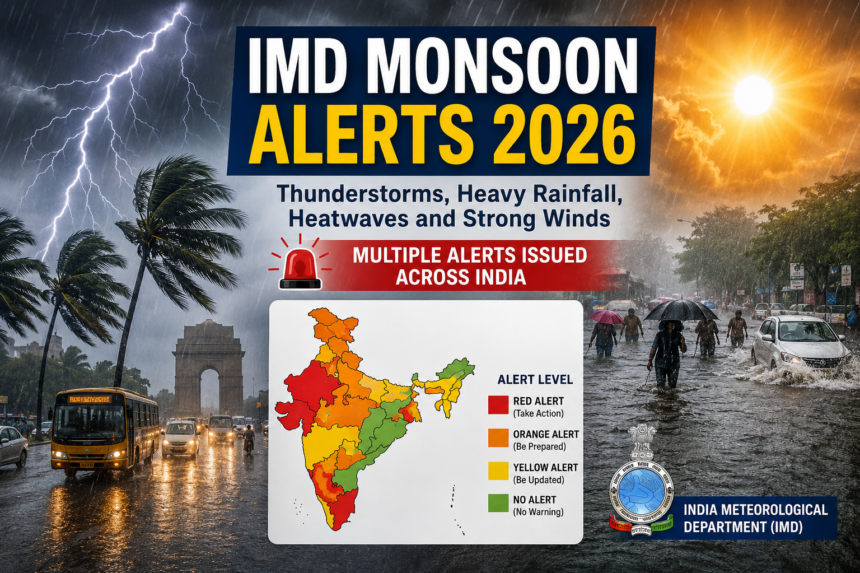
IMD Monsoon Alerts 2026, The southwest monsoon season has taken an unexpected turn, raising concerns among farmers, policymakers, and millions of residents across India. While the arrival of the monsoon initially brought hopes of widespread rainfall and relief from scorching summer temperatures, recent weather developments suggest a slower and weaker progression than expected.
According to weather experts, India is likely to experience below-average rainfall over the next two weeks, particularly across northern and central regions. The slowdown has been attributed to western disturbances that are disrupting the monsoon’s normal advancement pattern.
At the same time, several states are witnessing extreme weather conditions, including thunderstorms, heavy rainfall, lightning strikes, gusty winds, and persistent heatwave conditions. The IMD Weather Alerts released nationwide underscore the unpredictable nature of the 2026 monsoon season, as authorities issue warnings for severe storms, heavy rains, and extreme temperatures affecting multiple regions across India.
Why Is the Monsoon Slowing Down in 2026?
The southwest monsoon is often described as India’s economic lifeline because it directly impacts agriculture, water resources, and rural livelihoods. However, weather officials have indicated that western disturbances moving across northern India are interfering with the monsoon’s natural flow.
These atmospheric systems are preventing moisture-laden winds from advancing smoothly, resulting in uneven rainfall distribution. As a consequence, several regions may receive less rainfall than usual during the next fortnight.
For a country where nearly half of the farmland still depends on rainfall, even a short-term deficit can create significant concerns for agricultural production and water management.
Delhi Under Red Alert as Severe Thunderstorms Strike
IMD Monsoon Alerts 2026, The national capital witnessed dramatic weather conditions as strong winds swept through the city, prompting the IMD to issue a red alert.
Authorities warned residents about:
- Thunderstorms
- Lightning strikes
- Gusty winds reaching 70–80 kmph
- Wind gusts potentially touching 90 kmph
- Dust storms in several areas
The weather department also forecast light to moderate rainfall across various parts of Delhi. Residents were advised to remain indoors during peak storm activity and avoid unnecessary travel.
The sudden shift in weather offered temporary relief from the intense summer heat but also raised safety concerns due to falling trees, flying debris, and reduced visibility.
Delhi Experiences Slight Temperature Relief
Alongside storm warnings, Delhi recorded a modest decline in temperature levels.
The city’s base weather station at Safdarjung reported a maximum temperature of 38.7 degrees Celsius, slightly below the seasonal average. However, the humidity pushed the “feels-like” temperature to an uncomfortable 44.4 degrees Celsius.
This demonstrates how humidity can often make conditions feel much hotter than the actual recorded temperature, creating additional stress for residents.
Heavy Rain Brings Welcome Relief Across Uttar Pradesh
IMD Monsoon Alerts 2026, Several districts in Uttar Pradesh received moderate to heavy rainfall, providing much-needed relief from prolonged heat conditions.
Among the highest rainfall figures recorded was Bansgaon in Gorakhpur district, which received 75 mm of rain within a 24-hour period.
The showers significantly reduced temperatures across many districts, bringing them below seasonal norms. Nevertheless, parts of Bundelkhand and southwestern Uttar Pradesh continued to experience elevated temperatures.
Meteorologists expect additional rainfall, thunderstorms, and gusty winds across the state in the coming days.
Jharkhand Awaits Monsoon Arrival
The southwest monsoon is expected to enter parts of Jharkhand within the next two to three days.
Weather conditions have already begun changing across the state, with pre-monsoon showers and strong winds affecting several districts, including Ranchi.
Meteorologists believe atmospheric conditions are favorable for the monsoon’s advancement, which could provide substantial relief to farmers preparing for the agricultural season.
For Jharkhand’s farming communities, the arrival of the monsoon cannot come soon enough, as sowing activities largely depend on adequate rainfall.
Kerala Faces Heavy Rainfall Threat
While some regions are struggling with rainfall shortages, Kerala continues to face the opposite challenge.
The IMD has issued an orange alert for Idukki and Ernakulam districts, warning of very heavy rainfall. Meanwhile, yellow alerts have been declared in several districts, including:
- Pathanamthitta
- Alappuzha
- Kottayam
- Thrissur
- Kannur
- Kasaragod
Weather experts attribute the heavy rainfall activity to cyclonic circulations over the Bay of Bengal, which are enhancing moisture inflow into the state.
Residents in vulnerable areas have been advised to remain cautious, especially near rivers, hilly regions, and flood-prone zones.
Rising Health Concerns During Kerala’s Monsoon Season
IMD Monsoon Alerts 2026, Heavy rainfall often brings more than water—it creates ideal conditions for disease outbreaks.
Hospitals across Kerala’s central Travancore region are reporting a sharp rise in fever and infectious disease cases. Health officials are particularly concerned about:
- Dengue fever
- Leptospirosis
- H1N1 influenza
- Shigellosis
- Various waterborne infections
Medical facilities in Kottayam and Pathanamthitta are witnessing increasing patient numbers as monsoon-related illnesses spread across the region.
Public health authorities are urging citizens to maintain hygiene standards, consume safe drinking water, and eliminate stagnant water sources around homes.
Thiruvananthapuram Launches Disease Prevention Campaign
Recognizing the growing health risks associated with the monsoon season, the Thiruvananthapuram Municipal Corporation has launched a comprehensive disease-prevention campaign.
The initiative focuses on:
- Public awareness programs
- Vector-control measures
- Enhanced sanitation efforts
- Improved fogging operations
- Community outreach activities
Officials hope these preventive measures will reduce the spread of infectious diseases during the peak rainy season.
Marathwada Records Uneven Rainfall Distribution
IMD Monsoon Alerts 2026, Central Maharashtra’s Marathwada region continues to experience uneven monsoon performance.
Reports indicate that only two out of eight districts have received rainfall exceeding normal June expectations.
Overall, the region has recorded approximately 76.6% of its average rainfall target for the month so far.
Moreover, the monsoon has not yet covered all districts, creating uncertainty for farmers awaiting consistent rainfall for crop cultivation.
Vijayawada and NTR District Battle Waterlogging Issues
Heavy rainfall in Andhra Pradesh’s NTR district, including Vijayawada, caused significant waterlogging in several low-lying areas.
Authorities quickly mobilized response teams and instructed officials to remain vigilant.
Several prominent locations experienced flooding, including:
- Pandit Nehru Bus Station area
- Mango Market
- Benz Circle
- NTR Circle
- Collectorate surroundings
Municipal teams have been working continuously to remove stagnant water and restore normal traffic movement.
Telangana Faces Dual Challenge of Heatwaves and Thunderstorms
Even as the monsoon season progresses, parts of Telangana continue to experience heatwave conditions.
The IMD has forecast heatwave activity in several northern districts while simultaneously predicting thunderstorms, lightning, and gusty winds across multiple regions.
This unusual combination highlights the transitional nature of the current weather pattern, where summer heat and monsoon moisture are interacting simultaneously.
Such conditions can create sudden weather shifts, making accurate forecasting increasingly important.
Disaster Preparedness Takes Center Stage in Uttarakhand
IMD Monsoon Alerts 2026, With monsoon-related risks growing nationwide, disaster management agencies are intensifying preparedness efforts.
A two-day National Workshop on Monsoon Preparedness has been organized in Dehradun, bringing together officials from central and state governments.
The workshop focuses on:
- Flood preparedness
- Landslide mitigation
- Emergency response planning
- Community resilience strategies
- Infrastructure protection
The initiative aims to strengthen coordination among agencies before the monsoon reaches its peak intensity.
Road Safety Concerns Emerge Along Kerala’s NH-66
Another challenge emerging this monsoon season is road safety.
Motorists have identified several aquaplaning hotspots along the newly widened NH-66 corridor between Kozhikode and Malappuram.
Aquaplaning occurs when a layer of water builds between vehicle tires and the road surface, causing drivers to lose traction and control.
Experts warn that unless corrective measures are implemented quickly, these locations could become accident-prone zones during periods of intense rainfall.
Political Debate Surrounds Monsoon Preparedness in Telangana
IMD Monsoon Alerts 2026, The onset of heavy rains has also sparked political debate.
Opposition leaders have criticized the state government’s monsoon preparedness efforts, claiming insufficient preventive measures were taken before the arrival of seasonal rains.
The discussion has reignited broader concerns regarding urban drainage systems, flood management infrastructure, and emergency response capabilities in rapidly growing cities.
What Lies Ahead for India’s Monsoon Season?
Weather experts remain cautious about the coming weeks. Although the monsoon has advanced into several regions, below-average rainfall is expected across large parts of central and northern India during the immediate forecast period.
At the same time, southern states such as Kerala may continue experiencing heavy rainfall events.
The situation highlights the increasingly uneven nature of India’s weather patterns, where one region faces rainfall deficits while another struggles with flooding and disease outbreaks.
Read More: Climate Change in India 2026: Heatwaves, Floods, Renewable Energy & India’s Climate Future
Conclusion
IMD Monsoon Alerts 2026, India’s monsoon season is shaping up to be a story of contrasts. While northern and central regions face concerns over below-normal rainfall, states such as Kerala continue to battle heavy downpours, health risks, and infrastructure challenges. From Delhi’s severe thunderstorms to Uttar Pradesh’s cooling rains and Jharkhand’s anticipated monsoon arrival, weather conditions remain highly dynamic across the country. As authorities issue alerts and strengthen preparedness measures, citizens are being urged to stay informed and follow official advisories.
The next few weeks will be crucial in determining whether the monsoon regains momentum or continues its sluggish progress. For millions of Indians whose livelihoods, agriculture, and daily lives depend on seasonal rainfall, close monitoring of weather developments will remain essential throughout the remainder of the monsoon season.