UK Social Media Ban, The United Kingdom has announced a sweeping ban on social media access for children under the age of 16, placing itself alongside Australia, Indonesia, and Malaysia in adopting one of the toughest online safety measures in the world. The decision, unveiled by Prime Minister Keir Starmer, marks a significant shift in how governments are responding to growing concerns about the impact of social media on young people.
The move reflects mounting fears over children’s mental health, online addiction, cyberbullying, harmful content, and the growing influence of technology on everyday life. Under the government’s evolving UK online safety law, officials are introducing an “Australia-plus” approach aimed at protecting children from online harms, creating a safer digital environment, and restoring a healthier balance between childhood and technology.
Why the UK Decided to Ban Social Media for Under-16s
For years, parents, educators, psychologists, and child welfare groups have raised alarms about the effects of social media on children. Concerns have ranged from excessive screen time and declining attention spans to mental health struggles linked to online pressures.
Prime Minister Keir Starmer framed the ban as a necessary intervention to protect children from the growing intrusion of technology into their lives.
According to Starmer, modern children are growing up in a world where digital platforms constantly compete for their attention. The government’s new policy is designed to ensure that young people can enjoy a healthier childhood without being overwhelmed by online influences.
The initiative signals a broader commitment to prioritizing children’s wellbeing over the interests of major technology companies.
What Is Included in the New Social Media Ban?
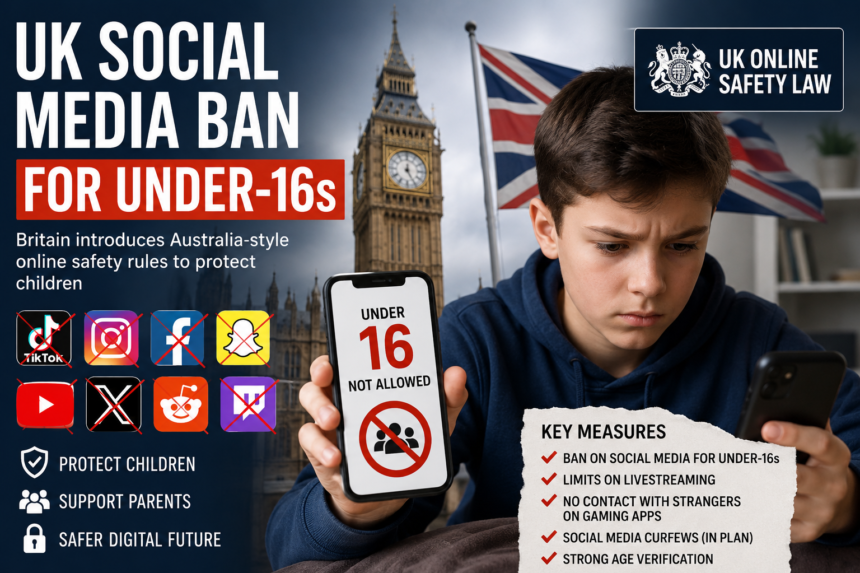
UK Social Media Ban, The proposed legislation is expected to prohibit children under 16 from accessing several major social media platforms. Reports indicate that the same platforms restricted in Australia will likely be included in the UK ban.
These platforms are expected to include:
- TikTok
- Snapchat
- Threads
- X (formerly Twitter)
- YouTube
- Twitch
- Kick
The restrictions would prevent users under 16 from creating accounts or actively using these services.
The ‘Australia-Plus’ Model Explained
While Australia became the first country to introduce a complete social media ban for under-16s in late 2025, Britain intends to go even further.
Government officials have described the policy as an “Australia-plus” approach because it expands beyond traditional social media restrictions.
Additional measures under consideration include:
- Limiting livestreaming features on certain platforms
- Preventing children from communicating with strangers through gaming applications
- Restricting access to advanced AI chatbots
- Introducing mandatory social media curfews
This broader strategy aims to address not only social media platforms but also other digital spaces where children may face risks.
Social Media Curfews Could Be the Next Big Change
UK Social Media Ban, One of the most closely watched proposals is the possibility of introducing social media curfews.
Think of it like a digital bedtime. Just as parents encourage children to switch off the television and go to sleep, the government is exploring ways to limit social media use during specific hours.
While final details have not yet been released, officials are expected to provide further information next month. If implemented, curfews could restrict access to certain online services during late-night hours, helping to reduce sleep disruption and excessive screen time.
Strong Public Support Helped Shape the Decision
The government’s decision follows an extensive three-month consultation process that gathered opinions from parents, educators, child safety experts, and members of the public.
The consultation generated an impressive 116,000 responses, highlighting the widespread concern surrounding children’s online safety.
Among participating parents:
- 90% supported a social media ban for children under 16.
- More than 83% believed that the dangers of social media outweigh its benefits for young users.
These findings suggest strong public backing for tougher regulations and may have played a crucial role in pushing the government toward more decisive action.
Online Safety Has Become One of the Defining Issues of Our Time
Starmer described online child safety as one of the most important social debates facing modern societies.
And it’s easy to understand why.
Children today are growing up in a digital world unlike anything previous generations experienced. Smartphones, social media feeds, AI tools, gaming platforms, and streaming services are now woven into nearly every aspect of daily life.
While technology offers valuable educational and social opportunities, critics argue that the risks have grown too significant to ignore.
Issues frequently cited include:
- Cyberbullying
- Exposure to harmful content
- Online grooming
- Addiction-like usage patterns
- Anxiety and depression
- Reduced face-to-face interaction
For policymakers, the challenge lies in balancing innovation with protection.
Age Verification Will Play a Critical Role
UK Social Media Ban, A key question surrounding the ban is how platforms will enforce age restrictions.
The government is expected to strengthen age verification systems to ensure that children cannot easily bypass the new rules.
Technology companies may be required to implement more advanced identity verification methods, creating greater accountability for platform operators.
However, privacy advocates have raised concerns about how personal data will be collected and stored during the verification process.
As a result, lawmakers will need to strike a careful balance between safety and privacy rights.
Not Everyone Supports a Full Ban
Despite widespread support, not all experts agree that a blanket social media ban is the best solution.
Some campaigners and digital rights groups argue that outright restrictions could create unintended consequences.
Critics suggest that children may seek alternative, less regulated platforms or find ways to circumvent restrictions altogether. Others believe that digital literacy education and parental guidance may be more effective than government-imposed bans.
There are also concerns that social media can provide valuable benefits, including educational resources, creative opportunities, peer support networks, and access to important information.
The debate highlights the complexity of regulating online spaces in a rapidly evolving digital landscape.
The Growing Global Trend Toward Youth Online Protection
The UK’s decision reflects a broader international movement toward stricter regulation of children’s online activities.
Governments around the world are increasingly examining how social media platforms affect young users and whether stronger safeguards are necessary.
Australia’s pioneering ban has already inspired discussions in several countries, while nations across Europe, Asia, and North America are considering similar measures.
As concerns over mental health and online safety continue to grow, policymakers are under increasing pressure to act.
Technology Companies Face New Challenges
UK Social Media Ban, The proposed ban could significantly impact major technology companies that rely on younger audiences for engagement and growth.
Platforms may need to invest heavily in:
- Enhanced age verification systems
- Compliance monitoring
- Safety infrastructure
- Content moderation
- User authentication technology
For social media giants, adapting to stricter regulations may become a critical business priority as governments worldwide introduce tougher online safety standards.
What Happens Next?
The UK government is expect to release further details regarding implementation, enforcement mechanisms, and additional restrictions in the coming weeks.
Lawmakers will also continue evaluating proposals involving AI chatbot limitations, livestreaming restrictions, and digital curfews.
If enacted as planned, the policy could become one of the most comprehensive child online safety frameworks ever introduced by a major Western nation.
The outcome may also influence similar policy discussions across the globe.
Read More: Apple Siri AI Revolution: Apple Unveils Smarter Assistant with Personal Context
Conclusion
UK Social Media Ban, Britain’s decision to ban social media access for children under 16 represents a landmark moment in the global debate over online safety. By adopting and expanding upon Australia’s model, the UK is sending a clear message that protecting children’s wellbeing has become a national priority.
Supporters view the move as a necessary safeguard against the growing risks associated with social media, while critics warn of potential unintended consequences. Regardless of where one stands, the policy highlights a fundamental challenge facing modern societies: how to harness the benefits of technology without sacrificing the wellbeing of younger generations.
As governments continue searching for solutions, the UK’s bold step may serve as a blueprint—or a cautionary tale—for countries grappling with the same digital-age dilemma.