Hindustan Unilever Quarterly Results, India’s largest fast-moving consumer goods (FMCG) company, delivered a mixed set of financial results for the first quarter of FY27. While the company reported a slight decline in net profit compared to the same period last year, its revenue growth, underlying sales momentum, and segment-wise performance painted a much stronger picture.
The FMCG giant posted its highest quarterly growth in more than three years, reflecting strong consumer demand, premium product expansion, and disciplined execution across its business portfolio. While Hindustan Unilever Net Profit declined marginally during the quarter due to the absence of a one-time tax benefit recorded last year, the company remained optimistic about future growth. Despite inflationary pressures and rising commodity costs weighing on margins, HUL expects improving economic conditions, strategic investments, and continued volume-led growth to support its performance in the coming quarters.
Here’s a detailed look at Hindustan Unilever Q1 FY27 Results, what drove the numbers, key segment performances, management commentary, outlook, and what it means for investors.
Hindustan Unilever Q1 FY27 Results Highlights
Hindustan Unilever reported consolidated financial results for the quarter ended June 30, 2026 (Q1 FY27), showcasing healthy top-line growth despite a marginal decline in profitability.
Key Financial Highlights
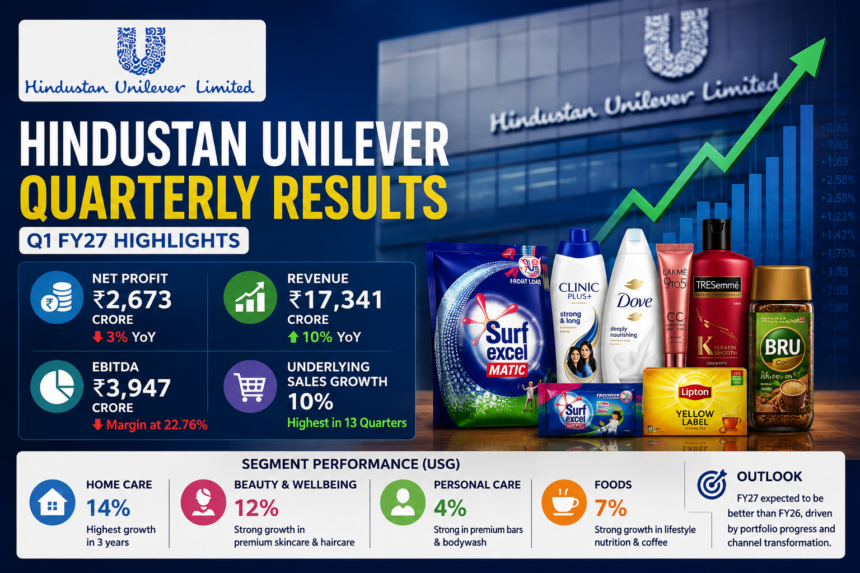
- Net Profit: ₹2,673 crore (down 3% YoY)
- Revenue/Total Income: ₹17,341 crore (up 10% YoY)
- Turnover: ₹17,184 crore
- EBITDA: ₹3,947 crore
- EBITDA Margin: 22.76%
- Underlying Sales Growth (USG): 10%
- Highest quarterly growth in the last 13 quarters
Although profits slipped slightly, the company managed to post double-digit revenue growth while maintaining operating margins within its guided range despite an uncertain global business environment.
HUL Net Profit Falls 3% in Q1 FY27
One of the biggest talking points from the Hindustan Unilever Q1 FY27 Results was the slight decline in net profit.
The company reported a consolidated net profit of ₹2,673 crore, compared with ₹2,756 crore in the corresponding quarter last year.
At first glance, the numbers may appear disappointing. However, the decline largely reflects the impact of a one-time tax credit recorded in the previous year’s quarter, making the comparison less straightforward.
Without this exceptional item, HUL’s profitability remains largely stable, supported by higher sales volumes and continued consumer demand across major categories.
Revenue Climbs 10% Year-on-Year
Hindustan Unilever Quarterly Results, While profits saw a modest decline, revenue growth emerged as the biggest positive.
HUL’s total income increased to ₹17,341 crore, up from ₹15,757 crore in Q1 FY26.
A double-digit revenue increase is significant for India’s largest FMCG company, particularly considering the challenging operating environment marked by:
- Commodity inflation
- Global geopolitical uncertainty
- Volatile raw material prices
- Uneven rural demand
The company attributed this impressive performance primarily to strong underlying sales growth and improving consumer demand across both premium and mass-market products.
Highest Growth in 13 Quarters Signals Strong Business Momentum
Perhaps the biggest achievement in the quarter was HUL’s strongest growth performance in over three years.
The company recorded 10% Underlying Sales Growth (USG)—its highest in 13 quarters.
This indicates that the growth wasn’t driven merely by price hikes. Instead, it reflected healthier demand across multiple product categories, improved execution, and expanding market share.
Such broad-based growth is particularly encouraging because it demonstrates that consumers continue purchasing HUL products despite inflationary pressures.
EBITDA Improves While Margins Face Pressure
Hindustan Unilever Quarterly Results, HUL’s operating performance remained resilient during the quarter.
The company reported EBITDA of ₹3,947 crore, showing improvement over the previous year’s operating performance.
However, EBITDA margins declined slightly to 22.76%, compared to 23.1% in the same quarter last year.
Why did margins shrink?
Several factors contributed:
- Rising commodity costs
- Continued palm oil inflation
- Higher input expenses
- Global supply chain uncertainties
Despite these challenges, management highlighted that margins remained comfortably within the company’s guidance.
That suggests HUL has successfully balanced growth investments while maintaining profitability.
Home Care Segment Delivers Outstanding Growth
Among all business divisions, Home Care emerged as the strongest performer.
The segment delivered:
- 14% Underlying Sales Growth
- Highest growth in three years
- Strong volume expansion
- Improved market leadership
Demand remained robust across detergents, fabric care products, and household cleaning solutions.
Importantly, growth was supported by healthy underlying volume gains, indicating increased consumer purchases rather than solely higher pricing.
This reflects improving household consumption trends across India.
Beauty and Wellbeing Business Continues Premium Growth
Hindustan Unilever Quarterly Results, The Beauty and Wellbeing division also delivered an impressive performance.
The segment posted:
- 12% Underlying Sales Growth
- High single-digit volume growth
- Double-digit growth in premium skincare
- Strong performance in haircare products
Consumers continue shifting toward premium personal care products, benefiting HUL’s expanding portfolio.
Higher disposable incomes, increasing beauty awareness, and premiumisation trends continue supporting long-term growth for this business.
Personal Care Business Maintains Steady Momentum
The Personal Care segment reported 4% Underlying Sales Growth.
Although growth was relatively slower compared to Home Care and Beauty, several bright spots stood out.
These included:
- Strong premium soap demand
- Continued leadership in Bodywash
- Pricing-led growth
- Stable consumer demand
Palm oil inflation continued to impact production costs, requiring selective price adjustments.
Nevertheless, premium product demand remained resilient, helping offset cost pressures.
Foods Business Remains Consistent Performer
HUL’s Foods business continued to generate healthy growth.
The segment recorded 7% Underlying Sales Growth, supported by:
- Mid-single-digit volume growth
- Strong lifestyle nutrition sales
- Robust coffee demand
- Expanding ready-to-drink beverage portfolio
One of the standout performers was coffee.
Premium offerings such as Bru Gold continued witnessing strong consumer acceptance, while ready-to-drink beverages also experienced healthy expansion.
Meanwhile, premium tea maintained stable volume growth despite evolving consumer preferences.
Management Remains Confident About India’s Consumer Story
Hindustan Unilever Quarterly Results, CEO and Managing Director Priya Nair expressed confidence in the Indian economy despite global uncertainties.
According to management, India continues demonstrating resilience due to supportive fiscal policies, improving macroeconomic conditions, and stable consumer demand.
The leadership credited the company’s performance to:
- Strong brands
- Improved competitiveness
- Effective portfolio management
- Consistent execution
- Focus on premiumisation
- Volume-led growth strategy
The company believes these strengths position HUL well for sustained long-term growth.
Commodity Inflation Continues to Challenge Margins
Although revenue growth remained impressive, commodity inflation continues to be one of HUL’s biggest concerns.
Management specifically highlighted:
- Palm oil inflation
- Raw material price volatility
- Global geopolitical developments
- Cost inflation across multiple categories
These factors are expected to remain elevated in the near term.
However, HUL believes its pricing strategy, operational efficiencies, and product mix improvements will help mitigate the impact.
FY27 Outlook Remains Positive
Despite global uncertainties, HUL maintained an optimistic outlook for the remainder of FY27.
The company expects business conditions to improve compared to FY26.
Several factors support this confidence:
- Stable domestic demand
- Portfolio transformation
- Strong distribution network
- Channel modernisation initiatives
- Continued premiumisation
- Improving rural recovery
HUL also stated that it will continue prioritising competitive, volume-led revenue growth rather than relying solely on price increases.
Regarding profitability, management expects EBITDA margins to remain broadly within the guided range despite ongoing inflation.
Market Reaction to Hindustan Unilever Q1 FY27 Results
Hindustan Unilever Quarterly Results, Despite reporting strong revenue growth, investors reacted cautiously to the quarterly earnings.
Following the announcement, HUL shares declined around 3.19%, trading near ₹2,105.30 on the National Stock Exchange.
The market’s negative reaction appeared to reflect concerns over:
- Declining net profit
- Margin contraction
- Persistent commodity inflation
- Near-term earnings pressure
However, many long-term investors may view the strong underlying sales growth and improving volumes as encouraging indicators for future performance.
What Investors Should Watch Going Forward
Several factors will determine HUL’s performance over the coming quarters.
Investors should closely monitor:
- Commodity price movements
- Rural consumption recovery
- Monsoon performance
- Premium product growth
- Inflation trends
- Volume expansion
- Margin stability
- Consumer demand
If raw material costs begin easing while demand remains healthy, HUL could witness stronger earnings growth in upcoming quarters.
Why HUL’s Q1 FY27 Results Matter
The Hindustan Unilever Q1 FY27 Results reinforce the company’s position as India’s leading FMCG player.
Despite operating in a challenging environment, HUL has demonstrated its ability to deliver:
- Double-digit revenue growth
- Strong volume expansion
- Healthy market leadership
- Premium portfolio growth
- Stable operating performance
While short-term profitability remains under pressure from inflation, the company’s long-term fundamentals remain solid.
Its diversified product portfolio, strong distribution network, trusted brands, and disciplined execution continue to provide a competitive advantage in India’s rapidly evolving consumer market.
Read More: Tata Power Quarterly Results: Net Profit Rises 11% Despite Margin Contraction, Revenue Up 5.6%
Conclusion
The Hindustan Unilever Quarterly Results present a balanced picture of resilience and cautious optimism. Although consolidated net profit slipped 3% year-on-year due to a high base and the absence of a one-time tax benefit, the company’s 10% revenue growth and strongest underlying sales performance in 13 quarters highlight the strength of its business model.
Robust growth across Home Care, Beauty & Wellbeing, and Foods demonstrates that consumer demand remains healthy, while premiumisation and volume-led expansion continue to support long-term growth. Margin pressures from commodity inflation remain a concern, but HUL has managed to keep profitability within its guided range through disciplined cost management.
Looking ahead, the company remains confident that improving economic conditions, portfolio transformation, and continued focus on competitive growth will help it outperform FY26. For investors, HUL continues to represent a fundamentally strong FMCG leader, though near-term market sentiment may remain influenced by inflation trends and margin performance.