
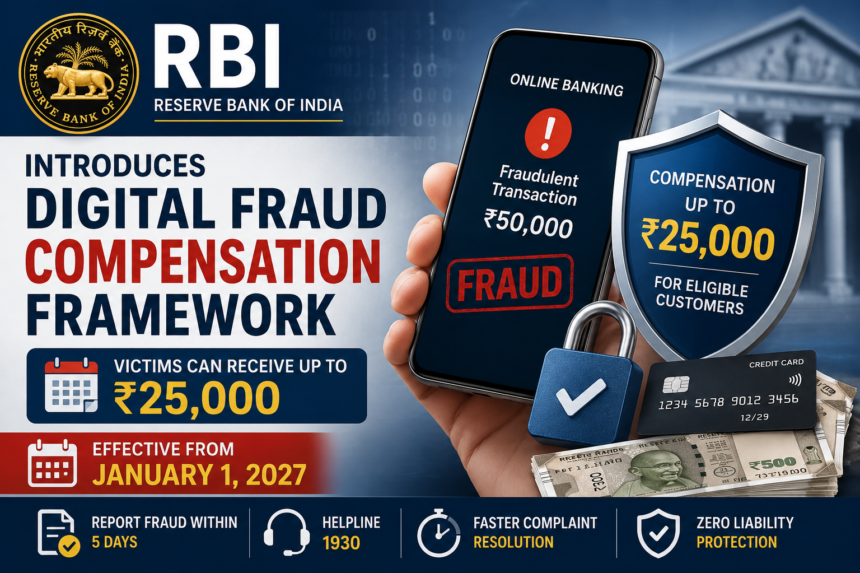
RBI Digital Fraud Compensation 2027, India’s digital payment ecosystem has transformed the way people manage money. From UPI transfers and mobile banking to credit cards and internet banking, financial transactions have become faster than ever. However, this rapid digital growth has also created opportunities for cybercriminals, leading to a steady rise in online banking fraud.
Although the framework was initially expected to take effect on July 1, 2026, the RBI has postponed its implementation by six months. The new regulations will now apply to fraudulent electronic banking transactions carried out on or after January 1, 2027.
Here’s everything you need to know about the RBI’s latest digital banking fraud compensation policy.
What Is the RBI’s New Fraud Compensation Framework?
The RBI’s newly finalized framework introduces a structured compensation mechanism for customers who lose money due to fraudulent electronic banking transactions.
Under the new rules, eligible victims can receive compensation of up to Rs 25,000 for digital fraud involving losses of up to Rs 50,000. The initiative is designed to reduce the financial burden on customers while encouraging quicker reporting of fraud incidents.
However, the compensation is not automatic. Customers must meet specific eligibility requirements before they can receive financial assistance.
Implementation Delayed Until January 2027
RBI Digital Fraud Compensation 2027, The RBI has decided to postpone the rollout of the framework by six months.
Instead of becoming effective on July 1, 2026, the new compensation rules will now come into force on January 1, 2027.
Only fraudulent electronic banking transactions that occur on or after this date will fall under the revised compensation mechanism.
The additional preparation period gives banks more time to upgrade security systems, establish better reporting channels, and ensure they are fully prepared to comply with the new regulatory requirements.
Who Can Claim Compensation?
The framework primarily benefits individual customers and sole proprietors who become victims of electronic banking fraud.
To qualify for compensation, customers must satisfy two important conditions:
- Report the fraudulent transaction to their bank within five calendar days.
- Report the same incident to the National Cyber Crime Reporting Portal or call Helpline 1930 within the same five-day period.
Missing this reporting deadline could affect eligibility under the compensation scheme.
The RBI has emphasized that quick reporting significantly improves the chances of limiting financial losses and tracing fraudulent transactions.
How Much Compensation Will Victims Receive?
RBI Digital Fraud Compensation 2027, The RBI has established a compensation formula based on the value of the financial loss.
Eligible customers will receive either:
- 85% of their net financial loss, or
- Rs 25,000,
whichever amount is lower.
This means compensation has a maximum ceiling of Rs 25,000, even if the eligible calculation exceeds that amount.
An important limitation is that this compensation benefit can only be claimed once during a customer’s lifetime.
How the Compensation Formula Works
The framework includes different calculations depending on the size of the fraud.
For fraud losses below Rs 29,412, customers will receive compensation equal to 85% of the net loss.
The financial responsibility will be shared as follows:
- RBI will contribute 65%.
- The customer’s bank will contribute 10%.
- The beneficiary bank will contribute another 10%.
For fraud losses ranging from Rs 29,412 to Rs 50,000, where the compensation reaches the maximum limit of Rs 25,000:
- RBI will contribute Rs 19,118.
- The customer’s bank will contribute Rs 2,941.
- The beneficiary bank will contribute Rs 2,941.
This cost-sharing model spreads the financial responsibility among the institutions involved.
Special Rules for Cross-Border Fraud
RBI Digital Fraud Compensation 2027, Cross-border digital fraud cases follow a slightly different compensation arrangement.
In such situations:
- RBI will contribute Rs 19,118.
- The customer’s bank will contribute Rs 5,882.
These provisions recognize the additional complexity involved when fraudulent transactions extend beyond India’s banking network.
What About Fraud Above Rs 50,000?
One notable aspect of the framework is that it does not specify compensation for fraudulent transactions involving losses exceeding Rs 50,000.
The current policy focuses only on smaller-value digital banking frauds.
Customers experiencing larger financial losses may still have access to other legal remedies or protections depending on the circumstances, but the new compensation framework itself does not outline any reimbursement mechanism for amounts above the Rs 50,000 threshold.
Zero Liability Protection Continues
RBI Digital Fraud Compensation 2027, The RBI has also reaffirmed its existing zero-liability policy for customers under certain situations.
If a fraudulent transaction occurs because of negligence or deficiencies on the part of the bank, customers will not be held financially responsible.
This protection applies regardless of when the customer reports the fraud.
Similarly, customers will continue to enjoy zero liability in cases involving third-party security breaches, provided the unauthorized transaction is reported within five calendar days.
One significant clarification in the updated rules is that the burden of proving customer liability rests with the bank.
In other words, banks—not customers—must demonstrate if a customer was responsible for the loss.
What Counts as Bank Negligence?
The RBI has expanded the definition of bank negligence to improve customer protection.
Examples include:
- Failure to implement required security measures.
- Failure to send mandatory transaction alerts.
- Lack of 24×7 fraud reporting facilities.
- Delays in responding to customer complaints.
- Internal fraud within the bank.
- Security breaches.
- Technical system failures that enable unauthorized transactions.
If any of these failures contribute to fraud, customers may qualify for complete protection under the zero-liability provisions.
New Responsibilities for Banks
RBI Digital Fraud Compensation 2027, The revised framework places greater accountability on banks.
Financial institutions must strengthen customer support and fraud prevention by introducing several mandatory measures.
Banks will now be required to:
- Offer 24-hour reporting channels for fraudulent transactions.
- Provide round-the-clock facilities to report lost debit or credit cards.
- Send instant SMS alerts for every electronic banking transaction exceeding Rs 500.
- Send email notifications wherever customers have registered email addresses.
These steps are intended to help customers detect suspicious activity almost immediately, allowing faster action against fraud.
Think of transaction alerts as a home’s security alarm. The quicker you’re notified that something is wrong, the better your chances of preventing further damage.
Faster Complaint Resolution Timelines
Waiting months for a fraud investigation can make an already stressful situation even worse.
To address this, the RBI has established clear timelines for banks to resolve complaints.
For domestic fraud cases:
- Banks must investigate and provide a final response within 45 calendar days.
For cross-border fraud cases:
- Banks have up to 60 calendar days to complete the process.
These deadlines aim to create greater transparency and consistency in handling fraud-related complaints.
Relief for Credit Card Fraud Victims
RBI Digital Fraud Compensation 2027, The new framework also introduces an important safeguard for credit card users.
When customers report fraudulent credit card transactions, banks must provide a “shadow reversal” equal to the disputed amount within five calendar days of receiving the complaint.
During the investigation period:
- Customers will not be charged additional interest.
- No penalty charges will accumulate on the disputed amount.
This temporary reversal offers immediate financial relief while banks investigate the complaint.
Why Prompt Reporting Matters
Time is one of the most important factors in combating digital fraud.
Every minute after an unauthorized transaction creates additional opportunities for criminals to move funds across multiple accounts.
By requiring customers to report fraud to both their bank and the National Cyber Crime Reporting Portal—or by calling Helpline 1930—within five days, the RBI aims to improve recovery efforts and strengthen coordination among banks, law enforcement agencies, and cybercrime investigators.
Quick reporting benefits not only individual victims but also the broader financial ecosystem by helping authorities identify emerging fraud patterns.
How the New Rules Could Improve Digital Banking Confidence
India continues to witness record growth in digital payments. Millions of people now rely on online banking every day for shopping, bill payments, investments, and money transfers.
As digital adoption expands, customer confidence becomes just as important as technological innovation.
The RBI’s updated compensation framework reflects an effort to balance convenience with accountability. By introducing clearer compensation rules, expanding zero-liability protections, requiring stronger security measures, and setting strict complaint resolution timelines, the central bank is reinforcing safeguards for digital banking users.
While the compensation cap may not cover every possible financial loss, the framework represents a structured approach to protecting consumers and encouraging better fraud management across the banking sector.
Conclusion
RBI Digital Fraud Compensation 2027, The RBI’s finalized compensation framework marks an important step toward strengthening consumer protection in India’s digital banking landscape. From January 1, 2027, eligible victims of electronic banking fraud involving losses of up to Rs 50,000 may receive compensation of up to Rs 25,000, provided they report the incident promptly to both their bank and the National Cyber Crime Reporting Portal or Helpline 1930.
Beyond financial compensation, the framework also introduces stronger obligations for banks, including instant transaction alerts, 24×7 fraud reporting channels, quicker complaint resolution, and continued zero-liability protection in qualifying cases. Together, these measures aim to improve customer confidence while encouraging faster action against digital fraud.