
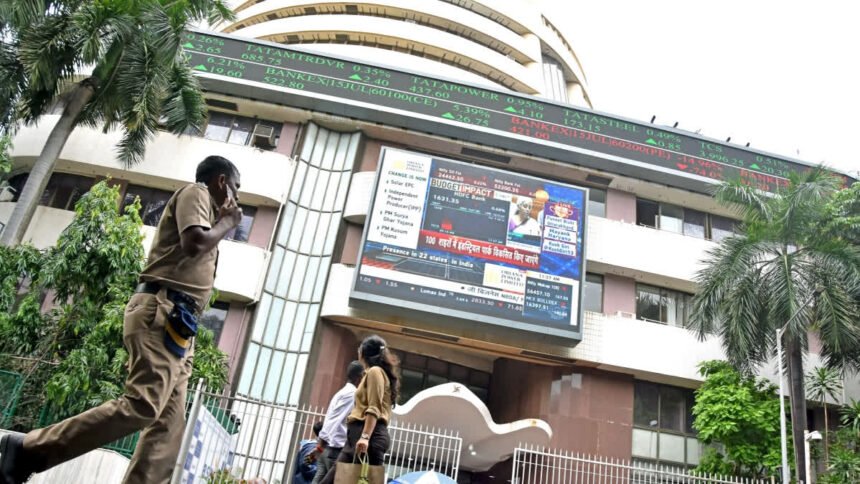
SEBI Closing Auction Session, India’s benchmark stock indices ended Monday firmly in positive territory, but something unusual happened at the closing bell. The Nifty 50 and BSE Sensex, which normally move closely together, recorded a striking divergence in their closing gains as Indian stock exchanges implemented a new mechanism for determining closing prices in stocks linked to futures and options contracts.
The Nifty 50 finished the session at 24,774.30, gaining 1.6%, while the BSE Sensex ended at 78,639.03, up 0.7%. Both benchmarks advanced, yet the considerable difference between their percentage gains immediately caught the market’s attention.
Why did two indices that usually travel along roughly the same road suddenly appear to take different lanes?
The answer may lie in India’s newly introduced Closing Auction Session (CAS). The mechanism changes how the official closing prices of eligible securities are determined and represents an important shift in India’s equity-market structure.
The Nifty Sensex Divergence came during an otherwise upbeat day for Indian equities, making the unusual movement between the two benchmark indices particularly noteworthy. Despite the Nifty Sensex Divergence, falling crude oil prices, positive corporate earnings sentiment, and strong information technology stocks supported the broader market rally. The Nifty Sensex Divergence also stood out because all 16 major sectors advanced, while mid-cap and small-cap indices posted healthy gains. With broad-based buying supporting Indian equities, the Nifty Sensex Divergence became one of the most closely watched developments of the trading session.
So, while investors had plenty of reasons to celebrate Monday’s rally, the closing-price discrepancy created a fresh question for traders, analysts and market participants: Was the divergence simply an early consequence of adapting to the new auction system?
Nifty 50 Jumps 1.6% While Sensex Gains 0.7%
The headline numbers tell the story.
At the end of Monday’s session, the Nifty 50 stood at 24,774.30, representing a gain of 1.6%. The BSE Sensex closed at 78,639.03, rising 0.7%.
On an ordinary trading day, a difference in performance between the two benchmarks is hardly shocking. After all, the indices do not contain exactly the same stocks or use identical constituent structures.
What made Monday different was the size and timing of the divergence.
The displayed Nifty level was the official closing level, according to a source familiar with the matter. Importantly, the source also indicated that there was no trading glitch.
That distinction matters.
Whenever a major benchmark suddenly behaves in an unexpected way, investors naturally wonder whether there has been a technical failure, incorrect data feed or exchange-related problem. In this case, however, the unusual close appeared to be connected to the mechanics of the end-of-session pricing process rather than a straightforward system malfunction.
And Monday was not just another day in India’s stock market. It was the first day of a significant change to how closing prices are established for an important group of securities.
What Is SEBI’s New Closing Auction Session?
The key development behind Monday’s unusual market close was the implementation of the Closing Auction Session, commonly referred to as CAS.
The new system applies to stocks in the futures and options segment and replaces the earlier approach used to establish closing prices.
Under the previous framework, the closing price of relevant securities was based on the volume-weighted average price of trades executed during the final 30 minutes of continuous trading.
In simple terms, the market did not rely on one final transaction to decide where a stock had officially closed. Instead, it looked at trading activity over the last half-hour and calculated a price that reflected both transaction prices and trading volumes.
CAS changes that process.
Under the new mechanism, eligible buy and sell orders submitted around the end of the trading session are brought together in an auction. Those orders are then matched at a single auction price, and the price generated through that process becomes the stock’s official closing price.
Think of the old system as taking an average photograph of the market over 30 minutes. The new system is closer to gathering everyone in one room at the end of the day and asking buyers and sellers to agree on one clearing price.
That may sound like a technical adjustment, but closing prices carry enormous significance across modern financial markets.
Why Closing Prices Matter So Much to Investors
SEBI Closing Auction Session, the closing price might look like nothing more than the final number displayed next to a stock at the end of the trading day.
In reality, it can play a much larger role.
Closing prices are widely used as reference points for portfolio valuations, benchmark calculations, index tracking, derivatives, investment-fund reporting and performance measurement. They can influence how investors assess daily returns and how financial institutions value positions at the end of a session.
That means the process used to establish an official close needs to be robust.
Imagine trying to determine the final score of a match by averaging what happened during the last 30 minutes. That approach can provide a reasonable picture, but it may not perfectly capture where the contest stood at the final whistle.
A closing auction works differently. It attempts to concentrate available buying and selling interest into one organized price-discovery event at the end of the session.
The objective is not simply to create a different number. The goal is to establish a closing price through a process designed to bring end-of-day liquidity together.
Why India Introduced the Closing Auction Mechanism
The central purpose of the new system is to make the closing-price discovery process fairer and more transparent.
Previously, closing prices for eligible stocks depended on trading throughout the final 30 minutes of continuous market activity. Under CAS, end-of-day liquidity is instead concentrated into a single auction process.
This concentration can potentially provide a clearer snapshot of where buyers and sellers are prepared to transact at the close.
Markets are essentially giant price-discovery machines. Millions of decisions—buy, sell, hold or wait—are continuously translated into prices. But the official closing price is particularly important because it becomes the market’s final reference point for that trading day.
By gathering end-of-session demand and supply into an auction, the system aims to allow those forces to interact more directly at a single clearing price.
The principle is straightforward: rather than deriving the close from a rolling period of continuous trading, create a dedicated closing event where available orders determine the final official price.
Monday provided the market with an early real-world test of that framework.
Did the Closing Auction Cause the Nifty-Sensex Divergence?
The timing naturally placed the new mechanism under the spotlight.
Siddhartha Khemka, head of research for wealth management at Motilal Oswal Financial Services, indicated that the divergence appeared to have resulted from a single end-of-session price movement.
Market participants were seeking further clarification and attempting to determine whether the unusual movement was specifically connected with the Closing Auction Session.
This is an important distinction.
A new market mechanism can alter the way end-of-day prices are discovered without necessarily changing the underlying economic value of the companies represented by an index.
In other words, the unusual Nifty-Sensex relationship at the close does not automatically mean that something fundamental suddenly changed across corporate India.
It could instead reflect how individual constituent stocks were priced during the closing process and how those prices subsequently affected benchmark calculations.
The first few sessions under a new market structure are therefore likely to attract close attention from institutional investors, traders and analysts.
When the rules governing the closing bell change, people naturally watch the clock more carefully.
Nifty Reaches a Five-Month High
SEBI Closing Auction Session, The benchmark divergence should not overshadow the broader direction of Monday’s market.
Indian equities had a strong session.
The Nifty 50 finished at a five-month high, while the Sensex reached its highest closing level in more than three months. Monday also marked the fourth consecutive session of gains for the country’s major equity benchmarks.
That winning streak suggests the rally was supported by more than an isolated closing-price adjustment.
Several positive factors combined to lift investor sentiment, including a sharp decline in crude oil prices, encouraging developments during the corporate earnings season and gains in technology shares.
The broader market participated as well.
India’s small-cap index advanced approximately 1.3%, while the mid-cap index gained around 1.2%.
This is significant because a rally extending beyond a small collection of heavyweight companies often indicates stronger market breadth.
And Monday’s breadth was particularly notable: all 16 major sectors finished higher.
For investors, that paints a much more comprehensive picture of the session than the benchmark divergence alone.
Lower Brent Crude Prices Give Indian Stocks a Major Boost
One of the most important drivers behind Monday’s optimism was the sharp fall in global oil prices.
Brent crude dropped around 5% to $83.55 per barrel.
For India, lower oil prices can be particularly important because the country relies heavily on imported energy. When crude becomes cheaper, investors may anticipate less pressure from the cost of energy imports and potentially improved conditions for businesses exposed to fuel and transportation expenses.
Oil functions almost like a hidden tax across many parts of the economy. It affects transportation, manufacturing, logistics and a wide range of operating costs.
When crude prices climb sharply, those costs can spread through the economy like ripples across water. When oil falls, some of that pressure can ease.
That is why movements in international crude markets are watched so carefully by Indian equity investors.
Monday offered a clear example of this relationship. The steep decline in Brent helped improve sentiment across domestic equities and contributed to the broad-based advance.
Trump’s Iran Talks Comments Influence Oil Markets
The drop in Brent crude followed comments from U.S. President Donald Trump regarding talks with Iran.
Trump said discussions with Iran would take place on Monday, although he did not specify a deadline for reaching an agreement.
Oil markets are highly sensitive to geopolitical developments, particularly when they involve major energy-producing regions.
Even a change in expectations surrounding negotiations can influence the geopolitical risk premium embedded in crude prices. Traders constantly assess whether political developments could threaten oil supply or reduce the probability of disruption.
In Monday’s case, the prospect of talks contributed to a substantial decline in Brent crude.
That movement then fed into Indian market sentiment.
It is a useful reminder of how interconnected global financial markets have become. A political statement involving Washington and Tehran can influence crude prices, which can then affect investor behaviour thousands of kilometres away in Mumbai.
Global markets are less like separate islands and more like rooms connected by the same electrical wiring. A switch in one room can cause the lights to flicker somewhere else.
Information Technology Stocks Lead Monday’s Rally
SEBI Closing Auction Session, While falling oil prices helped the broader market, information technology stocks were Monday’s strongest sectoral performers in India.
The Nifty IT index surged approximately 3.3%, making technology the top-performing major sector of the session.
The move provided substantial support to the broader market rally.
Technology companies carry meaningful weight in India’s major equity benchmarks, so strong performance across the IT sector can have a visible impact on index movements.
The rally was particularly interesting because technology sentiment elsewhere in Asia was far less positive.
While Indian IT shares climbed, significant losses in major chip stocks weighed heavily on South Korea’s equity market.
The contrast illustrates an important lesson for investors: even when markets belong to the same broad sector or geographic region, they do not necessarily move together.
Domestic company exposure, investor positioning, valuation, earnings expectations and index composition can all produce dramatically different outcomes.
South Korea’s Kospi Falls as Chip Stocks Come Under Pressure
The upbeat mood in India stood in sharp contrast to trading in South Korea.
Losses among important semiconductor stocks pushed the Kospi down approximately 5%.
That was a dramatic move, especially compared with the strong performance of Indian IT shares.
At first glance, this might appear contradictory. If technology stocks were under pressure in one major Asian market, why did Indian IT companies rally?
Because “technology” is an enormous umbrella.
A semiconductor manufacturer, an IT services provider and a software company may all be described as technology businesses, but their revenue models, customers, cost structures and market drivers can be very different.
The divergent performance therefore highlights why investors need to look beyond broad sector labels.
Monday’s Asian trading session showed that technology sentiment was not moving in one uniform direction. Indian IT shares emerged as clear winners even as semiconductor weakness created significant pressure elsewhere in the region.
All 16 Major Indian Sectors Finish in Positive Territory
Another encouraging feature of Monday’s trading session was the breadth of the advance.
All 16 major sectors gained.
That matters because benchmark indices can occasionally rise even when much of the market is weak. A handful of large companies with heavy index weightings can pull the headline index higher while many smaller stocks decline.
That was not the picture on Monday.
Gains across every major sector suggested that positive sentiment was distributed widely through the market.
Meanwhile, the small-cap index rose 1.3% and the mid-cap index advanced 1.2%, reinforcing the broad nature of the rally.
Broad participation can be useful for understanding market psychology. When investors are willing to buy across large-cap, mid-cap and small-cap segments simultaneously, it suggests that optimism is not confined to one narrow corner of the market.
Of course, a single session cannot establish a lasting trend. But Monday’s performance provided clear evidence that risk appetite was strong during the day.
Why Nifty and Sensex Do Not Always Move Identically
For investors wondering how the Nifty could rise 1.6% while the Sensex gained only 0.7%, it helps to remember that the two indices are related but not identical.
The Nifty 50 contains 50 major companies, while the Sensex tracks 30 prominent companies listed on the BSE.
There is considerable overlap between them, which is why their movements are often similar. But differences in constituents and index weightings mean their returns will not always match exactly.
Suppose two baskets contain many of the same fruits, but one basket has more apples while the other has more oranges. If apple prices suddenly jump, the value of the first basket will change more dramatically.
Stock indices work in a similar way.
A significant price move in a heavily weighted Nifty constituent can affect the Nifty differently from the Sensex depending on the stock’s presence and weight in each benchmark.
The new closing auction adds another variable to that relationship because official closing prices for eligible securities are now being determined through a different mechanism.
That makes end-of-day index behaviour particularly interesting as the market adapts to CAS.
How CAS Changes End-of-Day Price Discovery
The shift from a volume-weighted 30-minute calculation to a closing auction represents more than a cosmetic adjustment.
It changes the structure of end-of-day price discovery.
Previously, investors knew that trading activity across the final half-hour contributed to the official close. Large orders executed during that window could influence the volume-weighted calculation depending on both price and volume.
Under CAS, attention moves toward the dedicated auction period.
Buyers indicate where they are willing to purchase shares. Sellers indicate where they are willing to sell. The mechanism then seeks a single price at which those orders can be matched according to the applicable auction process.
For traders, this means the close becomes a more distinct market event.
Instead of thinking about the final price primarily as an average of recent trading activity, investors must increasingly view the official close as the outcome of concentrated end-of-session demand and supply.
That distinction may become especially important for institutional investors managing large portfolios or executing strategies linked to official closing prices.
What the New Mechanism Could Mean for Market Participants
Any major change in market structure requires an adjustment period.
Traders may need to modify execution strategies. Institutional investors may reassess how they place large end-of-day orders. Analysts may pay closer attention to auction-generated closing prices, while index investors may monitor how the mechanism affects benchmark calculations.
None of this necessarily means that CAS will regularly produce dramatic benchmark divergences.
Monday was the mechanism’s first day, making it far too early to draw sweeping conclusions about its long-term effects.
Still, the session demonstrates why implementation details matter.
Markets are built not only on companies, earnings and economic forecasts but also on infrastructure: order types, settlement systems, trading windows, auction rules and price-discovery mechanisms.
These details normally operate quietly in the background.
But when something unusual happens—such as a sharp divergence between two closely followed benchmarks—the machinery suddenly becomes visible.
It is a bit like noticing the gears inside a clock only when the hands move differently than expected.
Investors May Watch Closing Prices More Closely
The immediate focus will likely remain on how the new mechanism performs over subsequent trading sessions.
If Nifty and Sensex returns return to their more familiar relationship, Monday’s unusual divergence may ultimately be viewed primarily as an early adjustment to the new closing framework.
If unusual end-of-session moves occur repeatedly, market participants may examine the auction process more closely.
Either way, investors should avoid interpreting every closing-price movement as evidence of a technical problem.
Monday’s display Nifty level was identified as the official closing level, and the available information indicated that there was no trading glitch.
That makes the distinction between an “unexpected outcome” and an “incorrect outcome” particularly important.
Markets can behave unexpectedly while still operating according to their rules.
A Strong Session Beyond the Benchmark Anomaly
It would be easy to focus exclusively on the Nifty-Sensex divergence, but doing so would miss the larger story.
Indian equities had a notably positive session.
The Nifty gained 1.6%, reached a five-month high and extended the market’s winning streak to four sessions. The Sensex rose 0.7% and finished at its strongest level in more than three months.
Small-cap and mid-cap stocks participated in the advance. Every major sector closed higher. Information technology shares surged, and the decline in crude oil prices provided another supportive macroeconomic signal.
In other words, the unusual closing mechanics were only one part of Monday’s market story.
The broader message was one of widespread buying and improving sentiment.
Whether that momentum can continue will depend on the factors investors watch every day: corporate earnings, global markets, crude oil, geopolitics, foreign and domestic capital flows, and economic expectations.
Now there is another item on that list—the behaviour of the new closing auction.
Why Monday Could Be an Important Day for India’s Market Structure
Market milestones are not always dramatic crashes, record highs or billion-dollar deals.
Sometimes, an important change arrives through a technical reform that most retail investors barely notice.
The launch of the Closing Auction Session falls into that category.
Changing the method by which official closing prices are determine can influence trading behaviour around one of the most important moments of the market day.
Closing prices are reference points. They appear in financial reports, investor portfolios, benchmark calculations and countless market screens. Improving the process through which those prices are discover therefore has significance well beyond the final few minutes of trading.
Monday’s divergence gave CAS an unusually high-profile debut.
Instead of quietly entering the machinery of India’s capital markets, the mechanism immediately became part of a broader discussion about why the country’s two flagship benchmarks displayed noticeably different gains.
That attention may ultimately help investors understand a part of market infrastructure that normally receives little public discussion.
What Should Investors Take Away From the Nifty-Sensex Divergence?
Retail investors should keep the development in perspective.
First, both major indices ended higher. The divergence concerned the magnitude of their gains, not the overall direction of the market.
Second, the Nifty’s displayed figure was its official closing level, according to the information available, and there was no reported trading glitch behind the number.
Third, the market was operating under a newly introduced closing-price mechanism for eligible futures and options stocks.
Finally, broader market indicators remained strongly positive. All major sectors gained, mid-cap and small-cap indices advanced and IT stocks delivered particularly strong performance.
The takeaway, therefore, is not that the Indian market suddenly became disconnected or unreliable.
Rather, Monday showed how a change in market microstructure can influence headline index behaviour, particularly around the closing bell.
Investors may need some time to become familiar with how CAS affects closing prices, just as markets have historically adapted to other changes in trading systems and regulations.
Read More: Hindustan Unilever Quarterly Results: Revenue Jumps 10% in Q1 FY27
Conclusion
SEBI Closing Auction Session, India’s stock market delivered a memorable session as the Nifty 50 and BSE Sensex recorded an unusual divergence following the introduction of the new Closing Auction Session. The Nifty climbed 1.6% to 24,774.30, while the Sensex gained 0.7% to finish at 78,639.03. Although the difference attracted attention, the available information indicated that the Nifty figure represented the official close and that there was no trading glitch. The launch of CAS, which replaces the previous 30-minute volume-weighted closing-price methodology for eligible futures and options stocks with a single-price auction, placed market microstructure firmly in the spotlight. Beyond that technical development, Monday was overwhelmingly positive for Indian equities: the benchmarks extended their winning run, Brent crude fell sharply, all 16 major sectors advanced, IT stocks surged 3.3%, and mid-cap and small-cap shares participated in the rally.