
8th Pay Commission Salary Hike, The upcoming 8th Pay Commission has once again become a major talking point among central government employees, especially those working in the Indian Railways. As discussions around salary revisions continue to gain momentum, employee associations have started presenting their expectations and recommendations to the commission.
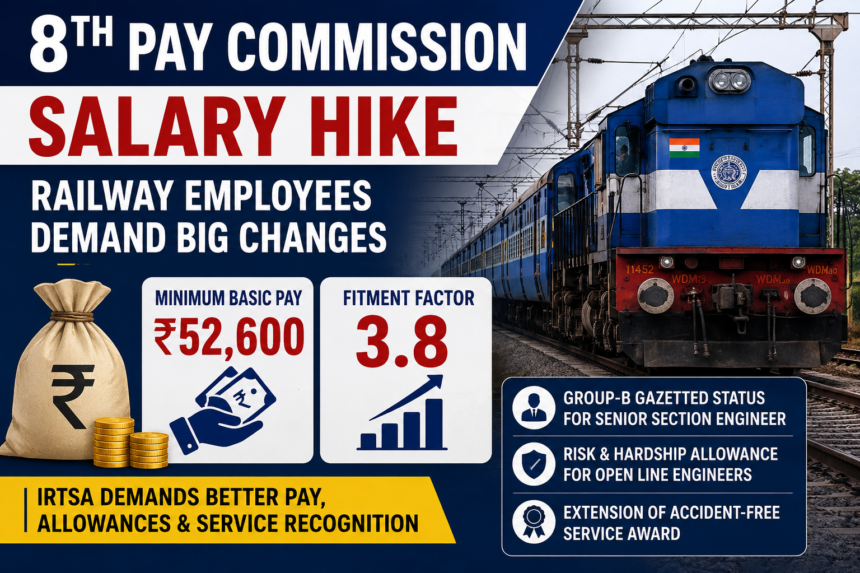
Among the latest organizations to submit its demands is the Indian Railways Technical Supervisors’ Association (IRTSA). The association has called for a significant increase in the minimum basic salary to Rs 52,600, along with an 8th Pay Commission fitment factor of 3.8. Apart from salary revisions, IRTSA has also sought several changes related to employee benefits, promotions, risk allowances, and service recognition. The proposed 8th Pay Commission fitment factor is expect to play a crucial role in determining revised salaries for central government employees if it is accept by the commission.
Although the government has not take any decision yet, these proposals are expect to become part of the broader consultation process before the 8th Pay Commission submits its recommendations to the Central Government.
What Is the 8th Pay Commission?
The 8th Central Pay Commission has been constituted to review the salaries, pensions, and allowances of central government employees and pensioners across India. Like previous pay commissions, its primary objective is to recommend a revised compensation structure that reflects current economic conditions, inflation, and changing job responsibilities.
Every Pay Commission has historically played a crucial role in improving the financial well-being of millions of government employees. The 8th Pay Commission is expected to continue that tradition by evaluating demands from various employee unions, departments, and stakeholder groups before preparing its final report.
Railway Employees Seek Rs 52,600 Minimum Basic Salary
8th Pay Commission Salary Hike, One of the headline demands made by IRTSA is a revision of the minimum basic pay to Rs 52,600. The association believes that the current salary structure no longer matches today’s economic realities, rising inflation, and the increasing responsibilities carried by railway technical staff.
According to the association, a higher minimum salary would better reflect the expertise, technical skills, and workload handled by railway engineers and supervisors. They argue that employees responsible for maintaining one of the world’s largest railway networks deserve compensation that keeps pace with the cost of living.
Why Is the 3.8 Fitment Factor So Important?
Perhaps the most closely watched demand is the proposal for a fitment factor of 3.8.
The fitment factor is the multiplier used to calculate revise basic salaries under a new Pay Commission. Simply put, it determines how much an employee’s existing basic pay will increase after implementation.
For example, if the commission accepts a higher fitment factor, employees across various pay levels would receive significantly larger salary revisions. This is why government employees across departments are paying close attention to discussions surrounding the proposed multiplier.
Employee organizations believe that a 3.8 fitment factor would provide a more realistic salary adjustment in view of inflation and changing economic conditions.
IRTSA Pushes for Group-B Gazetted Status
Salary isn’t the only issue raise by the association.
IRTSA has also request that the post of Senior Section Engineer (SSE) be classifi under Group-B Gazette status. According to the association, technical supervisors shoulder substantial responsibilities involving railway safety, infrastructure maintenance, inspections, and engineering operations.
Granting Group-B Gazetted status, they argue, would better recognize the professional role and administrative responsibilities of Senior Section Engineers while also improving career progression opportunities.
Demand for Risk and Hardship Allowances
8th Pay Commission Salary Hike, Working on India’s railway network often involves challenging environments and considerable risks.
Recognizing these conditions, IRTSA has request that risk and hardship allowances be extended to open line engineers and technical staff.
Employees working directly on railway tracks, electrical systems, maintenance zones, and operational infrastructure frequently perform duties under demanding circumstances. The association believes these working conditions justify additional financial compensation similar to allowances available in other high-risk government services.
Extension of Accident-Free Service Awards
Another important recommendation focuses on rewarding employees who contribute to railway safety.
IRTSA has proposed extending the Accident-Free Service Award to eligible engineers and technical employees. Such recognition, according to the association, would encourage higher safety standards while acknowledging the consistent efforts of employees who help maintain accident-free operations over extended periods.
In an industry where operational safety is critical, rewarding exemplary service could also boost employee morale and motivation.
Growing List of Demands Before the 8th Pay Commission
8th Pay Commission Salary Hike, IRTSA is not the only organization approaching the commission.
Over the past several months, multiple associations representing different categories of central government employees have submitted recommendations covering:
- Higher minimum salaries
- Improved fitment factors
- Better pension benefits
- Revised allowances
- Career progression reforms
- Promotion policies
- Employee welfare measures
This broad participation reflects the high expectations surrounding the 8th Pay Commission and its potential impact on millions of employees and pensioners.
No Final Decision Has Been Taken Yet
Despite growing discussions and widespread speculation, it is important to note that no decision has been take on IRTSA’s proposals.
The commission is currently expect to collect representations from various stakeholders before evaluating each recommendation. Only after reviewing submissions from employee associations, government departments, financial experts, and administrative authorities will the commission prepare its final report for the Central Government.
Therefore, the current demands should be view as proposals rather than confirmed policy changes.
How the Consultation Process Works
The Pay Commission typically follows a structured consultation process before making recommendations.
It examines multiple factors, including:
- Current salary structures
- Inflation trends
- Cost of living
- Fiscal impact on government finances
- Employee responsibilities
- Comparative compensation across departments
- Public administration requirements
Only after balancing employee expectations with the government’s financial capacity does the commission finalize its recommendations.
This process usually takes considerable time, which is why employees may have to wait before any official announcements are made.
Potential Impact on Central Government Employees
8th Pay Commission Salary Hike, If recommendations similar to those propose by employee associations are eventually accept, the financial impact could be significant.
Higher minimum salaries and an increased fitment factor would likely improve take-home pay for many central government employees. Revised allowances could further enhance overall compensation, particularly for staff working in demanding operational roles.
Additionally, changes in promotions, service classifications, and recognition programs could improve long-term career prospects for railway employees.
However, any changes will ultimately depend on the final recommendations approved by the government.
Why Railway Employees Are Watching Closely
The Indian Railways employs one of the largest government workforces in the country. Technical supervisors, engineers, maintenance personnel, and operational staff perform essential functions that directly affect passenger safety and railway efficiency.
Given their responsibilities, many employees believe the upcoming Pay Commission presents an important opportunity to modernize compensation structures and better align salaries with current economic realities.
Whether all these demands are accept remains uncertain, but the discussions have certainly place railway employees at the center of the broader 8th Pay Commission debate.
Read More: 8th Pay Commission Salary Hike India 2026: Expected Pay Revision, Fitment Factor & Pension Update
Conclusion
8th Pay Commission Salary Hike, The demands submitted by the Indian Railways Technical Supervisors’ Association have added fresh momentum to discussions surrounding the 8th Pay Commission. From seeking a minimum basic salary of Rs 52,600 and a 3.8 fitment factor to requesting Group-B Gazetted status, risk allowances, and accident-free service awards, the association has outlined a comprehensive set of proposals aimed at improving the financial and professional standing of railway technical employees.
At present, these remain recommendations under consideration. The commission is expected to continue gathering inputs from various employee groups before presenting its final report to the Central Government. Until official recommendations are released and approved, employees should treat circulating figures as proposals rather than confirmed revisions.