
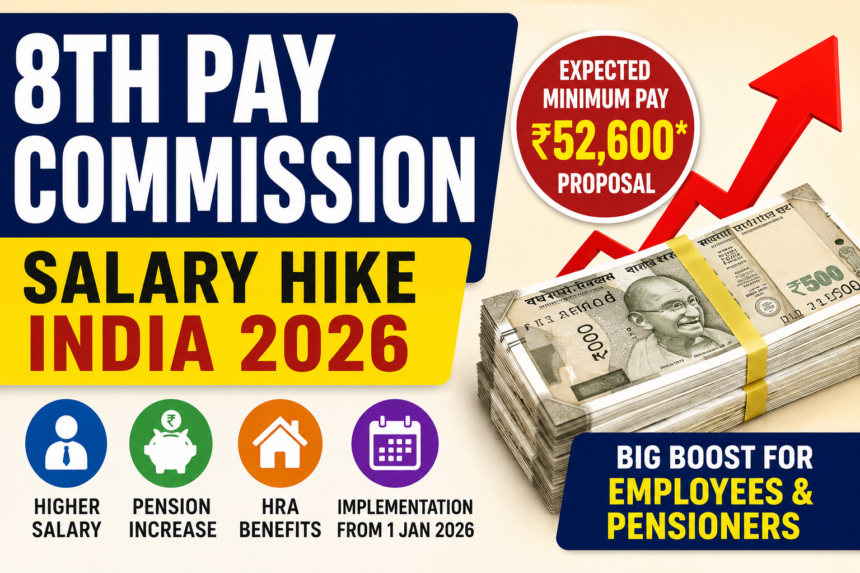
8th Pay Commission salary hike India 2026, For nearly 50 lakh central government employees and around 60 lakh pensioners, few developments matter more financially than a new Pay Commission. The 8th Pay Commission is now at the center of nationwide discussion as employees, pensioners, unions, and analysts wait for the government’s final recommendations on salaries, allowances, and pensions.
If you are a central government employee, railway staff member, defence personnel, or pensioner, understanding the latest proposals is extremely important. The upcoming revisions could significantly impact monthly salaries, pension payouts, arrears, and overall financial planning.
This article explains the latest developments surrounding the 8th Pay Commission, including the proposed minimum salary, the fitment factor debate, expected pay hikes across different levels, pension revisions, and the likely implementation timeline.
What Is the 8th Pay Commission?
The Government of India typically constitutes a Pay Commission every ten years to review and revise the salary structure of central government employees and pensioners.
The 7th Pay Commission was implemented from January 1, 2016. Since nearly a decade has passed since the last major revision, the 8th Pay Commission has been constituted to recommend a new salary framework effective from January 1, 2026.
The commission evaluates several factors before making recommendations, including:
- Inflation and rising cost of living
- Economic growth and fiscal conditions
- Employee welfare and purchasing power
- Pay parity with the private sector
- Government expenditure capacity
Once the commission submits its report and the Union Cabinet approves the recommendations, the revised pay structure becomes applicable across all central government departments.
8th Pay Commission: Major Proposals Under Discussion
Minimum Salary Proposal: Rs 52,600 Demand
One of the biggest demands currently being discussed comes from railway employee unions and central government staff associations. These groups have proposed that the minimum basic salary under the 8th Pay Commission should be increased to Rs 52,600 per month.
At present, the minimum basic pay under the 7th Pay Commission is Rs 18,000. Therefore, the proposed increase represents a massive jump in employee compensation.
However, several government sources suggest that the final minimum pay may realistically fall somewhere between Rs 34,560 and Rs 51,480, depending on the fitment factor ultimately approved by the government.
The final figure will largely depend on the country’s fiscal position, inflation trends, and the government’s budgetary priorities.
The Fitment Factor Debate
The fitment factor is one of the most important elements of every Pay Commission revision because it determines how existing salaries are converted into revised salaries.
Under the 7th Pay Commission, the government used a fitment factor of 2.57. This meant that an employee’s existing basic pay was multiplied by 2.57 to calculate the revised pay.
Now, employee unions are demanding a fitment factor of 2.86 or even higher under the 8th Pay Commission.
If the current minimum basic pay of Rs 18,000 is multiplied by 2.86, the revised basic pay becomes approximately Rs 51,480. This figure is very close to the Rs 52,600 minimum salary demand being raised by employee organizations.
Because of this, the fitment factor remains the most closely watched aspect of the entire Pay Commission process.
Proposal for Multiple Fitment Factors
8th Pay Commission salary hike India 2026, Another important proposal reportedly under consideration is the introduction of multiple fitment factors instead of a single universal multiplier.
Under this model:
- Lower pay grades may receive a higher fitment factor
- Higher pay grades may receive a slightly lower multiplier
This approach aims to reduce income disparity within government services while providing stronger financial support to lower-income employees.
Supporters of this proposal argue that it would create a more balanced and equitable salary structure across different categories of employees.
Expected Salary Hikes Under the 8th Pay Commission
Level 1 Employees (Current Basic Pay: Rs 18,000)
Employees in the minimum pay grade are expected to receive the largest percentage increase.
Expected Revised Basic Pay:
Rs 34,560 to Rs 51,480
This represents an increase of approximately 92% to 186% in basic pay.
After adding House Rent Allowance (HRA), Dearness Allowance (DA), and other benefits, the total monthly take-home salary for Level 1 employees could rise to approximately Rs 55,000 to Rs 80,000.
Level 6 Employees (Current Basic Pay: Rs 35,400)
Level 6 includes a large section of middle-management government employees.
Expected Revised Basic Pay:
Rs 67,944 to Rs 1,01,244
Employees in this category are expect to see major gains in absolute salary amounts, which could substantially improve household purchasing power and savings potential.
Level 10 Employees (Current Basic Pay: Rs 56,100)
Senior officers, including IAS and equivalent-level officials, are also likely to receive substantial increases.
Expected Revised Basic Pay:
Rs 1,07,712 to Rs 1,60,446
For many senior officers, revised salaries may cross the Rs 1 lakh basic pay mark for the first time. This would narrow the compensation gap between government leadership positions and comparable private-sector roles.
Pension Revision Under the 8th Pay Commission
8th Pay Commission salary hike India 2026, The 8th Pay Commission is equally important for India’s nearly 60 lakh central government pensioners.
Currently, pensions are generally calculate at 50% of the last basic pay drawn. Therefore, any increase in basic salaries will automatically lead to a corresponding increase in pension amounts.
In addition, the commission is expect to examine pension anomalies affecting pre-2016 retirees. Many pensioners who retired before the implementation of the 7th Pay Commission believe disparities still exist in the pension calculation system.
As a result, pensioners are hoping the 8th Pay Commission will introduce a more equitable and uniform pension framework.
HRA Changes Expected Under the 8th Pay Commission
House Rent Allowance (HRA) is link directly to basic pay and varies according to city classification:
- X Category Cities
- Y Category Cities
- Z Category Cities
Since HRA is calculate as a percentage of basic pay, any increase in salary will automatically increase HRA payouts as well.
However, the commission may also:
- Revise HRA percentage rates
- Reclassify certain cities based on urban growth
- Update city categories to reflect current living costs
Several rapidly growing urban centers may receive upgraded classifications under the new framework.
When Will the 8th Pay Commission Be Implement?
The target implementation date for the 8th Pay Commission is January 1, 2026.
However, in previous Pay Commission cycles, revise salaries were usually credit several months after the official implementation date. This delay occurs because the government needs time to:
- Review the commission report
- Obtain Cabinet approval
- Issue official notifications
- Upgrade payroll systems
Most analysts and employee associations expect revised salaries to begin arriving sometime during mid-2026.
Employees are also expecting arrears for the period between January 2026 and the actual implementation date. These arrears could amount to several months of additional salary paid in a lump sum.
For many families, this arrear payment is expect to provide a major financial boost.
Economic Impact of the 8th Pay Commission
8th Pay Commission salary hike India 2026, Pay Commission revisions have historically stimulated India’s economy by increasing consumer spending.
When millions of government employees receive higher salaries and arrears simultaneously, demand rises sharply in sectors such as:
- Consumer electronics
- Automobiles
- Real estate
- Home appliances
- Retail spending
The implementation of the 7th Pay Commission in 2016 was widely credit with boosting consumption demand across several sectors of the economy.
Similarly, economists expect the 8th Pay Commission to create another major spending cycle once revise salaries are disburse.
What Central Government Employees Should Do Now
As discussions around the 8th Pay Commission continue, employees should take a few important steps to avoid future complications.
1. Verify Service Records
Ensure that all service records are accurate and updated because discrepancies can delay salary revisions and arrear payments.
2. Check Pay Matrix Level
Employees should confirm their existing pay level in the pay matrix so they can estimate expected salary revisions correctly.
3. Update Family Details
Spouse, children, and dependent parent details should be update in HR records for accurate calculation of benefits and allowances.
4. Retirement Planning
Employees nearing retirement should carefully monitor developments because revised pension calculations may influence retirement timing decisions.
5. Follow Official Updates
Employees should rely only on official announcements from:
- Department of Personnel and Training (DoPT)
- Ministry of Finance
- Official government notifications
This helps avoid confusion caused by unofficial reports and speculative claims circulating online.
Read More: 8th Pay Commission Fitment Factor Update: Will Salaries Rise with 3.83 Formula?
Conclusion
8th Pay Commission salary hike India 2026, India’s central government employees and pensioners have waited nearly a decade for the next major salary revision. The 8th Pay Commission is expected to bring substantial increases in salaries, pensions, allowances, and arrears for millions of families across the country.
Although the final recommendations are still awaited, discussions around the fitment factor, minimum salary, pension revision, and HRA changes indicate that the financial impact could be significant.
As implementation approaches, employees and pensioners should stay informed and prepared for one of the most important financial developments of the decade.