
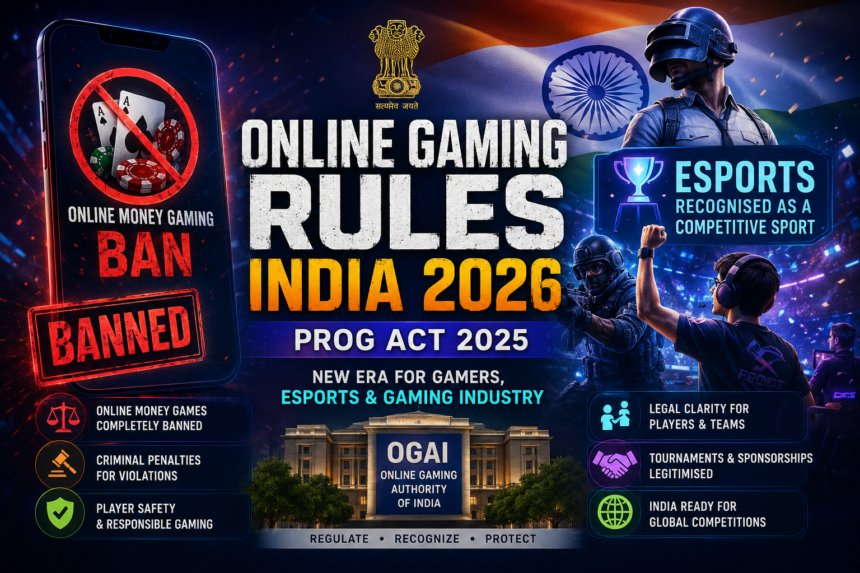
Online Gaming Rules India 2026, India’s gaming industry officially entered a new regulatory era on May 1, 2026. The Promotion and Regulation of Online Gaming Rules, 2026 — introduced under the Promotion and Regulation of Online Gaming Act, 2025 (PROG Act) — came into force nationwide, creating India’s first unified legal framework for digital gaming.
The implications are massive for gamers, startups, esports organisations, and gaming platforms across the country. Under the new rules, online money gaming has been completely banned with criminal penalties for violations. At the same time, esports has received formal legal recognition as a competitive digital sport. The government has also established a new regulatory authority, the Online Gaming Authority of India (OGAI), under the Ministry of Electronics and Information Technology (MeitY).
This comprehensive guide explains what changed under the India Online Gaming Rules 2026, who is affected, and what the future looks like for India’s gaming ecosystem.
What Are the India Online Gaming Rules 2026?
The Online Gaming Rules 2026 operationalise the PROG Act by creating a structured legal and regulatory framework for digital gaming platforms in India.
India’s online gaming market was valued at approximately INR 232 billion in 2024, with nearly 77% of revenue coming from transaction-based gaming models. According to industry projections, the market could reach INR 316 billion by 2027. The government’s new framework aims to redirect this growth toward skill-based gaming and esports while eliminating gambling-style gaming activities.
The rules divide online games into three distinct categories.
Three Categories of Online Games in India
1. Online Social Games
Online social games include non-competitive and non-monetary games such as:
- Puzzle games
- Casual mobile games
- Educational games
- Story-based games
- Single-player entertainment titles
These games face minimal regulation under the PROG framework. Most social games do not require mandatory registration or licensing.
2. Esports
Esports are now formally recognised as competitive multiplayer games based primarily on skill. Popular esports titles include:
- BGMI (Battlegrounds Mobile India)
- Valorant
- Counter-Strike 2
- EA Sports FC
- Chess.com competitions
This is the first time India has legally separated esports from gambling-related gaming activities.
3. Online Money Games (Real Money Gaming)
The most controversial category under the new rules is online money gaming.
Any game in which players deposit money to win cash rewards now falls under the online money gaming classification. Under the PROG Act framework, these games are treated as gambling activities and are completely banned across India.
Online Money Gaming Ban: What It Means
Online Gaming Rules India 2026, The nationwide ban on online money gaming is the most disruptive element of the new rules.
An estimated 45 crore Indians previously participated in online money gaming platforms. Reported financial losses linked to such platforms exceeded Rs 20,000 crore, according to government-linked estimates.
Major platforms such as Dream11, MPL (Mobile Premier League), WinZO, and several other companies that offered fantasy sports, rummy, poker, and cash-prize gaming formats now face a major operational crisis. Many platforms may be forced to completely restructure their business models or shut down certain services entirely.
Criminal Penalties Under the PROG Act
The new framework introduces strict criminal penalties for violations.
Repeat Offenders
Operators repeatedly running banned money gaming platforms can face prison sentences of up to five years.
First-Time Violations
First-time offenders may face heavy financial penalties and enforcement action.
Payment Gateway Liability
Banks, payment processors, and financial intermediaries facilitating online money gaming transactions can also face penalties under the new framework.
What Happens to Fantasy Sports and Rummy Platforms?
Fantasy sports operators such as Dream11 and My11Circle face the biggest legal uncertainty under the new rules.
For years, these companies argued that fantasy sports involved substantial skill and therefore did not qualify as gambling. Earlier Supreme Court rulings had also recognised fantasy sports as skill-based activities in certain contexts.
However, the PROG Act now classifies all cash-prize gaming formats under the online money gaming category regardless of skill involvement.
This represents a dramatic shift in India’s legal approach toward fantasy gaming and real-money skill games.
Legal experts expect multiple constitutional and commercial challenges against the framework. Ultimately, the Supreme Court may once again determine whether skill-based cash gaming can legally coexist with the new statute.
Esports Recognition: A Landmark Moment for Indian Gaming
Online Gaming Rules India 2026, While the ban on money gaming has created uncertainty for some companies, the formal recognition of esports is widely viewed as a historic breakthrough for India’s gaming industry.
Competitive gaming now has a legally recognised framework separate from gambling activities.
What Formal Esports Recognition Means
Legal Clarity for Players and Teams
Esports earnings are no longer automatically associated with gambling income by banks and tax authorities.
Tournament Legitimacy
Tournament organisers can now host, advertise, and sponsor esports events without major legal ambiguity.
Publisher Registration
Game publishers can formally register esports titles with regulators, helping protect tournament ecosystems and intellectual property rights.
Professional Player Contracts
Esports organisations and players now have a clearer legal structure for contracts, salaries, sponsorships, and commercial partnerships.
International Representation
India can formally send esports teams to international tournaments and multi-sport competitions under a recognised national framework.
Remaining Challenges for India’s Esports Industry
Despite the positive developments, industry stakeholders believe several issues still remain unresolved.
Gaming executives, including Akshat Rathee of NODWIN Gaming, have highlighted operational challenges involving banks and financial institutions. Many banks still struggle to differentiate esports prize earnings from gambling-related income.
As a result, some esports players continue to face delays, scrutiny, or freezing of prize money transactions.
In addition, there is currently no fully defined pathway for esports teams to register themselves under a dedicated national esports structure.
The Online Gaming Authority of India (OGAI) is expected to release further operational guidelines to address these issues.
Online Gaming Authority of India (OGAI): India’s New Gaming Regulator
The Online Gaming Authority of India (OGAI) has been established under MeitY to oversee implementation of the PROG Act framework.
Its primary responsibilities include:
- Classifying games into regulatory categories
- Registering esports titles
- Maintaining an official esports games registry
- Handling gamer complaints
- Monitoring platform safety compliance
- Coordinating enforcement against banned money gaming platforms
- Working with state governments on regulatory action
OGAI is expected to become the central authority for India’s gaming ecosystem moving forward.
India Gaming Market: What Survives and What Grows
Online Gaming Rules India 2026, The Indian gaming market is expected to undergo major structural changes under the new framework.
Mobile Gaming Remains Dominant
India is already the world’s largest mobile gaming market by download volume.
With online money gaming banned, the mobile gaming ecosystem will increasingly focus on:
- Free-to-play games
- Cosmetic purchases
- Battle passes
- Subscription models
- In-app progression systems
Games such as BGMI, Free Fire MAX, and Call of Duty Mobile are expected to continue dominating the Indian market.
Importantly, these games remain fully legal under the new framework.
PC and Console Gaming Are Growing Rapidly
India’s PC and console gaming market is also expanding quickly.
The formalisation of esports is expected to increase demand for gaming hardware, including:
- Mechanical keyboards
- Gaming mice
- High-refresh-rate monitors
- Gaming headsets
- Streaming equipment
Major global companies such as Intel, AMD, NVIDIA, Logitech, and Razer are already increasing their India-focused gaming investments and marketing efforts.
Esports Industry Emerges as the Biggest Beneficiary
India’s esports ecosystem appears to be the largest long-term beneficiary of the PROG Act framework.
With legal clarity now available, many mainstream brands and corporate sponsors that previously avoided gaming partnerships due to reputational concerns are expected to enter the esports industry.
Industry experts expect strong growth in:
- Esports tournament prize pools
- Team valuations
- Professional player salaries
- Sponsorship revenue
- Tournament production quality
- Esports streaming and content creation
Several organisations are particularly well-position for growth.
NODWIN Gaming
India’s largest esports tournament organiser is expect to benefit significantly from regulatory clarity.
S8UL Esports
As one of India’s biggest esports and gaming content organisations, S8UL could attract larger institutional and brand partnerships.
Team SouL, GodLike Esports, and Team Orangutan
Professional esports teams now operate within a clearer legal and commercial environment.
Tax Treatment of Esports Earnings in India
The new framework also clarifies taxation principles related to esports earnings.
Esports Prize Money
Prize winnings are generally treat as income from other sources and tax according to applicable income tax slabs.
30% TDS Rule
Tournament organisers must deduct 30% TDS on esports prize payouts exceeding Rs 10,000.
Foreign Prize Earnings
International esports winnings earned by Indian players are taxable in India if linked to services performed within the country.
Professional Player Salaries
Salaries paid by esports organisations are taxe as salary income, while independent esports professionals may be taxe under business income provisions.
OGAI is expect to release more detailed guidance regarding esports-related taxation and banking compliance.
India’s Gaming Creator Economy Gets a Boost
India’s gaming creator ecosystem is already one of the largest in the world.
Gaming creators on YouTube Gaming, Twitch, Instagram Reels, and YouTube Shorts attract hundreds of millions of monthly views.
Popular Indian gaming creators such as:
- Scout
- Mortal
- Dynamo
- Techno Gamerz
- CarryMinati
have built massive digital audiences and strong commercial brands.
The PROG Act’s legal clarity is expect to help gaming creators secure larger sponsorships, advertising deals, and long-term partnerships with brands that previously hesitate to enter the gaming sector.
India’s Esports Ambitions at International Events
Esports is already part of the Asian Games and continues to gain international legitimacy.
India’s formal esports recognition now strengthens the country’s ability to:
- Send officially recognised esports teams to international competitions
- Build a structured national esports federation system
- Apply for International Esports Federation (IESF) participation
- Receive foreign prize money with fewer regulatory complications
This could significantly improve India’s global esports competitiveness over the next decade.
Read More: Best Free AI Tools in India 2026: Complete Guide for Students, Freelancers & Professionals
Conclusion
The Online Gaming Rules India 2026 mark a turning point for India’s gaming ecosystem.
For years, the sector operated in a regulatory grey area filled with legal uncertainty, inconsistent state-level rules, and confusion between gaming, gambling, and esports.
The PROG Act changes that landscape completely.
The ban on online money gaming removes one of the most controversial segments of the industry. At the same time, the formal recognition of esports creates a legal foundation for professional competitive gaming in India.
Meanwhile, the creation of the Online Gaming Authority of India gives the country a central institutional framework for future gaming regulation.
The next phase will depend heavily on implementation. OGAI’s future guidelines, court rulings on legal challenges, industry adaptation, and investor confidence will all shape how India’s gaming economy evolves in the years ahead.
One thing, however, is already clear: India’s gaming industry is no longer operating on the sidelines. It is becoming a structured, mainstream, and globally competitive digital sector.