
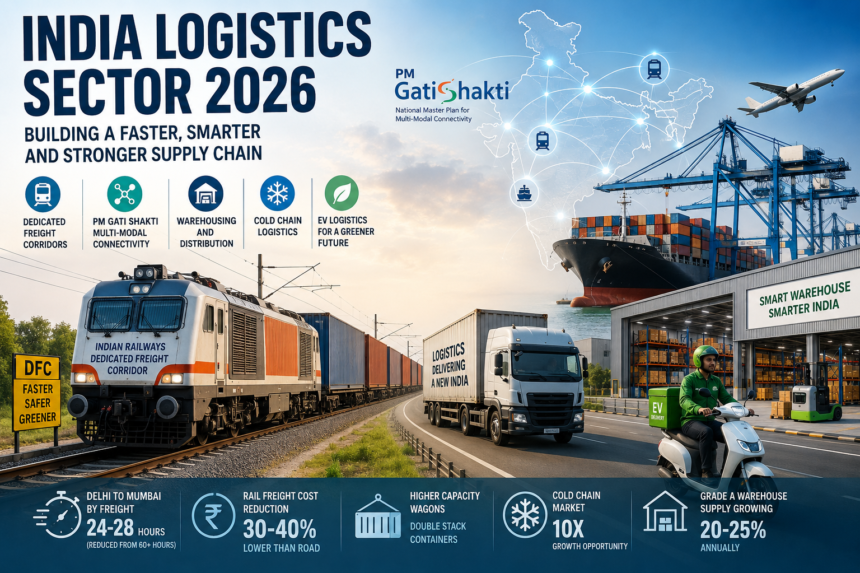
However, this situation is changing rapidly in 2026. The Eastern and Western Dedicated Freight Corridors (DFCs) are now operational and are transforming the economics of rail freight across the country. At the same time, PM Gati Shakti — the National Master Plan for Multi-modal Connectivity — is reducing infrastructure planning gaps, improving multi-modal connectivity, and accelerating project execution through coordinated infrastructure development across roads, railways, ports, airports, and industrial corridors.
In addition, India’s booming e-commerce market, PLI-driven manufacturing growth, and China+1 supply chain diversification strategy are creating unprecedented demand for logistics and warehousing services across the country.
Dedicated Freight Corridors: India’s Logistics Game-Changer
What Are Dedicated Freight Corridors?
Dedicated Freight Corridors (DFCs) are purpose-built railway lines created exclusively for freight transport. Unlike traditional rail systems where passenger and freight trains share the same tracks, DFCs separate cargo movement from passenger operations.
This separation creates two major advantages. First, freight trains can now travel at speeds of 60-100 km/h instead of the earlier 25-30 km/h average on congested mixed-use tracks. Second, passenger trains no longer experience delays caused by slower freight traffic.
As a result, India is witnessing dramatically faster, more reliable, and more cost-efficient freight movement.
Eastern Dedicated Freight Corridor (EDFC)
The Eastern Dedicated Freight Corridor (EDFC) — running from Ludhiana in Punjab to Sonnagar in Jharkhand, covering roughly 1,337 km and linking onward to Dankuni in West Bengal — is fully operational in 2026.
The corridor passes through Punjab, Haryana, Uttar Pradesh, Bihar, and Jharkhand, which together form one of India’s most important agricultural and industrial belts.
The EDFC primarily transports:
- Coal for power plants
- Agricultural produce from Punjab and Haryana
- Manufactured goods from industrial clusters in Uttar Pradesh
Consequently, industries located along the route are experiencing lower transportation costs and improved delivery timelines.
Western Dedicated Freight Corridor (WDFC)
India Logistics Sector 2026, The Western Dedicated Freight Corridor (WDFC) runs from Dadri near Delhi to Jawaharlal Nehru Port (JNPT) near Mumbai through Rajasthan, Gujarat, and Maharashtra, spanning approximately 1,504 km.
The WDFC is widely considered India’s most economically significant freight corridor because it connects:
- Delhi’s industrial ecosystem
- Rajasthan’s mining and marble industries
- Gujarat’s manufacturing and export base
- Maharashtra’s industrial clusters
- India’s busiest container port at JNPT
The impact has been transformational.
Major Benefits of the WDFC
- Freight travel time between Delhi and Mumbai has fallen from more than 60 hours to approximately 24-28 hours
- Rail freight costs on the corridor are 30-40% lower than equivalent road transport costs
- DFC wagons can handle higher axle loads and double-stack containers, enabling significantly larger cargo capacity per train
As a result, exporters, manufacturers, and logistics operators are experiencing major efficiency gains.
PM Gati Shakti: Coordinating India’s Infrastructure Development
PM Gati Shakti — the National Master Plan for Multi-modal Connectivity — is one of India’s most significant infrastructure coordination initiatives.
The platform uses GIS-based digital mapping technology to integrate data across roads, railways, ports, airports, waterways, energy infrastructure, and digital connectivity networks. By coordinating investments across 16 ministries, the platform helps identify gaps, eliminate duplication, and improve infrastructure integration.
What PM Gati Shakti Has Achieved
Reduced Last-Mile Connectivity Gaps
The initiative has improved coordination between highways, railways, ports, and industrial zones. Consequently, many infrastructure choke points caused by missing connectivity links are being eliminated.
Faster Project Approvals
Through integrated inter-ministerial coordination, project approvals that previously took years are now being cleared in months in several sectors.
PMIS-Based Real-Time Monitoring
The Project Management and Information System (PMIS) now tracks more than 400 major infrastructure projects in real time, improving accountability and execution speed.
Industrial Cluster Connectivity
PM Gati Shakti is also helping identify connectivity gaps in more than 56 industrial clusters developed under India’s Production Linked Incentive (PLI) schemes.
India’s Logistics Startup Ecosystem
India Logistics Sector 2026, India’s rapidly growing logistics sector has attracted substantial venture capital investment and produced several major technology-driven companies.
Delhivery — India’s Largest Listed Logistics Company
Delhivery is India’s most comprehensive logistics services provider. The company operates across:
- Express parcel delivery
- Part-truck load (PTL) freight
- Full-truck load (FTL) logistics
- Supply chain management
- Cross-border trade services
Its proprietary technology platform uses route optimisation algorithms, demand forecasting systems, and advanced network planning tools to improve operational efficiency.
Shadowfax — Quick Commerce Last-Mile Specialist
Shadowfax has built its business around quick commerce last-mile delivery for platforms such as Blinkit, Zepto, and Swiggy Instamart.
Delivering products within 10-15 minutes from dark stores requires a completely different logistics model compared to traditional courier delivery systems.
Shadowfax also listed on Indian markets in early 2026, reflecting growing investor interest in logistics technology businesses.
Ecom Express — E-commerce Logistics Specialist
Ecom Express focuses entirely on e-commerce logistics. The company provides next-day and same-day delivery services through a large network of service centres and delivery agents across India.
As India’s online retail market expands, specialised e-commerce logistics providers continue to grow rapidly.
Rivigo — Driver-Centric Innovation
Rivigo pioneered India’s relay trucking model, where long-distance trucks are driven in shifts by multiple drivers instead of relying on a single driver for the entire route.
This approach significantly reduces driver fatigue, improves road safety, and enables faster delivery of time-sensitive goods.
Cold Chain Logistics: Strengthening India’s Food Security Infrastructure
India Logistics Sector 2026, One of India’s biggest logistics gaps remains cold chain infrastructure, which includes refrigerated storage and temperature-controlled transport systems for perishable products such as food, medicines, vaccines, seafood, and dairy products.
India currently loses an estimated 16% of its food production due to spoilage caused by inadequate cold chain infrastructure.
Therefore, expanding cold chain capacity is not only a major business opportunity but also a critical food security and farmer income issue.
Current Cold Chain Situation in India
- India currently has more than 35 million metric tonnes of cold storage capacity
- Most cold storage facilities are concentrated in Uttar Pradesh and Punjab
- India still requires nearly 10 times more refrigerated transport capacity and approximately 3 times more cold storage infrastructure to reach global benchmarks
The largest opportunities exist in:
- Fruits and vegetables
- Dairy products
- Seafood exports
- Pharmaceutical cold chains
Key companies operating in this sector include:
- ColdStar Logistics
- Snowman Logistics
- Concord Enviro
- Pansari Group
Electric Vehicles in Logistics: Decarbonising Delivery Networks
India Logistics Sector 2026, India’s logistics and delivery sector is one of the country’s largest consumers of fossil fuels. As a result, the transition toward electric mobility is accelerating rapidly in 2026.
Major e-commerce and delivery companies such as Amazon, Flipkart, Meesho, Zomato, and Swiggy have all committed to transitioning significant portions of their delivery fleets to EVs.
Growth of EV Delivery Vehicles
Two-Wheeler EVs
Companies such as Ola Electric, Hero Electric, and Ampere are supplying electric scooters to logistics operators at scale.
Cargo Three-Wheeler EVs
Electric cargo vehicles such as the Mahindra Treo Zor are increasingly replacing diesel-powered autos for intra-city logistics and last-mile delivery.
Government Support
India’s FAME III incentive framework also includes support mechanisms for commercial EV adoption by logistics companies.
Warehousing and Distribution Centre Boom
India’s warehousing sector is experiencing explosive growth due to several converging trends:
- Expansion of e-commerce
- Growth in PLI-linked manufacturing
- Supply chain consolidation
- Rising demand for modern fulfilment centres
Grade A warehouse supply across India is currently growing at approximately 20-25% annually.
Major Warehousing Hubs in India
The country’s largest warehousing and distribution clusters are developing around:
- Pune
- Nhava Sheva
- Bhiwandi
- Delhi NCR’s Kundli-Manesar-Palwal corridor
- Bengaluru
- Hyderabad
- Chennai
Leading developers in this sector include:
- Welspun One
- IndoSpace
- Ascendas
- ESR India
- GLP India
Automation in Warehousing
Large fulfilment centres are increasingly deploying advanced automation technologies, including:
- Automated Storage and Retrieval Systems (ASRS)
- Conveyor-based sorting systems
- Robotic picking technologies
These technologies are helping improve efficiency, reduce turnaround time, and optimise labour productivity.
Read More: India FoodTech Sector 2026: Zomato, Swiggy, Cloud Kitchens & Future Food Trends
Conclusion
India Logistics Sector 2026, India’s logistics transformation is rapidly turning one of the country’s biggest competitive disadvantages into a modern, technology-driven, and increasingly efficient ecosystem.
The Dedicated Freight Corridors, PM Gati Shakti initiative, cold chain expansion, EV adoption, warehousing growth, and logistics technology innovations are collectively building the infrastructure foundation required for India’s manufacturing ambitions and its expanding consumer economy.
As supply chains become faster, cheaper, and more reliable, India is positioning itself as a stronger global manufacturing and export hub. The logistics sector is therefore no longer just an infrastructure story — it is becoming one of the most important drivers of India’s long-term economic growth.
Vikram Chatterjee is a seasoned financial analyst and market observer dedicated to financial literacy in India. With a decade of experience working with equity research firms in Kolkata and Mumbai, Vikram joined Taza Newsz to simplify the world of money for its readers. His expertise spans the Indian stock market, IPO analysis, and the rapidly evolving cryptocurrency landscape.Known for his data-driven approach, Vikram breaks down government schemes and economic policies to explain exactly how they impact the common man's wallet. He believes that smart investing should be accessible to everyone, not just Wall Street experts. When he isn't glued to the Sensex charts, Vikram enjoys playing chess and mentoring young commerce students. | View all posts