
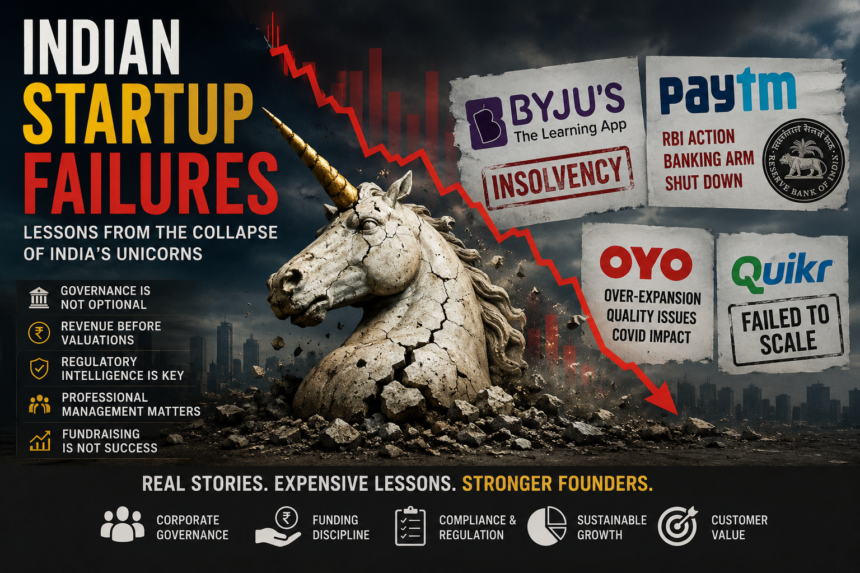
Indian Startup Failures, India’s startup ecosystem produces heroes and cautionary tales with equal generosity. For every Zepto or Ninjacart that quietly builds genuine value while growing into a sustainable business, there is a BYJU’S — once valued at USD 22 billion, backed by more than USD 5 billion in investor capital, and now navigating bankruptcy proceedings involving creditors, employees, and students.
Similarly, for every UPI success story, there is a Paytm crisis. The company that helped popularise digital payments in India saw its banking arm effectively shut down by the RBI, its stock crash nearly 80% from peak levels, and its leadership forced into a strategic reset.
Therefore, every Indian entrepreneur, investor, and business student needs to understand what went wrong — because these mistakes are systematic, not random.
BYJU’S: The Rise and Collapse of India’s EdTech Giant
The Peak of BYJU’S
Indian Startup Failures, BYJU’S was valued at USD 22 billion, making it the most valuable startup India had ever produced. The company raised over USD 5 billion from major investors including Sequoia, Tiger Global, General Atlantic, and Mark Zuckerberg’s Chan Zuckerberg Initiative.
In addition, BYJU’S aggressively acquired global companies such as Aakash Educational Services, WhiteHat Jr, Epic, and Tynker. Founder Byju Raveendran became one of India’s most recognisable entrepreneurs. His rags-to-riches story, combined with BYJU’S’ charismatic teaching platform, positioned him as the face of India’s EdTech ambition.
However, beneath the rapid growth and investor enthusiasm, structural weaknesses were already emerging.
What Went Wrong at BYJU’S
BYJU’S did not collapse because of one isolated mistake. Instead, the company suffered from multiple simultaneous failures that compounded over time.
Accounting Irregularities
First, BYJU’S repeatedly delayed filing audited financial statements. When the financial results were eventually released, they revealed losses that were far larger than investors had anticipated. Consequently, confidence in the company’s financial transparency weakened significantly.
Aggressive Sales Practices
At the same time, thousands of customer complaints emerged regarding high-pressure sales tactics. Reports suggested that sales representatives encouraged families to take loans for expensive educational courses while overstating the value of the products.
As a result, the company’s reputation suffered, and regulatory scrutiny intensified.
Acquisition Integration Failure
Another major issue was acquisition overload. BYJU’S simultaneously acquired Aakash, WhiteHat Jr, Epic, and several other companies. Each acquisition required operational integration, cultural alignment, and strategic coordination.
However, management capacity became overstretched. Although synergies were promised, they were never fully realised.
Founder Control and Weak Governance
Corporate governance also became a critical weakness. Byju Raveendran and family members occupied several key leadership positions, while investor oversight remained limited.
Consequently, founder-driven decision-making went largely unchecked, creating an environment where institutional accountability weakened over time.
Excessive Debt and Overleverage
In addition, BYJU’S took on substantial debt obligations, including a controversial USD 1.2 billion Term Loan B from US lenders. When revenue growth slowed and losses increased, this debt became a severe burden.
Eventually, liquidity pressures escalated into a full-scale crisis.
The Bankruptcy Proceedings
In 2024, creditors initiated insolvency proceedings against BYJU’S under the Insolvency and Bankruptcy Code (IBC). The legal process exposed the extent of the company’s financial distress, including allegations related to fund diversion and financial mismanagement.
Meanwhile, Aakash Educational Services — BYJU’S’ most valuable acquisition — continued operating independently. However, the future of the BYJU’S brand and its flagship learning app remains uncertain.
Paytm: Regulatory Crisis and the Importance of Compliance
What Happened to Paytm?
Indian Startup Failures, the banking entity associated with India’s most famous fintech startup, was directed by the RBI in January 2024 to stop accepting new deposits and gradually wind down major banking operations.
The RBI cited “persistent non-compliance” and “supervisory concerns,” representing one of the strongest regulatory actions against a major Indian fintech company. Simultaneously, Paytm Payments Services faced challenges regarding continuation of its payment aggregator licence.
Predictably, investor confidence collapsed. Paytm’s share price fell more than 70% in the aftermath, adding to the losses already suffered since its 2021 IPO at Rs 2,150 per share.
By 2026, the company had reorganised its business strategy and shifted focus toward payment services, lending distribution, and insurance partnerships. Nevertheless, the crisis fundamentally changed how Indian fintech companies approach compliance.
Lessons From the Paytm Crisis
Regulatory Relationships Are Non-Negotiable
The most important lesson is clear: no financial services company can succeed in India while being in prolonged conflict with the RBI.
Compliance is not optional. Instead, it is foundational to survival.
Product Vision Alone Is Not Enough
Vijay Shekhar Sharma remains widely respected as a product visionary. However, building large-scale compliance systems and regulatory frameworks requires different institutional capabilities.
Therefore, founder-driven innovation must eventually evolve into professionally managed institutional governance.
IPO Timing and Valuation Matter
Paytm’s IPO became India’s largest public offering at the time, raising approximately USD 2.5 billion. However, the valuation was disconnected from profitability and long-term financial fundamentals.
As market sentiment changed, the gap between valuation and reality corrected painfully.
Diversification Can Create Dangerous Complexity
Paytm attempted to operate simultaneously across payments, banking, lending, insurance, and entertainment ticketing.
While diversification appeared ambitious, it also created operational complexity that made it difficult for the company to dominate any single vertical.
Other Major Startup Failures in India
OYO and the Limits of the Aggregation Model
Indian Startup Failures, OYO was once valued at nearly USD 10 billion and expanded aggressively across India, Southeast Asia, Europe, and the United States. The company aggregated budget hotels under a standardised brand model and pursued hypergrowth internationally.
However, problems quickly emerged.
Property partner disputes increased, quality control became inconsistent, and operational standardisation proved difficult at scale. Then, the COVID-19 pandemic severely damaged global travel demand.
As a result, OYO restructured operations, reduced its international footprint, listed publicly at a much lower valuation, and focused on profitability over aggressive expansion.
Quikr and the Horizontal Classifieds Problem
Quikr raised more than USD 350 million in an effort to become India’s equivalent of Craigslist. The platform attempted to dominate multiple categories including jobs, real estate, used goods, and local services.
However, the company repeatedly pivoted into verticals such as QuikrHomes, QuikrJobs, and QuikrEasy without establishing clear market leadership in any segment.
Eventually, Quikr lost ground to more focused competitors like OLX and NoBroker and was acquired at a fraction of its peak valuation.
BigBasket: Survival Through Strategic Acquisition
BigBasket represents a more nuanced story. Unlike many failed startups, it survived through strategic acquisition rather than collapse.
As India’s pioneering online grocery platform, BigBasket faced intense competition from Amazon, Blinkit, and other rapid-delivery companies. Over time, it became clear that online grocery margins were structurally difficult.
Ultimately, Tata Digital acquired BigBasket, allowing the company to continue operating within the Tata ecosystem.
The lesson is important: sometimes survival depends not on independent scaling, but on becoming part of a larger strategic platform.
Systemic Lessons From Startup Failures in India
1. Governance Is Not Optional
The strongest pattern across startup failures in India is weak corporate governance.
Founder-dominated boards, delayed financial reporting, related-party transactions, and the “founder knows best” mindset repeatedly damaged institutional trust.
As startups scale, governance stops being a bureaucratic requirement and becomes essential business infrastructure.
2. Revenue Matters More Than Valuation
Between 2019 and 2022, many Indian startups raised money at valuations disconnected from revenue, profitability, or sustainable unit economics.
Investors focused heavily on GMV, downloads, and user growth while ignoring business fundamentals.
However, by 2026, investor expectations changed dramatically. Startups are now expected to demonstrate a credible path to profitability much earlier in their lifecycle.
3. Regulatory Intelligence Is a Competitive Advantage
In regulated sectors such as fintech, healthcare, education, transportation, and food delivery, regulatory understanding is a strategic advantage.
Founders who engage constructively with regulators build stronger and more durable companies than those who view regulation as an obstacle.
Paytm’s RBI crisis developed gradually over several years. Better regulatory intelligence could likely have prevented the situation from escalating.
4. Fundraising Is Not the Same as Success
India’s startup culture increasingly celebrated fundraising rounds as achievements in themselves. Media coverage often treated valuations as indicators of real business value.
BYJU’S became the clearest example of this distortion.
Every funding round increased the company’s public visibility, even while operational problems deepened internally.
Ultimately, genuine success comes from building products customers truly value and willingly pay for.
5. Professional Management Becomes Essential at Scale
Founder-led companies eventually need experienced CFOs, legal experts, compliance leaders, and operational managers capable of building institutional discipline.
However, many founders struggle to relinquish control or trust professional management.
Consequently, companies fail to transition from founder-centric startups into mature institutions.
The Positive Side: What Successful Indian Startups Do Differently
Indian Startup Failures, Not every Indian startup story ends in collapse. In fact, several successful companies demonstrate the opposite principles.
Physics Wallah
Physics Wallah achieved scale while maintaining profitability by focusing on affordability and customer value rather than growth-at-all-costs metrics.
Zepto
Zepto scaled rapidly but maintained strong operational execution and sharper attention to unit economics from an early stage.
Freshworks
Freshworks became one of India’s strongest SaaS success stories by building product-first global software capabilities and successfully listing on NASDAQ.
Ninjacart
Ninjacart built genuine supply-chain value in the B2B agricultural ecosystem while growing in a far more disciplined manner than many consumer internet startups.
Read More: India FoodTech Sector 2026: Zomato, Swiggy, Cloud Kitchens & Future Food Trends
Conclusion
Indian Startup Failures, India’s startup failures contain more entrepreneurial wisdom than many business school case studies.
BYJU’S teaches governance. Paytm teaches regulatory intelligence. OYO demonstrates the limits of aggregation without operational control. Quikr highlights the dangers of unfocused expansion.
Therefore, founders should study these cases not to become cynical about entrepreneurship, but to build stronger and more sustainable companies.
The next generation of Indian startups will likely be defined not by the companies that raise the most money, but by those that combine innovation with governance, compliance, operational discipline, and long-term customer value.