
Digital Personal Data Protection Act India 2026, create an account on a website, or make an online purchase, your personal data is collected, processed, and often shared with multiple third parties — sometimes without your meaningful knowledge or consent. In India, where more than 900 million people use the internet and digital services influence almost every aspect of daily life, data privacy has become one of the most important rights of the digital age.
India’s Digital Personal Data Protection Act (DPDPA), enacted in 2023 and now fully in force in 2026, is the country’s first comprehensive data protection law and a major step toward strengthening Digital Privacy Rights India. It establishes your rights over your personal data, imposes obligations on companies that collect and process this data, and creates the Data Protection Board of India (DPDPB) as the enforcement authority. This guide explains what DPDPA means for you as an individual Indian and what it requires from the businesses that handle your data.
This guide explains what the DPDP Act means for Indian citizens and what responsibilities businesses must fulfil while handling personal data.
What Is the DPDP Act and Why Does It Matter?
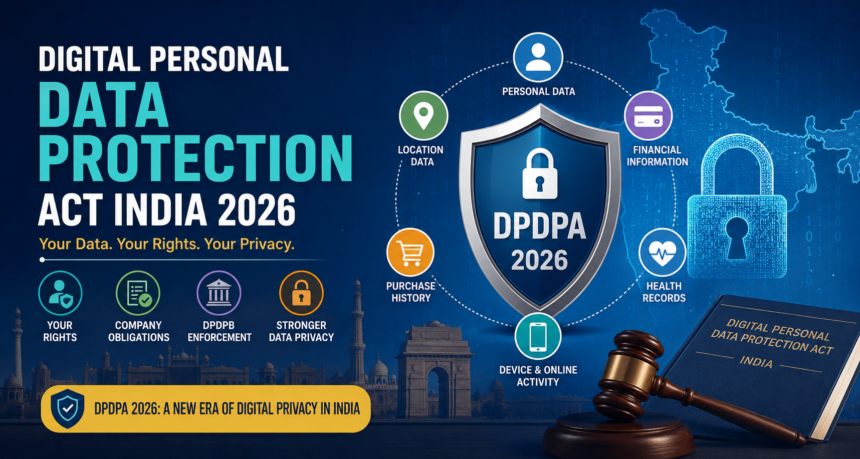
The Digital Personal Data Protection Act governs the processing of “digital personal data” — information about an individual that can identify them and is collected or processed in digital form.
This includes:
- Name
- Phone number
- Aadhaar number
- Location data
- Browsing history
- Purchase history
- Health records
- Financial information
In simple terms, almost any information about you that exists digitally and can identify you falls under the scope of the DPDPA.
Digital Personal Data Protection Act India 2026, India did not have a dedicated and comprehensive data protection law. As a result, companies could collect massive amounts of personal data with minimal disclosure, share information with third parties without meaningful consent, and often avoid serious consequences even after major data breaches.
The DPDPA fundamentally changes that framework by introducing legal accountability, user rights, and financial penalties for misuse of personal data.
Your Rights Under the DPDP Act India
1. Right to Information
Under the DPDPA, you have the right to know exactly what personal data a company is collecting about you and why it is being collected.
Companies must provide this information in clear and plain language through a Privacy Notice before or at the time of data collection. The notice must explain:
- What data is being collected
- Why the data is required
- How long the company will retain the data
- Whether the data will be shared with third parties
This requirement is intended to ensure transparency and prevent hidden or misleading data collection practices.
2. Right to Correction and Erasure
If the personal data held by a company is inaccurate, incomplete, or outdated, you have the right to request correction.
More importantly, you also have the right to request erasure of your data. This means companies must delete your personal data when:
- The data is no longer necessary for the original purpose
- You withdraw your consent
- Retention is no longer legally required
This provision effectively introduces a limited form of the “right to be forgotten” in India’s digital ecosystem.
3. Right to Grievance Redressal
If a company violates your data privacy rights, you have the legal right to file a complaint.
The process begins with the company’s designated grievance officer or Data Protection Officer (DPO). If the response is unsatisfactory or the issue remains unresolved, you can escalate the matter to the Data Protection Board of India (DPDPB).
The DPDPB has the authority to:
- Investigate complaints
- Direct companies to comply with the law
- Examine data breach incidents
- Impose significant financial penalties
4. Right to Nominate
One of the unique features of India’s DPDPA is the right to nominate another individual to exercise your data rights in the event of your death or incapacity.
This provision is particularly important for data connected to:
- Financial institutions
- Healthcare providers
- Insurance platforms
- Social media accounts
- Digital payment services
It ensures that sensitive digital information can still be managed lawfully when the original data principal is unable to act.
What Companies Must Do Under the DPDP Act
Consent Requirements
Companies can collect and process personal data only after obtaining consent that is:
- Free
- Specific
- Informed
- Unambiguous
Consent must be linked to a clearly defined purpose. Permission obtained for one activity cannot automatically be used for another unrelated purpose.
Additionally, companies must:
- Present consent requests in simple language
- Separate consent requests from lengthy terms and conditions
- Allow users to withdraw consent as easily as it was given
This marks a major shift from earlier practices where users often accepted broad and unclear data collection policies.
Data Minimisation
The DPDPA introduces the principle of data minimisation.
Under this principle, companies may collect only the personal data that is strictly necessary for the stated purpose. Collecting excessive information “just in case” it becomes useful later is not permitted.
This requirement directly impacts mobile apps and digital platforms that previously requested unnecessary permissions and excessive user information.
Data Localisation
Digital Personal Data Protection Act India 2026, The DPDPA gives the Indian government the authority to impose restrictions on cross-border transfer of certain categories of personal data.
In 2026, the government introduced additional rules restricting the transfer of sensitive personal data — including health, financial, and biometric information — outside India without specific approvals.
These localisation requirements have major implications for:
- Global technology companies
- Cloud service providers
- International fintech firms
- Multinational corporations operating in India
Data Principal Obligations
For the first time, Indian data protection law also places obligations on individuals, known as “data principals.”
Under the DPDPA, individuals must not:
- Impersonate another person
- Provide false information intentionally
- File frivolous or malicious complaints
These provisions are intended to prevent misuse of the legal framework while maintaining balance between individual rights and operational practicality.
Data Protection Board of India (DPDPB)
The Data Protection Board of India is the central enforcement authority established under the DPDPA.
The DPDPB has the power to:
- Investigate complaints against companies
- Conduct suo motu investigations into data breaches
- Issue compliance directions
- Monitor violations of the law
- Impose financial penalties on non-compliant entities
The establishment of the DPDPB represents a major institutional shift in India’s digital governance framework.
Penalty Structure Under the DPDPA
The law introduces substantial penalties for serious violations.
Major Penalties Include:
- Breach of children’s data protections: Up to ₹200 crore per violation
- Failure to implement adequate security safeguards leading to data breaches: Up to ₹250 crore
- Failure to notify the DPDPB about a data breach: Up to ₹200 crore
- Other violations: Up to ₹50 crore per violation
Although these penalties are lower than Europe’s GDPR penalties, they still represent a dramatic increase from India’s earlier enforcement environment, where meaningful financial consequences were rare.
DPDP Act and Key Indian Sectors
FinTech and Banking
Banks, NBFCs, payment apps, and insurance companies handle some of the most sensitive personal information in the country.
This includes:
- Financial transactions
- Income records
- Credit history
- Aadhaar-linked KYC data
- Biometric authentication information
Under the DPDPA, these organisations must implement strict consent management systems, robust cybersecurity safeguards, and purpose-based data processing controls.
KYC-related information requires particularly careful handling because of its sensitivity and fraud risks.
Healthcare
Health data is considered one of the most sensitive forms of personal information.
Hospitals, telemedicine platforms, health monitoring apps, diagnostic services, and insurance companies must ensure that:
- Health data is processed only with explicit consent
- Information is retained only for necessary periods
- Data is not shared beyond the approved purpose
- Strong security protections are maintained
As digital healthcare adoption expands rapidly in India, compliance obligations for health-tech companies have become significantly stricter.
EdTech and Children’s Data
The DPDPA provides some of its strongest protections for children’s data, defined as data relating to individuals below 18 years of age.
Companies handling children’s data must obtain verifiable parental consent before collecting or processing information.
Additionally, companies are prohibited from:
- Behavioural tracking of children
- Profiling children
- Targeted advertising directed at minors
EdTech platforms face particularly strict compliance requirements because they collect extensive educational and behavioural data from students.
DPDPA vs GDPR: How India Compares With Europe
Digital Personal Data Protection Act India 2026, Although India’s DPDPA shares similarities with Europe’s GDPR, there are important differences.
Scope
Both laws regulate digital personal data processing. However, GDPR also covers certain categories of non-digital personal data.
Consent Standards
Both frameworks require consent to be freely given, specific, informed, and unambiguous.
Data Portability
GDPR includes a stronger right to data portability, allowing users to transfer data easily between competing services. India’s DPDPA does not yet provide a comparable right.
Penalties
GDPR penalties can reach up to 4% of a company’s global annual turnover. In comparison, DPDPA penalties currently cap at ₹250 crore.
Government Exemptions
One of the most debated aspects of the DPDPA is its broader exemptions for government data processing compared to GDPR. Privacy advocates have raised concerns regarding these provisions.
How to Exercise Your DPDP Rights in 2026
If you want to exercise your rights under the DPDPA, the process generally involves four steps.
Step 1: Find the Company’s Grievance Contact
Every company covered under the law must publish the contact details of its grievance officer or Data Protection Officer on its website or application.
Step 2: Submit a Request
You can submit a written request — including by email — specifying:
- Which right you want to exercise
- What specific data is involved
- What action you are requesting
Step 3: Wait for the Company’s Response
The company is generally expected to respond within 30 days of receiving your request.
Step 4: Escalate to the DPDPB
If the company fails to respond or does not resolve the issue satisfactorily, you can file a complaint through the official online portal of the Data Protection Board of India.
Read More: Viksit Bharat 2047: India’s Roadmap to Becoming a Developed Nation
Conclusion
The implementation of the Digital Personal Data Protection Act India 2026 marks a major turning point in India’s digital governance landscape.
For the first time, Indian citizens now have legally enforceable rights over their personal data. At the same time, companies that collect and process personal information face real compliance obligations and meaningful financial penalties for violations.
Although implementation challenges remain — including regulatory capacity building, evolving compliance frameworks, and ongoing interpretation of the law — the direction is clear. Data privacy has become a central legal and business issue in India’s digital economy.
As internet usage, digital payments, online healthcare, and AI-driven services continue to grow, the importance of strong data protection standards will only increase in the years ahead.