India Russia Relations in 2026 remains one of the most complex and strategically nuanced partnerships in global geopolitics. The partnership is simultaneously deepening economically, facing strategic pressure, and being carefully managed to preserve India’s most important foreign policy principle: strategic autonomy.
Since Russia’s invasion of Ukraine in February 2022, India has walked an extraordinarily delicate diplomatic tightrope. New Delhi has refused to directly condemn Russia at the United Nations, dramatically increased purchases of discounted Russian oil, continued long-standing defence cooperation, and at the same time strengthened strategic ties with the United States through initiatives like the Quad.
In 2026, this balancing act has become even more complicated. Russia’s evolving position in the Ukraine war, growing American pressure on Indian entities dealing with Moscow, concerns about the battlefield performance of Russian military equipment, and India’s emerging role as a potential diplomatic intermediary have all added new layers to the relationship.
This comprehensive guide explains the current state of India-Russia relations in 2026 and why the partnership continues to matter deeply for both countries.
India-Russia Trade in 2026: The Oil Partnership Driving the Relationship
The Discounted Russian Oil Revolution
The most significant transformation in India-Russia relations since 2022 has been energy trade.
After Western sanctions severely restricted Russia’s access to European and American energy markets, Moscow urgently needed alternative buyers for its crude oil exports. India quickly emerged as one of the most important replacement markets.
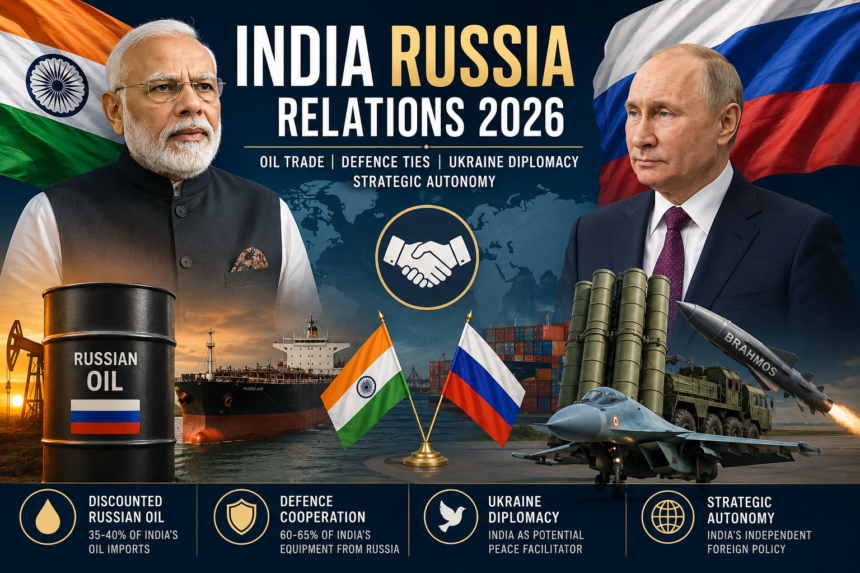
Before the Ukraine war, Russian oil accounted for only around 2–3% of India’s total crude imports. However, by 2023–24, Russian oil’s share surged to nearly 35–40% of India’s imports and has remained elevated through 2026.
India has benefited enormously from purchasing Russian Urals crude at substantial discounts to global benchmark prices. Depending on market conditions, those discounts have ranged between USD 10 and USD 20 per barrel.
With imports exceeding two million barrels per day at various points, India has saved tens of billions of dollars annually on its oil import bill. These savings have supported India’s foreign exchange reserves, helped stabilize the rupee, and reduced inflationary pressure on fuel prices.
As a result, energy trade has become the central economic pillar of the India-Russia relationship.
Payment Mechanism Challenges and Sanctions Pressure
Despite the economic benefits, India-Russia trade faces major financial complications because of Western sanctions.
Russia’s exclusion from the SWIFT banking system disrupted traditional international payment channels. Consequently, India and Russia have experimented with several alternative settlement mechanisms.
These include:
- Rupee-Rouble trade arrangements
- Third-country currency settlements through UAE dirhams
- Limited use of Chinese yuan settlements
- Transactions through intermediary banks outside Western sanctions networks
However, these arrangements have not been entirely smooth.
Russia has accumulated large reserves of Indian rupees but struggles to spend them effectively because Indian exports to Russia remain relatively limited. Meanwhile, India prefers greater use of rupee settlements to strengthen its currency internationally and reduce dollar dependence.
At the same time, the US Treasury continues monitoring Indian companies and financial institutions for possible sanctions exposure linked to Russian transactions.
Therefore, while trade volumes remain strong, financial settlement mechanisms continue to create friction beneath the surface of the partnership.
Defence Cooperation: The Core of India-Russia Strategic Relations
India’s Heavy Dependence on Russian-Origin Military Equipment
Defence remains the deepest and most strategically sensitive aspect of India-Russia relations.
Even in 2026, approximately 60–65% of India’s military inventory is of Russian or Soviet origin. This dependence has developed over decades and cannot be reduced quickly.
Indian Air Force Dependence
Russia-origin platforms continue to form the backbone of the Indian Air Force, including:
- Su-30 MKI fighter aircraft
- MiG-29 fighters
- AN-32 transport aircraft
- Remaining MiG-21 squadrons awaiting retirement
The Su-30 MKI fleet alone, consisting of over 270 aircraft, remains India’s most important combat air capability.
Indian Navy Dependence
The Indian Navy also relies heavily on Russian equipment, including:
- INS Vikramaditya aircraft carrier
- Kilo-class submarines
- Akula-class nuclear-powered submarines
- Talwar-class frigates
Russia continues to provide maintenance, spare parts, upgrades, and technical assistance critical to operational readiness.
Indian Army Dependence
The Indian Army’s dependence includes:
- T-90 Bhishma main battle tanks
- BMP-2 infantry fighting vehicles
- S-400 Triumf air defence systems
India’s missile cooperation with Russia also remains strategically significant through the BrahMos cruise missile program, widely regarded as one of India’s most successful defence joint ventures.
Ukraine War and Questions About Russian Military Equipment
Battlefield Performance and Indian Concerns
Russia’s war in Ukraine has unintentionally become a real-world testing ground for Russian military hardware.
The performance of several Russian systems has raised concerns within Indian defence circles. Russian tanks, including variants of the T-90 platform, have shown vulnerabilities against modern anti-tank guided missiles and drone warfare.
Similarly, Russian air defence systems have produced mixed results against Ukrainian drones, cruise missiles, and Western-supplied weapons.
Indian defence planners are studying these battlefield lessons carefully. As a result, the Ukraine conflict has accelerated India’s push toward defence diversification and indigenous military manufacturing under the Atmanirbhar Bharat initiative.
India is increasingly expanding defence cooperation with:
- The United States
- France
- Israel
- Domestic Indian defence manufacturers
Nevertheless, replacing Russian systems remains a long-term process because India’s logistics, maintenance infrastructure, and training systems remain deeply integrated with Russian-origin equipment.
S-400 Air Defence System and US Pressure
The CAATSA Challenge
India Russia Relations, India’s acquisition of the Russian S-400 Triumf air defence system remains one of the most contentious issues in India-US relations.
The United States introduced the CAATSA law — the Countering America’s Adversaries Through Sanctions Act — to penalize countries purchasing major Russian defence systems.
Technically, India’s S-400 deal qualified for sanctions exposure under CAATSA. However, Washington provided India with a waiver due to the broader strategic importance of the India-US partnership and shared concerns regarding China.
By 2026, the S-400 system is fully operational within India’s integrated air defence network. Although the immediate sanctions threat has eased, the issue continues to require delicate diplomatic management between New Delhi and Washington.
India’s Ukraine Diplomacy in 2026
India’s Carefully Balanced Official Position
India has consistently maintained a calibrated and carefully worded stance on the Ukraine conflict.
New Delhi has repeatedly:
- Called for dialogue and diplomacy
- Expressed concern over civilian casualties
- Supported humanitarian assistance
- Avoided directly condemning Russia
- Emphasized sovereignty and territorial integrity in general terms
At the United Nations, India has often abstained from resolutions explicitly criticizing Moscow.
This approach reflects India’s attempt to preserve strategic flexibility while avoiding direct confrontation with either Russia or the Western bloc.
India as a Potential Peace Facilitator
India has also positioned itself as a possible diplomatic intermediary in the Ukraine conflict.
Prime Minister Narendra Modi’s engagement with both President Vladimir Putin and President Volodymyr Zelensky has given India a unique communication channel with both sides.
Modi’s visit to Kyiv in 2024, combined with continued engagement with Moscow, strengthened India’s image as a country capable of speaking to all major actors involved in the conflict.
In 2026, with global pressure growing for some form of negotiated settlement, India’s intermediary role has attracted increasing international attention.
However, India’s ability to become a meaningful peace broker remains uncertain. While neither Russia nor Ukraine fully trusts India as a neutral actor, neither side has rejected India’s involvement outright.
That ambiguity creates diplomatic opportunity — but also clear limitations.
Strategic Autonomy: The Foundation of India’s Foreign Policy
Why India Refuses to Choose Sides
India Russia Relations, India’s management of its Russia relationship represents the clearest expression of its doctrine of strategic autonomy.
Strategic autonomy means India refuses to become fully aligned with any single geopolitical bloc. Instead, New Delhi seeks to maximize flexibility by maintaining relationships across competing power centers.
External Affairs Minister S. Jaishankar has repeatedly defended this approach, arguing that India’s foreign policy decisions must reflect Indian national interests rather than external pressure.
This strategy allows India to simultaneously:
- Maintain defence and energy ties with Russia
- Expand technology and investment partnerships with the US
- Participate in the Quad
- Engage economically with China where necessary
- Preserve independent diplomatic decision-making
For India, abandoning Russia entirely would reduce strategic flexibility and weaken bargaining power globally.
Russia’s Strategic Value Beyond Oil and Defence
Arctic Cooperation and Energy Interests
Russia’s Arctic resources are becoming increasingly important as climate change opens new shipping routes and energy opportunities.
India sees long-term strategic value in access to Arctic energy projects and participation in the Northern Sea Route, which could eventually reduce shipping times between Europe and Asia.
Consequently, Arctic cooperation has emerged as an additional pillar of India-Russia engagement.
Space Cooperation and Gaganyaan Support
India and Russia also maintain long-standing cooperation in the space sector.
Russia has assisted India with astronaut training for the Gaganyaan human spaceflight mission and has historically supported Indian launch capabilities and space technology development.
Although India’s space program is increasingly self-reliant, Russian expertise still plays a supporting role in certain areas.
Fertiliser and Agricultural Supply Chains
Russia remains one of India’s major suppliers of fertilizers, including potash and urea.
Maintaining these supply chains has become strategically important for India’s agricultural sector, especially amid global disruptions caused by sanctions and geopolitical instability.
As a result, fertilizer trade has quietly become another critical dimension of the bilateral partnership.
United Nations and Geopolitical Coordination
Russia’s veto power at the United Nations Security Council also carries geopolitical value for India.
Moscow has historically supported India’s bid for permanent UNSC membership and has often backed Indian positions in multilateral forums.
For New Delhi, maintaining strong ties with a permanent UNSC member remains strategically advantageous.
The Future of India-Russia Relations
Three Major Factors Will Shape the Partnership
India Russia Relations, The future trajectory of India-Russia relations will depend primarily on three major variables.
1. The Outcome of the Ukraine War
A negotiated settlement could reduce sanctions pressure and normalize economic relations. However, a prolonged conflict or continued geopolitical confrontation would preserve current tensions and financial complications.
2. India’s Defence Indigenisation
India’s long-term strategy is to gradually reduce military dependence on Russia through indigenous manufacturing and diversification.
Programs such as:
- Tejas MkII
- Indigenous missile systems
- Domestic drones
- Indian naval platforms
could slowly reduce Russian dependence over the next decade.
However, this transition will take considerable time and investment.
3. Russia’s Growing Alignment With China
Perhaps the most sensitive issue for India is Russia’s increasingly close strategic partnership with China.
India and China remain geopolitical rivals with unresolved border tensions. Therefore, deeper Russia-China alignment creates discomfort within Indian strategic circles.
If Moscow becomes excessively dependent on Beijing economically or militarily, India’s ability to maintain balanced relations with Russia could become more difficult.
Read More: India China Relations 2026: Border Dispute, Trade Tensions and Strategic Rivalry
Conclusion
India Russia Relations in 2026 is shaped by history, necessity, and strategic calculation.
Russia remains essential for India’s energy security, defence logistics, fertilizer supply chains, and geopolitical balancing strategy. At the same time, the Ukraine war, Western sanctions, and Russia’s growing closeness with China have introduced serious long-term challenges into the partnership.
India’s long-term objective is not to abruptly abandon Russia but to gradually reduce strategic dependence through defence indigenisation, diversified energy sourcing, and expanded global partnerships.
However, those transitions will take years.
In the near term, India’s most practical strategy is to continue managing its Russia relationship pragmatically while maintaining strong ties with the West. By preserving communication channels with all major powers and leveraging its unique diplomatic position, India aims to protect its national interests while potentially contributing to future peace diplomacy surrounding the Ukraine conflict.