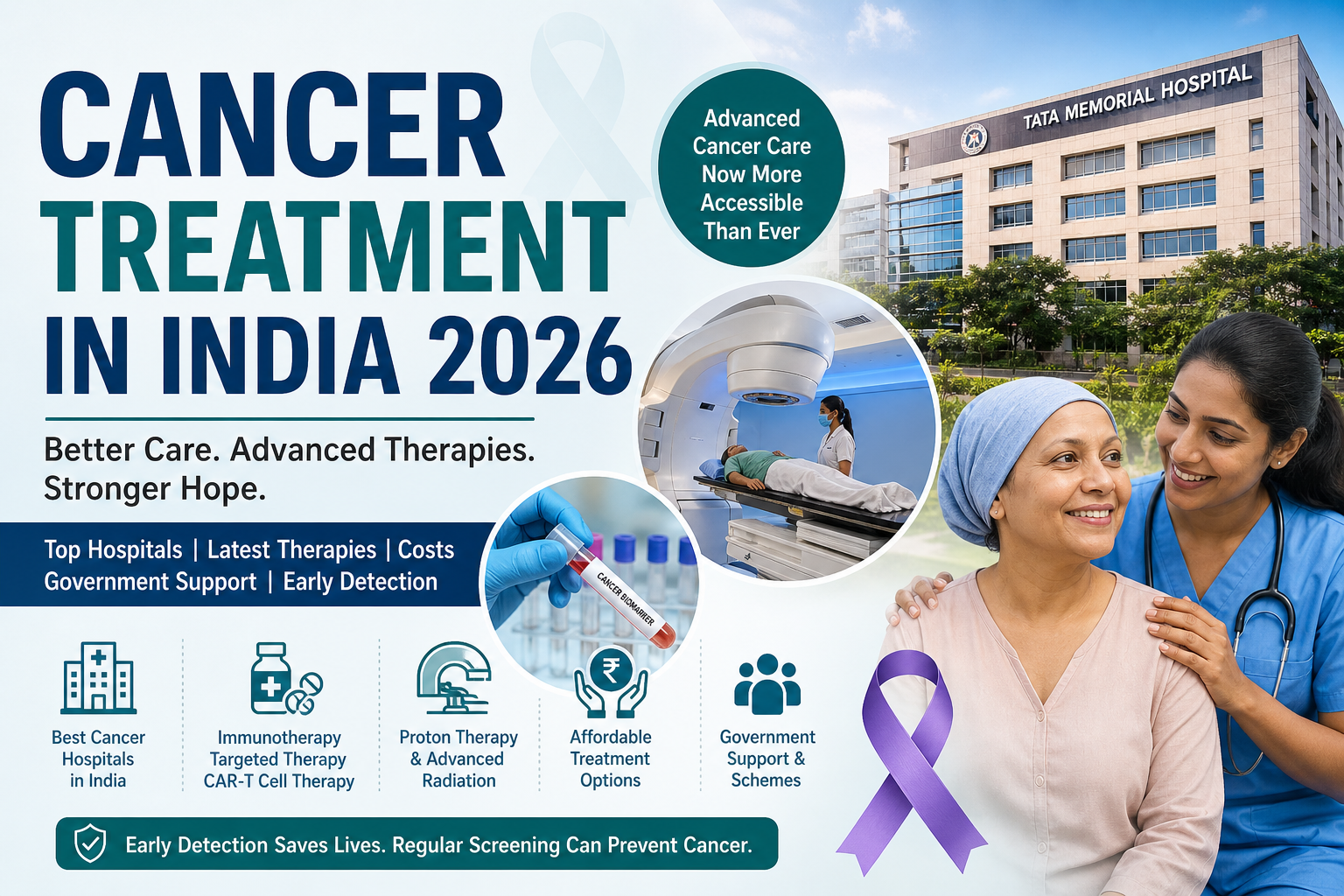
Cancer Treatment in India, Cancer has become India’s second-leading cause of disease burden — with approximately 1.46 million new cancer cases diagnosed annually and 800,000+ cancer-related deaths each year. As India’s population ages, tobacco and alcohol use remain widespread, air pollution worsens, and sedentary lifestyles spread, cancer incidence is projected to rise to 2+ million new cases per year by 2040. Understanding cancer treatment options — what is available, where to get it, how much it costs, and what support is available — has never been more important for Indian families.
The good news is that India’s cancer treatment landscape in 2026 is dramatically better than a decade ago. New therapies — immunotherapy, targeted therapy, CAR-T cell therapy, and proton beam therapy — that were previously available only in Western countries are now accessible at Indian hospitals. And India’s position as a medical tourism hub means that foreign patients are increasingly coming to India for cancer treatment, bringing world-class standards that benefit domestic patients too.
Cancer Incidence in India: Which Cancers Are Most Common?
Most Common Cancers in Indian Men
- Lip and oral cavity cancer: India has among the world’s highest rates — linked to tobacco chewing, pan masala, gutka
- Lung cancer: Driven by smoking and increasingly air pollution
- Colorectal cancer: Rising with diet westernisation
- Stomach cancer: Higher prevalence in South India
- Prostate cancer: Rising with aging population
Most Common Cancers in Indian Women
- Breast cancer: Most common cancer in Indian women — now surpassing cervical cancer
- Cervical cancer: India has the world’s second-highest burden — preventable with HPV vaccination and screening
- Ovarian cancer: Often diagnosed late due to vague symptoms
- Colorectal cancer: Rising incidence in urban India
- Thyroid cancer: Increasing detection rates in India
Best Cancer Hospitals in India 2026
Tata Memorial Hospital, Mumbai
Tata Memorial is India’s premier cancer hospital — a comprehensive cancer centre established in 1941 and consistently ranked as one of Asia’s best cancer treatment institutions. Operated by the Department of Atomic Energy, Tata Memorial provides high-quality cancer care at subsidised rates for economically disadvantaged patients. The hospital handles over 70,000 new cancer patients annually, with particular expertise in head and neck cancers, haematological malignancies, and gastrointestinal cancers.
- Key strength: Comprehensive cancer care — surgery, radiation, chemotherapy, bone marrow transplant
- Cost advantage: Significant subsidisation for economically weaker patients
- Research: Active clinical trials, internationally published cancer research
AIIMS New Delhi Cancer Centre
The All India Institute of Medical Sciences has one of India’s most comprehensive oncology departments — covering all major cancer types with the latest diagnostic and treatment technologies. AIIMS’s cancer care is provided at government rates, making it highly accessible financially. The Institute also offers advanced genetic testing for hereditary cancers and participates in multiple international clinical trials.
Apollo Cancer Centre Network
Apollo Hospitals operates a network of dedicated cancer centres across India — Chennai, Hyderabad, Delhi, Mumbai, Bangalore — providing internationally accredited cancer care with the latest technology. Apollo’s cancer centres hold JCI accreditation and use robotic surgery, proton therapy (in select centres), and advanced radiation systems.
HCG (HealthCare Global Enterprises)
HCG operates India’s largest network of cancer hospitals — over 25 centres across India. Founded by renowned oncologist BS Ajaikumar, HCG pioneered affordable advanced cancer care in Tier 2 cities, bringing techniques previously available only in metros to patients in Ahmedabad, Jaipur, Nagpur, Kolkata, and dozens of other cities. HCG’s model of volume-driven cost efficiency has dramatically improved cancer care accessibility across India.
New Cancer Therapies in India 2026
Immunotherapy: Revolutionising Certain Cancers
Immunotherapy — which harnesses the patient’s own immune system to recognise and destroy cancer cells — has transformed outcomes for several cancers that were previously considered untreatable. In India, checkpoint inhibitors (pembrolizumab, nivolumab) and other immunotherapy agents are now available for lung cancer, melanoma, bladder cancer, head and neck cancers, and several other tumour types.
- Success rates: Some metastatic cancers that previously had median survival of 12 months now show 5-year survival rates above 30% with immunotherapy
- Cost in India: Rs 1.5-4 lakh per month for biologic immunotherapy — expensive but dramatically cheaper than Western prices
- Patient selection: Immunotherapy works for patients whose tumours express PD-L1 — genetic testing essential before starting treatment
CAR-T Cell Therapy: India’s Breakthrough
Chimeric Antigen Receptor T-cell (CAR-T) therapy is the most exciting recent development in blood cancer treatment. India’s own CAR-T therapy — NexCAR19, developed by ImmunoACT — received regulatory approval from CDSCO and is being used at Tata Memorial and AIIMS for relapsed/refractory B-cell lymphomas and ALL. India’s homegrown CAR-T therapy costs approximately Rs 30-40 lakh — still expensive but a fraction of the USD 400,000+ cost in the USA.
Proton Therapy: Precision Radiation
Proton beam therapy delivers radiation with extreme precision, depositing most energy at the tumour site and minimising damage to surrounding healthy tissue. This is particularly valuable for tumours near critical structures — brain, spine, eye, paediatric cancers. Apollo Proton Cancer Centre in Chennai operates India’s first and leading proton therapy facility. AIIMS is developing proton therapy capability.
Targeted Therapy
Targeted therapies — drugs that attack specific molecular changes in cancer cells — have transformed outcomes in lung cancer (EGFR and ALK mutations), breast cancer (HER2-positive tumours), CML (imatinib), and several other cancers. India’s generic pharmaceutical sector produces affordable targeted therapy generics — dramatically improving access for Indian patients who previously could not afford branded drugs.
Cancer Treatment Costs in India 2026
Cancer Treatment in India cost vary enormously based on the type of cancer, stage at diagnosis, treatment modality, and hospital chosen:
- Surgery (most cancers): Rs 1-5 lakh depending on complexity and hospital tier
- Chemotherapy course: Rs 50,000-5 lakh depending on drugs and number of cycles
- Radiation therapy course: Rs 1-5 lakh for conventional radiation
- Immunotherapy (per cycle): Rs 1.5-4 lakh — typically 4-6 cycles minimum
- CAR-T cell therapy: Rs 30-40 lakh (India-made NexCAR19) to Rs 2 crore+ (imported)
- Bone marrow transplant: Rs 15-35 lakh depending on donor type and hospital
- Total estimated cost for common cancers (all stages): Rs 2-20 lakh for most solid tumours
Government Support for Cancer Patients
Ayushman Bharat PM-JAY
Ayushman Bharat provides Rs 5 lakh per year per family for hospitalisation — including cancer treatment. For many cancer patients, this covers surgery, chemotherapy, and radiation costs at government and empanelled private hospitals. The scheme covers over 1,700 cancer treatment procedures. Cancer patients who qualify (bottom 40% of population by income) should prioritise empanelled hospitals to access cashless care.
National Cancer Grid
The National Cancer Grid (NCG), coordinated by Tata Memorial Hospital, connects over 250 cancer treatment centres across India — enabling standardised treatment protocols, pathology review, and multi-disciplinary consultations. For patients in smaller cities, NCG membership of their local cancer centre provides a pathway to getting expert review of their case from leading oncologists.
Rashtriya Arogya Nidhi (RAN)
For below-poverty-line patients with serious illnesses including cancer, Rashtriya Arogya Nidhi provides one-time financial assistance of up to Rs 15 lakh for treatment at government medical institutions. Apply through the Medical Superintendent of the treating government hospital.
Cancer Prevention and Early Detection
The Power of Screening
Most cancer deaths in India are from cancers diagnosed at late stages — when treatment is much harder and outcomes much worse. Screening programmes — which detect cancer at early, treatable stages — can dramatically reduce cancer mortality. India’s National Programme for Cancer, Diabetes, Cardiovascular Diseases and Stroke mandates free screening for oral, breast, and cervical cancer at all government health facilities.
- Cervical cancer: Pap smear or VIA test every 3 years for women 30-65 — free at government health centres
- Breast cancer: Clinical breast examination every 2 years and mammogram (40+) — free at government centres under NPCDCS
- Oral cancer: Visual examination by trained health worker — look for white patches, non-healing ulcers, red patches in mouth
Read More: India Mental Health Policy 2026: Government Reforms, TELE MANAS & Treatment Gap
Conclusion
Cancer Treatment in India landscape in 2026 combines world-class technology at accessible costs with an expanding public health safety net. The challenge remains early detection — most cancers that kill Indian patients are diagnosed at Stage 3 or 4, when they are much harder to treat. If India can shift diagnosis to Stage 1 or 2 through expanded screening programmes and public awareness, the cancer mortality burden will fall dramatically. Until then, knowing your options — hospitals, therapies, costs, and government support — is the first step to better outcomes. Taza Newsz covers health news, cancer awareness, and patient guidance from across India.