
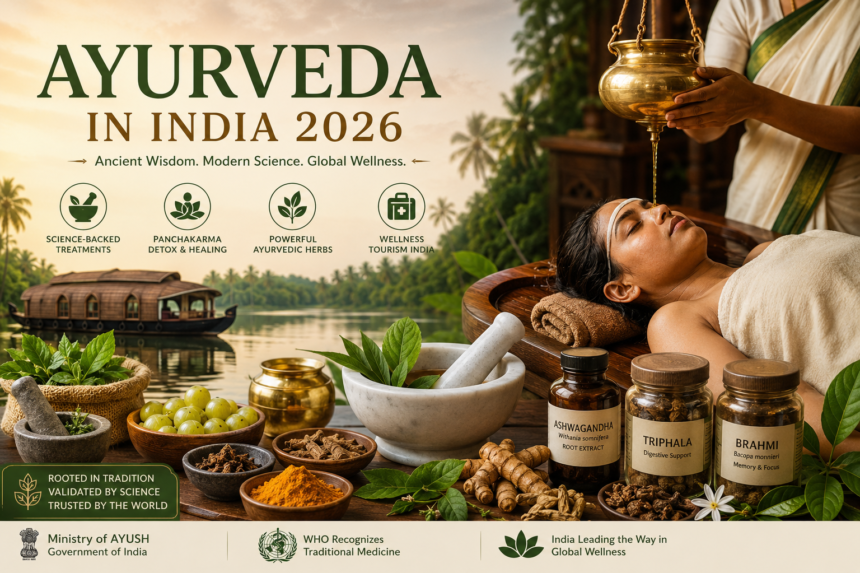
Ayurveda in India 2026 — the ancient Indian system of medicine dating back over 5,000 years — is experiencing a global renaissance in 2026. What was once dismissed by Western medicine as folk wisdom or placebo is increasingly being validated by rigorous scientific research, embraced by mainstream wellness culture, and integrated into modern healthcare systems across the world. From Kerala’s Panchakarma retreats attracting international patients to AIIMS Delhi conducting clinical trials on Ashwagandha to the WHO officially recognising traditional medicine systems — Ayurveda’s moment is emphatically now.
This comprehensive guide covers the state of Ayurveda in India in 2026 — what treatments work and are scientifically supported, how to find authentic AYUSH practitioners, Panchakarma treatments in Kerala, the science behind key Ayurvedic herbs, and how Ayurveda fits into India’s growing medical tourism ecosystem.
What Is Ayurveda? A Modern Understanding
Ayurveda (from Sanskrit: Ayus = life, Veda = knowledge) is a comprehensive system of medicine that emphasises the prevention of disease, the maintenance of health, and the personalised treatment of illness through diet, herbal medicines, lifestyle practices, physical therapies, and surgery. Its foundational concepts include:
- Tridosha theory: Vata (air and space — governs movement), Pitta (fire and water — governs transformation), and Kapha (water and earth — governs structure). Imbalance in these three doshas causes disease
- Prakriti (body constitution): Each individual has a unique constitutional type determined by their dominant doshas at birth — Ayurvedic treatment is personalised to this constitution
- Ahara (diet) as medicine: Food choices aligned with one’s constitution and season are the foundation of Ayurvedic health maintenance
- Panchakarma: The five-action detoxification and rejuvenation therapy — Ayurveda’s most comprehensive treatment protocol
Science-Validated Ayurvedic Treatments in 2026
Ashwagandha (Withania somnifera) — Most Researched Ayurvedic Herb
Ashwagandha is the most extensively researched Ayurvedic herb, with hundreds of clinical studies confirming its adaptogenic (stress-reducing), anti-inflammatory, and anabolic properties. In 2026, Ashwagandha research includes:
- Stress and anxiety: Multiple randomised controlled trials show 60-66% reduction in perceived stress scores with Ashwagandha supplementation (KSM-66 standardised extract)
- Testosterone and muscle mass: Clinically significant increases in testosterone levels, muscle strength, and muscle recovery in resistance-trained males
- Thyroid function: Shows promise in improving thyroid hormone levels in subclinical hypothyroid patients
- Cognitive function: Improvement in memory, reaction time, and cognitive task performance in clinical studies
Turmeric (Curcuma longa) — Anti-Inflammatory Powerhouse
Curcumin — turmeric’s active compound — is the most published natural compound in medical literature, with over 15,000 peer-reviewed studies. Confirmed effects:
- Anti-inflammatory: Comparable to NSAIDs (non-steroidal anti-inflammatory drugs) for osteoarthritis pain relief without gastrointestinal side effects
- Antioxidant: Powerful free-radical scavenging — relevant for cancer prevention research
- Brain health: Crosses blood-brain barrier — research shows potential in Alzheimer’s prevention
- Important caveat: Curcumin has poor bioavailability alone — must be taken with piperine (black pepper) or in lipid-soluble form for significant absorption
Triphala — Gastrointestinal Health
Triphala (three fruits: Amalaki, Bibhitaki, Haritaki) is one of Ayurveda’s most important formulations. Clinical research confirms its benefits for digestive health, gentle bowel regulation, and antioxidant protection. Unlike harsh laxatives, Triphala improves gut motility without dependence. Research also shows anti-microbial, anti-inflammatory, and hepatoprotective (liver protective) properties.
Brahmi (Bacopa monnieri) — Cognitive Enhancement
Brahmi has been traditionally used in Ayurveda for cognitive enhancement for thousands of years. Modern clinical trials confirm improvements in memory formation, recall speed, learning rate, and reduction of anxiety and depression symptoms. It is increasingly studied in the context of ADHD, age-related cognitive decline, and examination performance in students.
Panchakarma: Ayurveda’s Most Powerful Treatment
Panchakarma (five actions) is the cornerstone of classical Ayurvedic treatment — a systematic detoxification and rejuvenation protocol that removes accumulated toxins (Ama) from the body and restores doshic balance. The five classical treatments are:
- Vamana: Therapeutic emesis (induced vomiting) — for Kapha disorders
- Virechana: Therapeutic purgation — for Pitta disorders
- Basti: Medicated enema — considered the king of Panchakarma; powerful for Vata disorders
- Nasya: Nasal administration of medicated oils — for head and neck conditions
- Raktamokshana: Blood purification — bloodletting therapies for specific conditions
Ayurveda in India 2026, A classical Panchakarma programme typically lasts 14-21 days in a residential Ayurvedic centre. It is preceded by several days of Snehana (internal and external oleation) and Swedana (therapeutic sweating) to mobilise toxins before elimination. The experience — when conducted by qualified physicians using authentic classical protocols — is deeply rejuvenating and addresses conditions from chronic lifestyle diseases to autoimmune disorders.
Best Panchakarma Centres in Kerala 2026
Kottakkal Arya Vaidya Sala, Malappuram
Established in 1902, Kottakkal is India’s most respected Ayurvedic institution — manufacturing over 550 classical formulations and operating a treatment hospital. Panchakarma at Kottakkal is conducted by formally trained Ayurvedic physicians using classical protocols and the institution’s own authenticated preparations. This is the gold standard for classical Ayurvedic treatment in India.
Somatheeram Ayurvedic Health Resort, Trivandrum
India’s first internationally certified Ayurvedic resort, Somatheeram has won multiple national tourism awards. It offers comprehensive Panchakarma programmes ranging from 7 to 28 days, conducted by experienced Ayurvedic doctors in a beautiful coastal setting. The international patient coordination is excellent, making it a top choice for medical tourists.
CGH Earth Experience Hotels — Kalari Rasayana and Others
CGH Earth operates a portfolio of authentic Ayurvedic wellness properties in Kerala — from Kalari Rasayana in Fort Kochi to SwaSwara in Goa. Their integration of authentic Ayurvedic medicine with sustainable luxury hospitality is among the best in India.
AYUSH Ministry and Regulation in India 2026
Ayurveda in India 2026, The Ministry of AYUSH (Ayurveda, Yoga and Naturopathy, Unani, Siddha, and Homeopathy) has significantly expanded its mandate and budget in recent years. Key 2026 developments:
- AYUSH hospitals: Over 3,000 government AYUSH hospitals and 30,000+ AYUSH dispensaries provide accessible traditional medicine across India
- Ayurveda Day: National Ayurveda Day celebrated on Dhanwantari Jayanti — growing public awareness programme
- Quality regulation: AYUSH Ministry has strengthened quality standards for Ayurvedic medicine manufacturers — 100% compliance with Schedule M (GMP) now required
- Research funding: National Ayurveda Research Institute and Council for Scientific and Industrial Research conducting rigorous clinical trials
- International recognition: WHO’s Traditional Medicine Strategy (2025-2034) explicitly recognises Ayurveda and encourages member states to integrate traditional medicine into health systems
How to Find an Authentic Ayurvedic Practitioner
The quality of Ayurvedic practitioners varies enormously in India. Here is how to find authentic, qualified practitioners:
- BAMS (Bachelor of Ayurvedic Medicine and Surgery) degree: The minimum qualification for an Ayurvedic doctor — 5.5-year programme including internship
- MD Ayurveda: Postgraduate specialisation — seek MD-qualified physicians for complex conditions
- Government hospitals: AIIMS and All India Institute of Ayurveda (AIIA) in New Delhi offer Ayurvedic OPD with qualified doctors
- Red flags: Avoid practitioners who promise to cure cancer, diabetes, or other conditions ‘permanently’ without clinical evidence
Read More: Yoga Benefits for Indians 2026 Health Transformation: Daily Yoga for Better Health
Conclusion
Ayurveda in India 2026 occupies a fascinating position — validated by science in some areas, still requiring rigorous research in others, and embraced globally by wellness-conscious consumers. Its greatest strength — personalised, holistic, preventive healthcare — aligns perfectly with the direction modern medicine is moving. India’s opportunity is to be the world’s centre of authentic, evidence-based Ayurvedic practice.
Taza Newsz covers Ayurveda, AYUSH policy, wellness tourism, and India’s traditional medicine sector. Follow us for the latest in India’s ancient yet thoroughly modern healing tradition.