
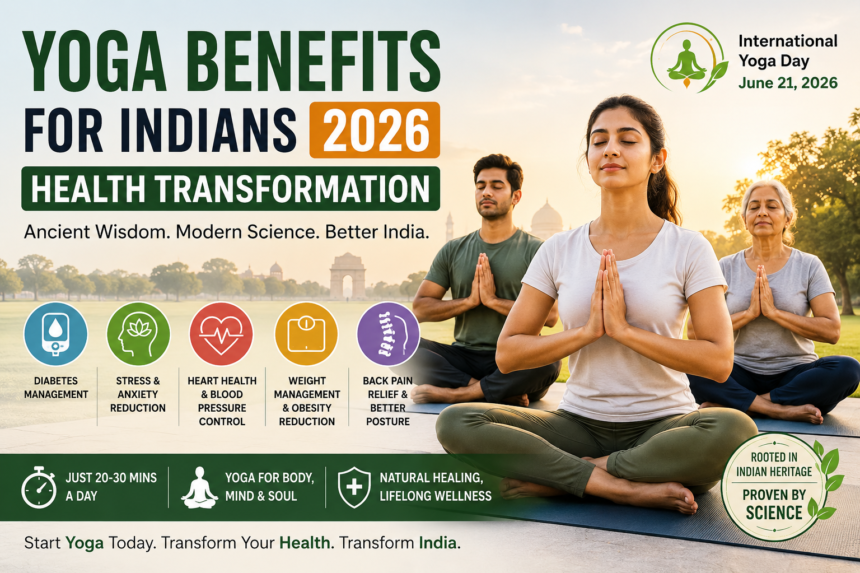
yoga benefits for Indians 2026 health transformation, In a country that introduced yoga to the world, it is one of history’s greatest ironies that millions of Indians have drifted away from this ancient practice. Instead, modern lifestyles dominated by sedentary work, processed foods, late-night screen time, and chronic stress have become the norm.
The Economic Survey 2025-26 highlighted a growing national health crisis. Rising obesity, diabetes, cardiovascular disease, anxiety disorders, and other lifestyle-related illnesses are now threatening India’s long-term health and economic productivity.
Fortunately, the solution is deeply rooted in India’s own heritage. Yoga, when practised consistently for just 30 minutes a day, offers scientifically proven health benefits that rival many pharmaceutical interventions for lifestyle diseases. Decades of modern research now confirm what traditional Indian wellness systems have long understood.
This guide explores the proven health benefits of yoga for Indians in 2026, the best yoga practices for specific health conditions, and practical ways to begin your yoga journey today — whether you are 25 or 65, physically fit or managing chronic illness.
What the Science Says: Proven Health Benefits of Yoga
Diabetes Management and Blood Sugar Control
yoga benefits for Indians 2026 health transformation, India’s diabetes epidemic continues to worsen, with more than 101 million diabetics recorded in 2026. As a result, yoga has emerged as one of the most effective complementary therapies for diabetes management.
Multiple clinical studies have shown that regular yoga practice can significantly reduce fasting blood glucose levels, improve HbA1c readings, and enhance insulin sensitivity. A landmark study published in the Indian Journal of Physiology and Pharmacology found that 40 days of yoga reduced fasting blood sugar by an average of 26 mg/dL among Type 2 diabetic patients.
Several yoga asanas are especially beneficial for diabetes management:
- Mandukasana (Frog Pose): Helps massage and stimulate the pancreas
- Dhanurasana (Bow Pose): Activates abdominal organs and improves digestion
- Paschimottanasana (Seated Forward Fold): Supports metabolic function
- Vakrasana (Twisted Pose): Encourages pancreatic stimulation
- Anulom Vilom and Kapalabhati Pranayama: Regulate the autonomic nervous system and improve metabolic balance
Stress and Anxiety Reduction
Yoga is now considered one of the most evidence-based interventions for stress and anxiety management. These conditions currently affect an estimated 200 million Indians.
Scientific research shows that yoga activates the parasympathetic nervous system — commonly known as the body’s “rest and digest” system. In addition, yoga reduces cortisol levels, lowers mental fatigue, and promotes the release of GABA, a neurotransmitter associated with reduced anxiety and emotional stability.
The unique strength of yoga lies in its integrated approach. A single yoga session combines:
- Physical movement through asanas
- Controlled breathing through pranayama
- Mental relaxation through meditation
Together, these practices address stress from physical, neurological, and emotional angles simultaneously.
Research conducted by the National Institute of Mental Health and Neurosciences (NIMHANS) has documented significant reductions in anxiety and depression symptoms among individuals who practise yoga consistently.
Back Pain Relief
Back pain remains one of India’s most common musculoskeletal problems. Experts estimate that nearly 60% of Indians experience back pain at some point in life.
Modern work culture has worsened the issue considerably. Long desk hours, poor posture, extended commuting times, and weak core muscles are major contributing factors.
Fortunately, several systematic reviews have confirmed that yoga is as effective as physiotherapy — and often more effective than passive treatments such as bed rest or heat packs — for non-specific lower back pain.
The following yoga poses are particularly effective:
Balasana (Child’s Pose)
This pose gently stretches the lower back while helping decompress the spine.
Marjaryasana-Bitilasana (Cat-Cow Pose)
Cat-Cow improves spinal flexibility, increases mobility, and warms up the back muscles safely.
Bhujangasana (Cobra Pose)
Cobra Pose strengthens the erector muscles of the spine and improves posture.
Setu Bandha Sarvangasana (Bridge Pose)
Bridge Pose strengthens the glutes, lower back, and posterior chain muscles.
Supta Matsyendrasana (Supine Twist)
This relaxing twist releases tension stored in the lower back and hips.
Heart Health and Blood Pressure Control
Cardiovascular disease remains the leading cause of death in India. Therefore, preventive health practices have become more important than ever.
Yoga offers measurable cardiovascular benefits because it combines gentle aerobic movement, stress reduction, improved breathing efficiency, and autonomic nervous system regulation.
Studies have shown that regular yoga practice can:
- Reduce systolic blood pressure by 5–10 mmHg
- Lower LDL (“bad”) cholesterol
- Improve heart rate variability
- Reduce inflammation markers
- Lower the risk of cardiac events in high-risk individuals
Moreover, yoga improves sleep quality and stress resilience, both of which are strongly linked to long-term heart health.
Weight Management and Obesity Reduction
Although yoga burns fewer calories than high-intensity workouts like running or cycling, its impact on weight management is substantial.
Yoga supports healthy weight loss through multiple mechanisms:
- Improves mindfulness around eating habits
- Reduces emotional and stress-related overeating
- Enhances metabolism
- Improves hormonal balance
- Encourages long-term lifestyle discipline
Certain poses, particularly Sarvangasana and Halasana, are believed to stimulate thyroid function and metabolic activity.
Meanwhile, more vigorous yoga styles such as Power Yoga and Ashtanga Yoga provide genuine cardiovascular conditioning and calorie expenditure.
Best Yoga Practices for Common Indian Health Conditions
Yoga for PCOD and PCOS
Polycystic Ovary Syndrome (PCOS) affects an estimated 10–20% of Indian women of reproductive age. Stress, insulin resistance, hormonal imbalance, and sedentary lifestyles all contribute to the condition.
Yoga helps by:
- Reducing cortisol levels
- Improving insulin sensitivity
- Supporting hormonal regulation
- Enhancing reproductive health
Recommended practices include:
- Supta Baddha Konasana
- Bharadvajasana
- Janu Sirsasana
- 20 minutes of daily Pranayama
Consistent practice may also improve menstrual regularity and emotional wellbeing.
Yoga for Thyroid Disorders
Both hypothyroidism and hyperthyroidism are increasingly common in India. Genetic factors, stress, and iodine imbalance contribute significantly to thyroid disorders.
Yoga practices involving gentle inversions may help stimulate thyroid gland activity. Commonly recommended poses include:
- Sarvangasana (Shoulder Stand)
- Matsyasana (Fish Pose)
However, individuals with thyroid disorders should always practise under qualified guidance, especially when attempting inversion-based postures.
International Yoga Day 2026: June 21
yoga benefits for Indians 2026 health transformation, International Yoga Day is celebrated globally every year on June 21. Prime Minister Narendra Modi first proposed the idea at the United Nations in 2014, and it has since become one of the world’s largest wellness movements.
In 2026, the theme for International Yoga Day continues to focus on “Yoga for Self and Society”, highlighting both personal wellbeing and yoga’s broader contribution to social harmony and global health.
Across India and in more than 180 countries worldwide, governments, schools, wellness organisations, and local communities organise:
- Free yoga sessions
- Public wellness campaigns
- Meditation workshops
- Fitness awareness drives
Major national events are usually hosted at prominent locations in Delhi, with millions participating across the country.
Mark the date — June 21, 2026 — and join your nearest yoga event.
How to Start Yoga in 2026: Beginner’s Guide
Start With Just 20–30 Minutes Daily
You do not need 90-minute sessions to experience the benefits of yoga. Research consistently shows that even 20–30 minutes of daily practice can deliver measurable health improvements within 8–12 weeks.
The key is consistency rather than intensity.
Start small, practise regularly, and gradually increase both duration and complexity.
Find the Right Yoga Style for Your Goals
Hatha Yoga
Slow and foundational, Hatha Yoga is ideal for beginners and older adults.
Vinyasa Yoga
Dynamic and flowing, Vinyasa Yoga suits younger practitioners seeking cardiovascular benefits.
Ashtanga Yoga
Structured and physically demanding, Ashtanga is excellent for disciplined practitioners who enjoy fixed sequences.
Iyengar Yoga
Focused on alignment and precision, Iyengar Yoga is highly effective for rehabilitation and injury recovery.
Yin Yoga
This slow-paced style uses long-held poses and is particularly effective for flexibility and stress relief.
Power Yoga
Fitness-focused and vigorous, Power Yoga is ideal for individuals wanting a workout-oriented yoga experience.
Free Resources to Learn Yoga Online
Several excellent platforms now make yoga accessible from home:
- Yoga with Adriene (YouTube): One of the world’s most popular beginner-friendly yoga channels
- Isha Foundation: Offers authentic Indian yoga programs and free introductory sessions
- Art of Living: Provides online and offline programs developed by Sri Sri Ravi Shankar
- AYUSH Ministry’s mYoga App: Official Indian government app offering structured yoga guidance
These resources are especially useful for beginners who want to build confidence before joining in-person classes.
Yoga in India: Economic and Cultural Opportunity
India’s yoga economy is now valued at more than Rs 80,000 crore in 2026 and continues to grow rapidly.
Several industries linked to yoga are expanding, including:
- Yoga teacher training
- Wellness retreats
- Yoga therapy
- Corporate wellness programs
- Yoga apparel and accessories
- Yoga tourism
For young Indians exploring careers in wellness, a Registered Yoga Teacher (RYT) certification from Yoga Alliance remains one of the most internationally recognised qualifications in the industry.
As global interest in holistic health continues to rise, India remains uniquely positioned as the world’s spiritual and cultural hub for yoga education.
Read More: Pariksha Pe Charcha 2026 Becomes a Nationwide Movement for Stress-Free Exams
Conclusion
yoga benefits for Indians 2026 health transformation, with diabetes, heart disease, obesity, anxiety, and lifestyle disorders reaching epidemic levels, yoga is no longer just a hobby or wellness trend. It has become a practical public health intervention.
Its greatest advantage is accessibility. Yoga requires no expensive equipment, no gym membership, and no complicated infrastructure. All you truly need is a clean floor, a few minutes of daily commitment, and the willingness to begin.
Start today. Even five minutes of Pranayama and five rounds of Surya Namaskar can become the foundation of lifelong health.
Follow Taza Newsz for more yoga tips, wellness updates, and practical health guidance designed for the realities of Indian life in 2026.