
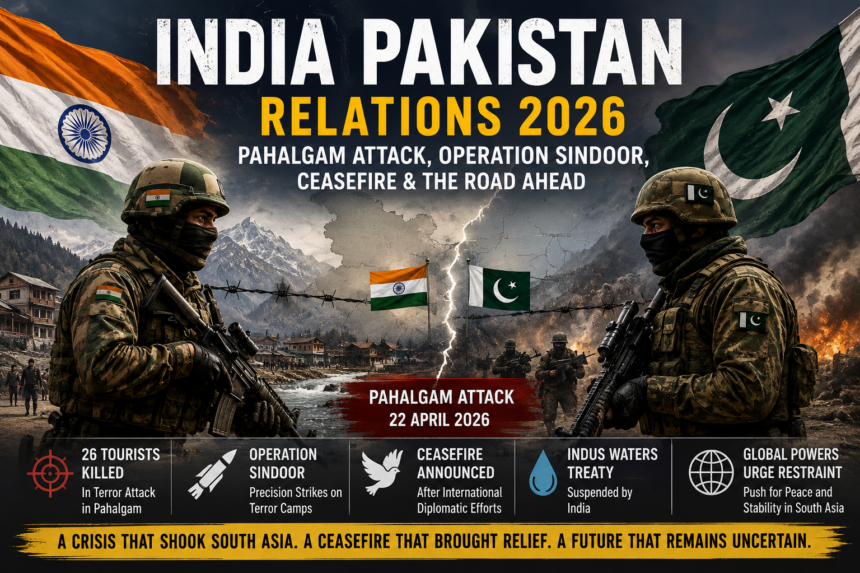
India Pakistan Relations 2026 have entered one of the most dangerous phases since the 1999 Kargil conflict. The April 2026 terrorist attack in Pahalgam, Kashmir — which killed 26 tourists in one of the deadliest civilian attacks in the Valley in recent years — triggered a rapid escalation between the two nuclear-armed neighbours.
What followed was a chain of military, diplomatic, and strategic developments that pushed the region to the brink of open conflict before international pressure and backchannel diplomacy helped secure a ceasefire.
This article provides a detailed and factual overview of the India-Pakistan crisis in 2026, including the Pahalgam attack, India’s military response through Operation Sindoor, the ceasefire negotiations, diplomatic fallout, suspension of bilateral agreements, and the wider geopolitical implications for South Asia.
The Pahalgam Attack: What Happened?
On April 22, 2026, heavily armed terrorists attacked tourists in the Baisaran Valley near Pahalgam in Jammu and Kashmir’s Anantnag district. The assault killed 26 people, most of whom were Hindu tourists visiting Kashmir from different Indian states. Several others were injured.
The attack quickly became one of the most horrific acts of civilian-targeted violence in Kashmir in over two decades. Survivors described scenes of panic and chaos as gunmen opened fire in a popular tourist area known for its scenic meadows and trekking routes.
Indian security agencies attributed the attack to The Resistance Front (TRF), which India describes as a proxy organisation linked to the Pakistan-based terror group Lashkar-e-Taiba. Lashkar-e-Taiba is designated as a terrorist organisation by the United Nations Security Council.
Following the attack, India accused Pakistan-based networks of providing logistical and operational support to the attackers. Indian authorities also demanded accountability from Islamabad and stated that cross-border terrorism remained the central obstacle to peace in the region.
India’s Military Response: Operation Sindoor
In response to the Pahalgam attack, India launched Operation Sindoor, a series of precision military strikes targeting what the Indian government described as terrorist camps and operational infrastructure located in Pakistan and Pakistan-Occupied Kashmir (PoK).
According to Indian military officials, the operation was carefully calibrated and designed to avoid escalation into full-scale war. India stated that the strikes targeted only terrorist infrastructure and deliberately avoided Pakistani military bases or civilian population centres.
Indian officials described the operation as:
- Focused
- Measured
- Precise
- Non-escalatory
The government maintained that Operation Sindoor was a counter-terrorism response rather than an act of war against Pakistan as a sovereign state.
Pakistan, however, rejected India’s justification and condemned the strikes as a violation of its sovereignty. Pakistani officials described the operation as an act of aggression and warned that Islamabad reserved the right to respond.
As tensions increased, military activity intensified across the Line of Control (LoC), including drone interceptions, artillery exchanges, and cross-border firing in sensitive sectors.
Rising Military Tensions and International Alarm
India Pakistan Relations 2026, The days following Operation Sindoor saw a sharp increase in military tensions between the two countries. Border regions in Jammu and Kashmir experienced repeated exchanges of fire, while air defence systems on both sides remained on high alert.
The rapid escalation alarmed the international community because both India and Pakistan possess nuclear weapons. Global powers feared that even limited conventional military exchanges could spiral into a broader regional conflict.
Consequently, several countries launched urgent diplomatic efforts to de-escalate the situation.
Among the nations actively involved were:
- United States
- China
- Saudi Arabia
- United Arab Emirates (UAE)
- United Kingdom
- European partners
Reports indicated that senior American officials held emergency conversations with both Indian and Pakistani leadership to prevent further escalation.
The Ceasefire: How De-escalation Happened
After several days of heightened military exchanges, India and Pakistan agreed to a ceasefire aimed at reducing immediate tensions along the border.
However, both countries framed the ceasefire differently.
India described the ceasefire as conditional and tactical. New Delhi clarified that the pause applied only to active military hostilities and did not restrict India’s right to respond to future terrorist attacks.
Pakistan, meanwhile, presented the agreement as a mutual decision taken in the broader interest of regional stability.
Diplomatic observers noted that the ceasefire was achieved through a combination of:
- International diplomatic pressure
- Military risk calculations
- Backchannel communication
- Economic concerns
- Fear of uncontrolled escalation
Although firing along the LoC significantly reduced after the agreement, analysts stressed that the ceasefire represented a temporary pause rather than a long-term political solution.
Diplomatic Fallout Between India and Pakistan
Suspension of the Indus Waters Treaty
One of the most significant developments during the crisis was India’s suspension of the Indus Waters Treaty.
Signed in 1960 and mediated by the World Bank, the treaty governs the sharing of water from the Indus river system between India and Pakistan. Despite multiple wars and decades of hostility, the agreement had survived previous crises and was often viewed as one of the few stable pillars of bilateral engagement.
India’s decision to suspend the treaty marked an extraordinary escalation in diplomatic pressure.
The implications are especially serious for Pakistan because the country relies heavily on Indus river waters for agriculture and irrigation. Analysts described the move as one of the strongest non-military leverage tools India has used against Pakistan in decades.
Trade and People-to-People Relations Frozen
India Pakistan Relations 2026, Bilateral trade between India and Pakistan had already declined sharply over previous years. Following the 2026 crisis, remaining trade links were effectively suspended.
Key developments included:
- Closure of the Integrated Check Post at Wagah-Attari
- Suspension of cross-border trade activity
- Continued freeze on bilateral cricket series
- Halt to educational and cultural exchanges
- Restrictions on people-to-people engagement
Pakistan also withdrew Most Favoured Nation (MFN)-equivalent trade treatment for India.
As a result, diplomatic and social engagement between the two countries has reached one of its lowest points in recent history.
Diplomatic Downgrades
Both countries reduced the scale of their diplomatic presence.
High commissioners were recalled, embassy staffing levels were reduced, and official diplomatic communication became limited. Nevertheless, neither side completely severed diplomatic ties.
Minimal diplomatic channels remained operational and reportedly played an important role during ceasefire negotiations and crisis management discussions.
International Response: Global Powers React
United States
The United States strongly condemned the Pahalgam attack and expressed condolences to the victims’ families.
Washington also called for restraint from both India and Pakistan while simultaneously urging Pakistan to take “verifiable action” against terrorist organisations operating from its territory.
This language was widely interpreted as broadly supportive of India’s longstanding concerns regarding cross-border terrorism.
At the same time, the United States focused heavily on preventing military escalation between the two nuclear powers.
China
China adopted a more cautious position during the crisis.
Beijing called for restraint from both sides and offered support for diplomatic dialogue. However, China did not explicitly describe the Pahalgam incident as a terrorist attack, a stance that drew criticism from India.
China’s position was closely watched because of its strategic partnership with Pakistan and its major economic investments in the region, particularly through the China-Pakistan Economic Corridor (CPEC).
Saudi Arabia and the UAE
Saudi Arabia and the United Arab Emirates engaged in quiet diplomatic outreach aimed at reducing tensions.
Both Gulf countries maintain strong economic and political relations with India and Pakistan. Additionally, millions of Indian and Pakistani citizens work in Gulf states, giving these countries significant leverage and regional influence.
Their role in backchannel diplomacy was considered important in encouraging restraint on both sides.
Impact on Ordinary Citizens
Impact on Indian Citizens
For most Indians, the direct security impact remained limited because military activity was largely concentrated near border regions and sensitive areas in Jammu and Kashmir.
Economically, the disruption caused relatively little damage to India because bilateral trade with Pakistan was already minimal.
However, the psychological and political impact inside India was significant. Public opinion strongly supported a firm response against terrorism, and national security became a dominant public discussion point.
Impact on Border States
Residents in border areas of Punjab, Jammu and Kashmir, and Rajasthan experienced the most immediate effects of the conflict.
Several districts witnessed:
- Cross-border shelling
- Temporary evacuations
- School closures
- Civilian casualties and injuries
- Emergency shelter operations
Following the ceasefire, conditions in most affected regions gradually stabilised, although security forces remained on high alert.
The Nuclear Dimension: Why the World Closely Watches India and Pakistan
Every India-Pakistan crisis carries the risk of nuclear escalation.
Both countries possess nuclear weapons, and this reality fundamentally shapes how military confrontations unfold in South Asia. Although India officially maintains a no-first-use nuclear doctrine, Pakistan’s policy remains comparatively ambiguous.
This nuclear backdrop explains why the international community reacts rapidly whenever tensions rise between the two countries.
Ironically, many analysts argue that nuclear deterrence has also enabled limited conventional military exchanges below the nuclear threshold. Both sides often calculate that the other will avoid uncontrolled escalation because of the catastrophic risks associated with nuclear conflict.
Nevertheless, this strategic logic is tested during every major crisis.
Key Requirements for Long-Term Stability
1. Credible Action Against Terror Groups
India continues to insist that Pakistan must take verifiable action against internationally designated terrorist organisations operating from its territory.
2. Restoration of Diplomatic Dialogue
Regular diplomatic engagement and structured bilateral talks are considered essential for reducing misunderstandings and preventing future crises.
3. Stronger Ceasefire Monitoring
Some experts advocate for improved monitoring mechanisms along the Line of Control that are trusted by both sides.
4. Economic Engagement
Analysts frequently argue that economic cooperation and regional trade could reduce incentives for prolonged hostility and create shared interests in stability.
Can Peace Return? The Long-Term Outlook
Despite the ceasefire, the core issues driving India-Pakistan hostility remain unresolved.
These include:
- Cross-border terrorism
- The status of Jammu and Kashmir
- Deep political mistrust
- Security competition
- Regional geopolitical rivalry
Most strategic analysts believe that meaningful de-escalation would require several major developments.
Read More: Operation Sindoor: A Bold Mission Against Terror in Jammu and Kashmir
Conclusion
India Pakistan Relations 2026 are at one of their lowest points in years.
The Pahalgam attack was both a human tragedy and a major security crisis. India’s response through Operation Sindoor, followed by military tensions and an internationally supported ceasefire, has reshaped the regional security environment once again.
Although the ceasefire reduced immediate risks, it did not resolve the underlying causes of conflict between the two countries.
What remains clear is that:
- India’s tolerance for cross-border terrorism has sharply diminished
- Pakistan continues to face international pressure regarding extremist groups
- Global powers prioritise stability in South Asia
- Ordinary citizens on both sides benefit far more from peace than prolonged hostility
The future of India-Pakistan relations will depend on whether both countries can move beyond crisis management and toward sustained political engagement. Until then, the region is likely to remain in a state of fragile and uneasy stability.