
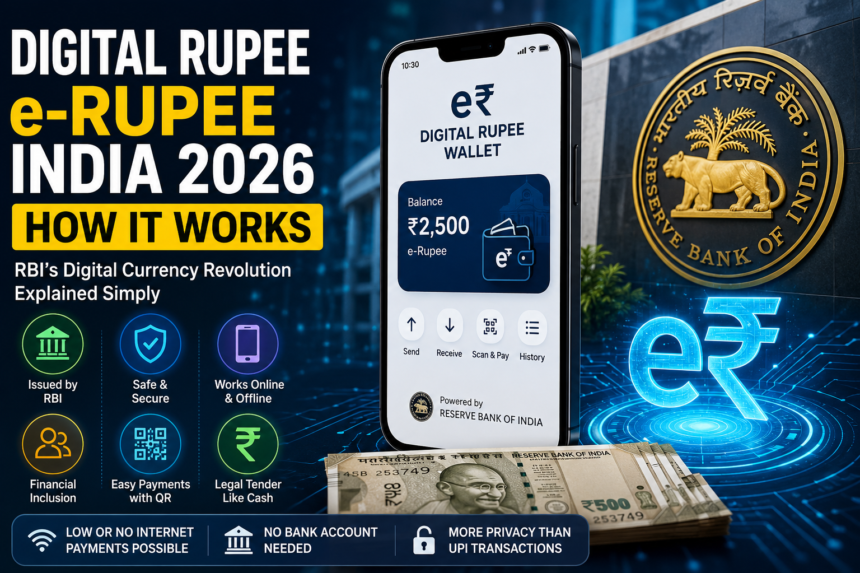
Digital Rupee e-Rupee India 2026 How It Works, India is in the middle of a quiet financial revolution that many people still do not fully understand. While UPI continues to dominate headlines as the country’s biggest digital payments success story, the Reserve Bank of India (RBI) has been steadily developing and expanding something far more significant — the Digital Rupee, officially known as the Central Bank Digital Currency (CBDC) or e-Rupee.
Unlike UPI, which simply acts as a platform for transferring money between bank accounts, the Digital Rupee is actual money issued directly by the RBI in digital form. In simple terms, it is the digital equivalent of physical cash.
This distinction is extremely important. As the Digital Rupee expands further across India in 2026, every Indian should understand what it is, how it works, why the government is promoting it, and what it could mean for the future of money in the country.
What Is the Digital Rupee (e-Rupee)?
The Digital Rupee is India’s official Central Bank Digital Currency. It is a digital version of the sovereign Indian Rupee issued directly by the RBI.
However, it is important to understand what the Digital Rupee is not.
It is not cryptocurrency like Bitcoin. It is also not a UPI payment service. Instead, the Digital Rupee is legal tender, exactly like the currency notes in your wallet, except that it exists entirely in digital form.
For example, when you hold a Rs 500 note, you are effectively holding a claim issued by the RBI. Similarly, the Digital Rupee represents the same claim on the RBI, but in digital format stored inside a digital wallet.
Most importantly, the Digital Rupee does not necessarily require a traditional bank account for transactions. This makes it fundamentally different from UPI-based payment systems.
Digital Rupee vs UPI: Key Differences Explained
Although many Indians compare the Digital Rupee with UPI, the two systems are completely different in nature.
Nature of Transaction
UPI transfers money between bank accounts. In contrast, the Digital Rupee itself is money, functioning like digital cash.
Bank Dependency
UPI requires users to have a linked bank account. On the other hand, the Digital Rupee can operate through a digital wallet without depending entirely on a bank account.
Interest Earnings
Money stored in bank accounts can earn interest. However, Digital Rupee holdings do not generate interest, similar to physical cash.
Issuing Authority
UPI is operated by NPCI. Meanwhile, the Digital Rupee is issued directly by the Reserve Bank of India.
Offline Capability
Another major advantage is offline functionality. The Digital Rupee can work in limited or no internet conditions for smaller transactions, while UPI usually requires an active internet connection.
Privacy
Digital Rupee payments are expected to offer greater transaction privacy compared to standard UPI transfers because they may not appear in traditional bank statements in the same way.
Technology Infrastructure
UPI runs on existing banking rails. Meanwhile, the Digital Rupee uses blockchain-inspired distributed ledger technology developed under RBI supervision.
Digital Rupee vs Cryptocurrency: Why They Are Completely Different
Many people still confuse the Digital Rupee with cryptocurrencies such as Bitcoin or Ethereum. However, the two are fundamentally different.
Issuer
The Digital Rupee is issued and backed by the RBI. Cryptocurrencies are privately created and operate without government backing.
Legal Status
The Digital Rupee is legal tender in India. Bitcoin and other cryptocurrencies are not legal tender and are largely treated as speculative digital assets.
Price Stability
The value of the Digital Rupee always remains equal to one Indian Rupee. Cryptocurrencies, however, experience massive price fluctuations.
Regulation
The Digital Rupee is fully regulated by Indian authorities. Cryptocurrency regulation in India remains uncertain and continuously evolving.
Purpose
The primary purpose of the Digital Rupee is everyday transactions and payments. Cryptocurrencies are mainly used for investment, speculation, and trading.
Traceability
Digital Rupee transactions are traceable by regulators when required. In comparison, cryptocurrencies operate through pseudonymous blockchain systems.
How Is the Digital Rupee Being Rolled Out in India?
The RBI has introduced the Digital Rupee gradually through both retail and wholesale pilot programs.
Retail CBDC for Citizens
The RBI launched the retail Digital Rupee pilot in December 2022 across selected cities and banks.
By 2026, the e-Rupee is available through digital wallets offered by several participating banks, including:
- SBI
- HDFC Bank
- ICICI Bank
- Kotak Mahindra Bank
- YES Bank
- IDFC First Bank
- HSBC
- Bank of Baroda
Users can download their bank’s Digital Rupee wallet app, transfer money from their bank account into the wallet, and make payments using QR codes or wallet IDs.
Although the interface may look similar to apps like PhonePe or Google Pay, the underlying system is very different. Instead of transferring bank balances, users are actually transferring RBI-issued digital cash.
Wholesale CBDC for Financial Institutions
The wholesale Digital Rupee is designed for banks and financial institutions.
It is mainly used for interbank settlements and government securities transactions. While ordinary citizens may never directly interact with the wholesale CBDC, it can significantly improve the efficiency and speed of India’s financial infrastructure.
How to Use the Digital Rupee in 2026: Step-by-Step
Using the Digital Rupee has become increasingly simple in 2026.
Step 1: Download the Wallet
First, download your bank’s official Digital Rupee wallet application.
Step 2: Complete KYC
Next, complete the KYC verification process using your existing banking details.
Step 3: Load e-Rupee
Transfer funds from your savings account into your Digital Rupee wallet.
Step 4: Make Payments
At participating merchants, scan the Digital Rupee QR code or enter the merchant’s wallet ID.
Step 5: Confirm Transaction
Confirm the payment amount and complete the transaction instantly.
Step 6: Balance Updates
After payment, your wallet balance decreases while the merchant’s Digital Rupee wallet balance increases immediately.
Importantly, small-value transactions can also work in offline environments with limited connectivity.
Where Can You Use the Digital Rupee in India in 2026?
The acceptance network for the Digital Rupee continues to grow steadily across India.
As of 2026, the e-Rupee is accepted at:
- Major supermarkets and retail chains in cities such as Delhi, Mumbai, Bengaluru, Bhubaneswar, and Chandigarh
- Government service counters for utility bills and property taxes in selected municipalities
- Online merchants integrated with Digital Rupee systems
- Person-to-person transfers between Digital Rupee wallet users
Although acceptance is expanding rapidly, the system is still not universally available nationwide.
However, many merchants that already support UPI QR payments are gradually integrating Digital Rupee acceptance as well.
Why Is the RBI Promoting the Digital Rupee?
Digital Rupee e-Rupee India 2026 How It Works, The RBI sees the Digital Rupee as a major long-term innovation for India’s financial ecosystem.
Financial Inclusion
One of the biggest goals is financial inclusion.
Because the Digital Rupee can potentially operate without a full bank account, it could help millions of unbanked Indians access digital payments more easily.
This is especially important in rural areas where traditional banking infrastructure remains limited.
Reducing Cash Management Costs
India remains heavily dependent on physical cash. Printing, transporting, and securing currency notes is extremely expensive.
The Digital Rupee offers the convenience of digital payments while preserving many characteristics of physical cash.
Countering Private Cryptocurrencies
The RBI has repeatedly expressed concerns about private cryptocurrencies.
By introducing the Digital Rupee, the central bank aims to provide a secure government-backed alternative that supports digital transactions without the volatility and risks associated with crypto assets.
Is the Digital Rupee Safe?
Yes, the Digital Rupee is considered extremely safe because it is directly backed by the RBI.
In many ways, it carries the same trust level as physical currency notes issued by the central bank.
However, users should still remain cautious.
Wallet Recovery Risks
If users lose access to their Digital Rupee wallet without proper recovery options, regaining access could become difficult.
Technology Is Still Evolving
Since the infrastructure is still relatively new, the RBI continues to improve scalability, security, and transaction systems.
Use Only Official Apps
Users should always download Digital Rupee wallets only from official bank applications. Avoid third-party apps claiming to provide unofficial Digital Rupee services.
Read More: EPF Withdrawal Through UPI: How PF Money Could Become Instantly Accessible
Conclusion
Digital Rupee e-Rupee India 2026 How It Works, The Digital Rupee represents one of the biggest transformations in India’s financial system in decades.
Although it is not replacing UPI, bank accounts, or physical cash immediately, it is steadily becoming an important part of India’s digital economy.
As adoption increases in 2026 and beyond, the e-Rupee could reshape financial inclusion, government payments, retail transactions, and the broader future of money in India.
Follow Taza Newsz for the latest updates on Digital Rupee expansion, new city launches, RBI announcements, and everything related to India’s growing digital money revolution.