
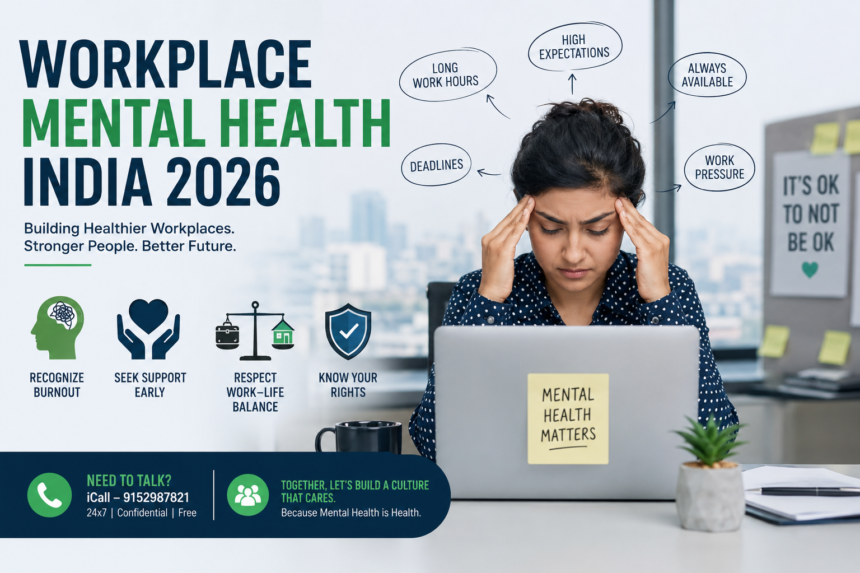
Workplace Mental Health India, Anna Sebastian Pekai was 26 years old, just four months into her job at Ernst and Young India, when she died in July 2024. Her mother’s heartbreaking letter to EY’s India chairman — describing the crushing work pressure her daughter faced — went viral and sparked India’s most significant conversation about workplace mental health in decades. That conversation has not stopped. In 2026, employee mental health, work-life balance, and corporate wellness have moved from HR periphery to boardroom priority — driven by the twin pressures of talent retention and genuine human concern.
The statistics are alarming. Multiple surveys in 2025-2026 suggest that over 60% of Indian professionals report experiencing burnout symptoms, with IT, consulting, banking, and startup sectors showing the highest rates. India’s always-on work culture — perpetuated by WhatsApp groups, midnight emails, and the unspoken expectation of availability beyond official hours — is taking a measurable toll on the health, relationships, and productivity of millions of Indian workers.
Understanding Burnout: Not Just Tiredness
The World Health Organization defines burnout as an occupational syndrome resulting from chronic workplace stress that has not been successfully managed. It is characterised by three dimensions:
- Exhaustion: Feeling depleted of physical and emotional energy — even after rest
- Cynicism: Increased mental distance from your job, or negative and detached feelings about your work
- Reduced professional efficacy: A sense that you are not doing your work well, declining performance and confidence
Workplace Mental Health India, The key word is chronic — burnout is not a bad week or a difficult project. It is the accumulated consequence of sustained, unmanaged work stress over months or years. And it does not resolve with a weekend holiday or a few days of leave — it requires genuine recovery and often structural change in the work environment.
Burnout Symptoms: Physical, Mental, Behavioural
- Physical: Chronic headaches, digestive problems, frequent illness (reduced immunity), sleep disorders, chest pain
- Mental: Difficulty concentrating, forgetfulness, loss of creativity, pervasive feelings of failure and self-doubt
- Behavioural: Isolating from colleagues and family, decreased satisfaction from work previously enjoyed, increased cynicism and negativity, missing deadlines, reduced output quality
The Indian Work Culture Problem
Always-On Culture
India’s corporate work culture — particularly in IT, consulting, banking, law firms, and startups — is characterised by an expectation of constant availability. WhatsApp groups from reporting managers, emails at 11pm, weekend calls ‘just this once’, and the implicit understanding that leaving on time is ‘not committed enough’ create a systematic inability to psychologically disconnect from work.
Long Working Hours
India has no statutory maximum working hours for most private sector employees — the Factory Act limits apply to factories, but office workers are largely unprotected. A 2025 survey found that 35% of Indian corporate employees regularly work more than 60 hours per week. EY’s own submission following the Anna Sebastian tragedy acknowledged that work pressure had not been adequately managed.
Stigma Around Mental Health
Despite growing awareness, mental health stigma in Indian workplaces remains significant. Many employees fear that disclosing mental health struggles will lead to being perceived as weak, unreliable, or ‘not a fit’. This fear — often justified by real experiences of discrimination — prevents employees from seeking help until they are in crisis.
Your Legal Rights as an Employee in India: Mental Health
The Mental Healthcare Act 2017
The Mental Healthcare Act 2017 explicitly guarantees that every person has the right to access mental health care and treatment. Section 18 states that every person shall have the right to access mental health care and treatment. Importantly, the Act prohibits discrimination in employment on the basis of mental illness — employers cannot terminate an employee solely on grounds of having a mental health condition.
POSH Act and Hostile Work Environments
The Prevention of Sexual Harassment (POSH) Act mandates Internal Complaints Committees (ICCs) in workplaces with 10+ employees. While POSH specifically addresses sexual harassment, the hostile work environment standards it creates provide some framework for addressing other forms of workplace harassment and intimidation that contribute to mental health deterioration.
Proposed Right to Disconnect
Several State governments and labour advocates are pushing for a ‘Right to Disconnect’ legislation — the legal right of employees not to be contacted by employers outside official working hours. France, Belgium, and Spain have enacted similar legislation. While India’s central legislation has not yet passed, the conversation is active in 2026 and several progressive companies have voluntarily implemented disconnect policies.
What Good Corporate Mental Health Programmes Look Like in 2026
Employee Assistance Programmes (EAPs)
Workplace Mental Health India, EAPs provide confidential counselling services to employees and sometimes family members, typically funded by the employer. Good EAPs in India in 2026 offer:
- Unlimited or high-volume counselling sessions (not just 3-4 sessions annually)
- Access to licensed clinical psychologists, not just wellness coaches
- Legal, financial, and family counselling beyond mental health
- 24/7 crisis helpline access
- Telehealth options — video and chat counselling for employees who cannot attend in person
Genuine Workload Management
The most impactful mental health intervention is also the most uncomfortable: honest assessment of whether workload is reasonable. Companies that genuinely invest in mental health hire adequate staff, set realistic deadlines, push back on clients when timelines are impossible, and reward managers who protect their team’s capacity — not those who extract the most hours.
Manager Training
Managers are the single most important factor in employee mental health — research shows that the quality of the manager-employee relationship predicts burnout better than any other workplace factor. Training managers to recognise burnout symptoms, have supportive conversations, model healthy boundaries, and create psychologically safe teams is one of the highest-ROI mental health investments a company can make.
Practical Steps for Employees: Protecting Your Mental Health at Work
Identify Your Limits
Before you can set boundaries, you need to know your own limits. What work volume, hours, and type of pressure can you sustainably manage? What are the warning signs that you are approaching your limit? Self-awareness about your own capacity and stress responses is the foundation of good workplace mental health management.
Have Honest Conversations
Many Indian employees suffer in silence because they fear the consequences of honesty. In environments where it is safe to do so, having early, honest conversations with managers about workload concerns — before reaching crisis — is far more effective than suffering until breakdown. Frame concerns in terms of deliverable quality: ‘I want to ensure I can deliver X, Y, Z at the quality we both expect — I need to flag that the current timeline is creating quality risk.’
Use Your Leave
India’s Earned Leave entitlement is a legal right — not a bonus. Studies show that over 40% of Indian corporate employees do not use their full leave entitlement. Taking regular breaks — including mental health days — is not weakness. It is essential maintenance. Block leave on your calendar well in advance and treat it as non-negotiable.
When to Seek Professional Help for Workplace Stress
Seek professional help — from a psychologist, psychiatrist, or counsellor — if:
- Work stress is significantly affecting your physical health (sleep, eating, immunity)
- You feel unable to experience joy or satisfaction in non-work activities
- Work thoughts intrude on all leisure time and personal relationships
- You are experiencing symptoms of anxiety or depression that persist beyond work hours
- You have thoughts of self-harm — please contact iCall at 9152987821 immediately
Read More: India Startup Ecosystem 2026: Funding Boom, Deep Tech Rise & Startup Trends
Conclusion
Workplace Mental Health India crisis is real, measurable, and in some cases fatal. The conversation that Anna Sebastian’s death started in 2024 must result in structural change — not just wellness app subscriptions and annual mental health days. Every Indian worker deserves a workplace that respects their time, capacity, and humanity.
If you are struggling with workplace stress or burnout, you are not alone and you are not weak. Reach out to a professional, use available resources, and know your rights. Taza Newsz will continue covering workplace mental health, employee rights, and corporate wellness with the seriousness this issue deserves.