
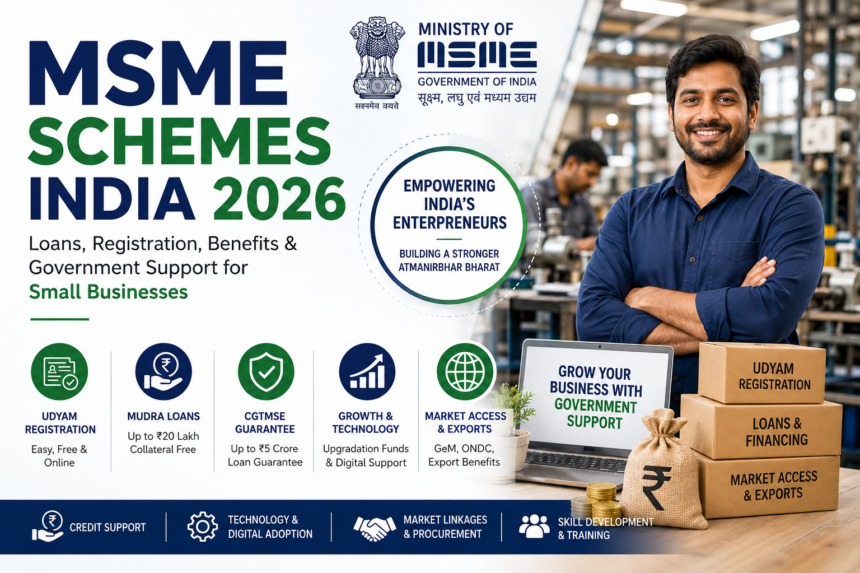
MSME Schemes India 2026, India’s Micro, Small, and Medium Enterprises (MSMEs) are the backbone of the country’s economy — employing over 110 million people, contributing approximately 30% of India’s GDP, and accounting for nearly 50% of India’s exports. From the small textile manufacturer in Surat to the food processing unit in Pune to the software service provider in Hyderabad, India’s MSME sector is where most of India’s economic activity actually happens.
Yet access to formal credit, government schemes, and market linkages remains a persistent challenge for Indian MSMEs. In 2026, the government has significantly strengthened its support framework — expanded credit guarantees, higher MUDRA loan limits, Udyam registration benefits, and Budget 2026’s focus on first-time entrepreneurs. This comprehensive guide helps every Indian small business owner understand and access the support they deserve.
What Is an MSME? Updated Definition in 2026
India’s MSME definition was revised in 2020 and remains in force in 2026:
- Micro enterprise: Investment in plant and machinery up to Rs 1 crore AND turnover up to Rs 5 crore
- Small enterprise: Investment up to Rs 10 crore AND turnover up to Rs 50 crore
- Medium enterprise: Investment up to Rs 50 crore AND turnover up to Rs 250 crore
The key word is ‘AND’ — both investment and turnover criteria must be met to qualify for a specific category. Once classified as an MSME, businesses can access a comprehensive range of government schemes, priority sector lending benefits, and market support.
Udyam Registration: The Most Important First Step
MSME Schemes India 2026, Udyam registration on the Udyam Portal (udyamregistration.gov.in) is the official registration process for MSMEs. It is free, fully online, self-declaration based, and integrated with PAN and GST databases. Once registered, businesses receive a Udyam Registration Number (URN) and Udyam Registration Certificate — essential for accessing all MSME schemes, priority sector loans, and government procurement.
How to Register on Udyam Portal
- Step 1: Visit udyamregistration.gov.in
- Step 2: Enter your Aadhaar number and validate with OTP
- Step 3: The portal auto-fills your PAN and GSTIN details from linked databases
- Step 4: Fill in business details — type, location, bank account, activity
- Step 5: Submit — receive Udyam Registration Certificate instantly
Registration is permanent and does not require renewal. However, update your registration if your business grows beyond the current category’s investment/turnover limits.
Best Government Loan Schemes for MSMEs in India 2026
1. PM MUDRA Yojana — For Micro Businesses
MSME Schemes India 2026, Pradhan Mantri MUDRA Yojana provides collateral-free loans to small and micro enterprises that do not have access to formal bank credit. In 2026, the maximum MUDRA loan limit was raised to Rs 20 lakh (from the previous Rs 10 lakh) — a significant expansion that brings more small businesses into the formal credit ecosystem.
- Shishu loans: Up to Rs 50,000 — for starting a new business or covering initial working capital
- Kishore loans: Rs 50,001 to Rs 5 lakh — for expanding an established micro business
- Tarun loans: Rs 5 lakh to Rs 20 lakh — for scaling a growing small business
MUDRA loans are available through all scheduled commercial banks, RRBs (Regional Rural Banks), MFIs (Microfinance Institutions), and NBFCs. Apply at your nearest bank branch or through the Jan Samarth portal (jansamarth.in).
2. CGTMSE — Credit Guarantee for Small Business Loans
The Credit Guarantee Fund Trust for Micro and Small Enterprises (CGTMSE) provides guarantee cover to banks making collateral-free loans to MSMEs. This means small businesses without property to pledge as collateral can still access bank credit — with CGTMSE guaranteeing up to 85% of the loan amount to the lending bank.
- Maximum loan amount: Up to Rs 5 crore under CGTMSE guarantee
- Guarantee coverage: 75-85% of the loan amount depending on business category
- Applicability: Manufacturing, services, trading, and retail businesses
- How to access: Apply for a business loan at any CGTMSE member institution (all major banks are members)
3. SIDBI Direct Credit Schemes
The Small Industries Development Bank of India (SIDBI) offers several direct lending schemes for MSMEs, particularly in manufacturing. SIDBI’s SPEED scheme (Same day in-principle approval for eligible MSMEs) and SMILE scheme (low-cost loans for digitally enabled small businesses) are particularly relevant in 2026’s digital-first environment.
4. Emergency Credit Line Guarantee Scheme (ECLGS) — Extended
The ECLGS, originally launched during COVID-19 to support struggling MSMEs, has been extended in modified form as a permanent credit enhancement tool. It provides additional working capital loans to eligible MSMEs at capped interest rates, backed by a government guarantee.
Budget 2026 MSME Benefits: What Changed
- Credit guarantee enhancement: Guarantee cover for first-time entrepreneurs increased — making it easier for new business owners to access their first business loan
- Technology adoption support: Rs 5,000 crore MSME Technology Upgradation Fund for manufacturing automation and digital adoption
- Export credit: Enhanced ECGC (Export Credit Guarantee Corporation) coverage for MSME exporters
- GST simplification: GST 2.0 planned to simplify compliance burden for small businesses — more details expected in 2026
- Cluster development: Rs 3,000 crore for development of 100 new MSME industrial clusters in Tier 2 and Tier 3 cities
MSME Digital Tools and Technology Adoption in 2026
GeM (Government e-Marketplace)
GeM is the online platform through which MSMEs can sell products and services directly to central and state government departments. In 2026, GeM has over 63,000 buyer organisations and Rs 4+ lakh crore in annual procurement. For MSMEs in manufacturing, IT services, office supplies, and a wide range of other categories, GeM is a significant market access opportunity. Registration is free at gem.gov.in.
ONDC (Open Network for Digital Commerce)
The Open Network for Digital Commerce is India’s government-backed open digital commerce infrastructure — a potential alternative to marketplace dependence on Amazon and Flipkart. MSMEs can list on ONDC-compatible platforms and reach customers nationally at lower commission rates than proprietary marketplaces. In 2026, ONDC’s merchant onboarding is expanding rapidly.
Digital Payments and GST Compliance
MSMEs that fully adopt digital payments (UPI, NEFT, RTGS) build a verifiable transaction history that significantly improves their loan eligibility assessment by banks using GST data and bank statement analysis. Digital payment adoption is no longer optional for growth-oriented MSMEs — it is the foundation of formal credit access.
MSME Export Opportunities in 2026
India’s trade policy in 2026 is actively seeking to expand MSME export participation. The India-EU Free Trade Agreement — expected to be finalised — will open significant new market access for Indian MSMEs in textiles, handicrafts, pharmaceuticals, engineering goods, and processed food. Key export support mechanisms:
- FIEO (Federation of Indian Export Organisations): Membership provides market intelligence, buyer connections, and export documentation support
- ECGC insurance: Protects MSMEs against payment defaults by foreign buyers
- RoDTEP scheme: Duty remission on export of goods — reduces the cost disadvantage of indirect taxes for exporters
- Trade fairs: Participation in international trade fairs subsidised through MSME Ministry schemes
Common MSME Challenges and Solutions in 2026
- Late payment from large buyers: Register on MSME Samadhaan portal (samadhaan.msme.gov.in) to file complaints against delayed payments from large companies — legally mandated 45-day payment cycle
- GST compliance burden: Use Zoho Books, Tally, or ClearTax GST software — Budget 2026’s GST 2.0 promises further simplification
- Skilled labour shortage: Access PM Kaushal Vikas Yojana (PMKVY) for subsidised skill training for employees
- Quality certification: BIS (Bureau of Indian Standards) and ISO certifications improve market access — subsidised for MSMEs under Quality Management Scheme
Read More: Pension Scheme India 2026: OPS vs NPS vs UPS Explained for Government and Private Employees
Conclusion
MSME Schemes India 2026, The Indian government’s support ecosystem for MSMEs — from Udyam registration to MUDRA loans to GeM market access to Budget 2026’s credit guarantee expansion — is more comprehensive than ever. The challenge is awareness and utilisation. Many small business owners do not know about the schemes available to them, or find the application process daunting.
Start with Udyam registration if you have not done so. Then explore MUDRA loans, GeM listing, and MSME technology funds. Taza Newsz covers MSME news, scheme notifications, and small business guidance. Follow us for practical support for India’s small business community.