
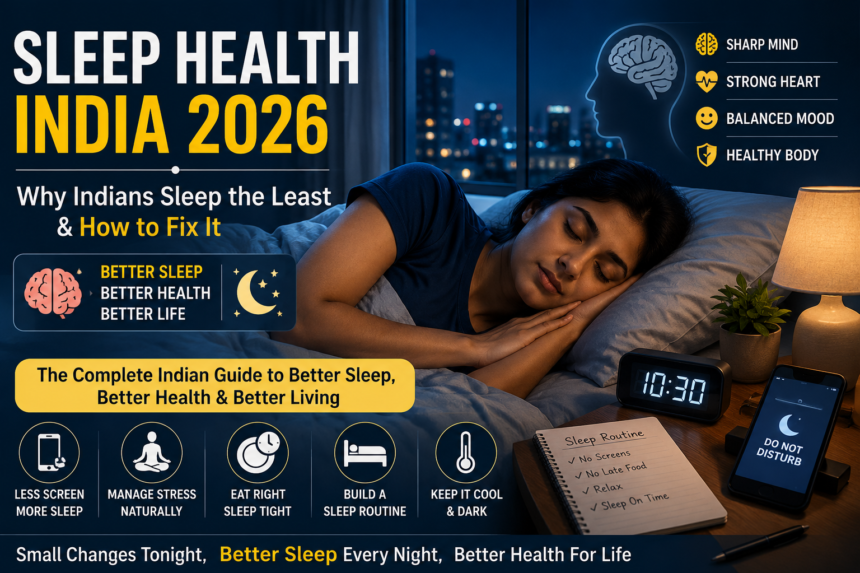
Sleep Health India— and most people do not know it. According to global sleep studies, Indians sleep the least of any major population in the world, averaging just 6.5 hours per night — significantly below the 7-9 hours recommended by the American Academy of Sleep Medicine and the Indian Sleep Disorders Association. In a country where hustle culture celebrates ‘I’ll sleep when I’m dead’ as a badge of honour, where working late signals commitment, and where nights are increasingly fragmented by smartphones, WhatsApp notifications, and streaming services, sleep deprivation has become one of India’s most pervasive and least-discussed public health crises.
The consequences are severe and far-reaching. Poor sleep is directly linked to increased risk of Type 2 diabetes (particularly relevant given India’s 101 million diabetics), cardiovascular disease, obesity, depression, anxiety, reduced cognitive performance, and weakened immune function. This comprehensive guide explains why Indians are not sleeping enough, the health consequences, and science-backed strategies to fix your sleep starting tonight.
Why Indians Are Not Getting Enough Sleep
Smartphone and Screen Use
Sleep Health India, The average Indian spends over 4.5 hours on their smartphone daily — and a large proportion of this screen time happens in bed, in the hour before sleep, and during nighttime wakefulness. Smartphones and screens emit blue light — short-wavelength light that suppresses melatonin production. Melatonin is the hormone that signals to your brain that it is time to sleep. Even 30 minutes of smartphone use in the hour before bed measurably delays sleep onset and reduces sleep quality.
WhatsApp group notifications at 11pm, Instagram reels at midnight, YouTube at 1am — the digital world is perfectly engineered to steal your sleep. The notification model of social media is designed to maximise engagement at the expense of sleep.
Late-Night Eating
India’s eating culture — particularly in urban households — involves late dinners. Many urban Indian families eat their primary meal between 9pm and 11pm. Eating close to bedtime raises core body temperature (digestion generates heat), stimulates the digestive system at a time when it should be winding down, and can cause acid reflux — all of which disrupt sleep quality. The ideal time for dinner is at least 2-3 hours before bedtime.
Stress and Anxiety
India’s high-pressure work culture, financial anxiety, relationship stress, parenting pressure, and the constant information overload of news and social media create a state of chronic psychological arousal that makes switching off for sleep genuinely difficult. When your brain is in problem-solving mode at bedtime, it cannot transition to sleep — the sleep-wake system requires a period of genuine mental deceleration.
Heat and Climate
India’s climate — particularly during the April-June pre-monsoon period and in tropical coastal areas — creates ambient temperatures that interfere with sleep. Core body temperature must fall by 1-2°C to initiate and maintain sleep. When ambient temperatures are high, this thermal drop is delayed or insufficient, fragmenting sleep and reducing time spent in restorative deep sleep stages.
Irregular Sleep Schedules
India’s social culture — late-night family gatherings, festivals, weddings, cricket matches — constantly disrupts sleep schedules. Sleeping at 11pm on weekdays and 2am on weekends is the equivalent of weekly jet lag — it confuses the body’s circadian rhythm and reduces the quality of sleep on both weekday and weekend nights.
How Poor Sleep Damages Your Health
Diabetes and Metabolic Health
Sleep Health India, The connection between sleep deprivation and diabetes is one of the most robustly researched in medicine. Even one week of sleeping 5-6 hours per night instead of 7-8 hours measurably reduces insulin sensitivity — meaning the body needs more insulin to manage the same glucose load. For India’s enormous prediabetic and diabetic population, poor sleep directly worsens metabolic control.
Cardiovascular Disease
Sleeping less than 6 hours per night is associated with a 20-30% increased risk of cardiovascular disease. Poor sleep raises blood pressure, increases inflammatory markers, elevates cortisol, and promotes arterial stiffness — all risk factors for heart attack and stroke. Given that cardiovascular disease is India’s leading cause of death, the sleep-heart disease connection is a critical public health issue.
Weight Gain and Obesity
Sleep deprivation directly disrupts appetite-regulating hormones — ghrelin (hunger hormone) rises and leptin (satiety hormone) falls. The result: sleep-deprived people eat more, crave higher-calorie foods, and metabolise food less efficiently. Multiple studies have shown that even modest sleep restriction (6 vs 8 hours) leads to significantly increased caloric intake and weight gain over time.
Cognitive Performance
Inadequate sleep impairs attention, working memory, decision-making, emotional regulation, and creative thinking. For students preparing for competitive exams — JEE, NEET, UPSC — the temptation to sacrifice sleep for study time is counterproductive. Memory consolidation — the process by which short-term learning becomes long-term memory — occurs during sleep. Studying without sleeping is studying into a leaky container.
The Science of Sleep: What Happens When You Sleep
Sleep Health India, Sleep is not a passive state of unconsciousness — it is a highly active biological process with distinct stages that each serve specific physiological functions:
- NREM Stage 1 and 2 (Light Sleep): Transition from wakefulness, consolidation of muscle memory and procedural skills
- NREM Stage 3 (Deep Sleep/Slow Wave Sleep): The most physically restorative stage — growth hormone released, immune function boosted, tissue repair occurs
- REM Sleep (Rapid Eye Movement): Emotional processing, memory consolidation, creative thinking, and dreaming — occurs primarily in the last third of the night
A complete sleep cycle takes approximately 90 minutes. Getting 7-8 hours allows 4-5 complete cycles — ensuring adequate time in each stage. Sleeping 5-6 hours primarily cuts into REM sleep, which occurs in the later cycles — disproportionately affecting emotional health and cognitive performance.
Science-Backed Tips to Sleep Better in India
1. Fix Your Sleep Schedule
Go to bed and wake up at the same time every day — including weekends. Even one morning of sleeping in by 2 hours disrupts your circadian rhythm for several days. This is the single most powerful sleep improvement intervention available.
2. Create a Pre-Sleep Routine
The hour before bed should be dedicated to winding down. Dim the lights (bright light signals daytime to your brain), put the phone on Do Not Disturb and ideally in another room, avoid news and anxiety-provoking content, and engage in calming activities — reading a physical book, light stretching, meditation, or a warm shower.
3. Optimise Your Sleep Environment
- Temperature: Keep your bedroom cool — 18-22°C is optimal for most Indians (air conditioning or a good fan during summer)
- Darkness: Blackout curtains or a sleep mask — even small amounts of light during sleep reduce melatonin and sleep quality
- Silence or consistent noise: Use earplugs or a white noise machine if external noise is disruptive
- Reserve the bed for sleep: Do not work, watch TV, or scroll in bed — your brain associates the bed with whatever you do there
4. Avoid Stimulants After 2pm
Caffeine (chai, coffee) has a half-life of approximately 5-6 hours. A cup of chai at 4pm still has half its caffeine in your system at 10pm — measurably affecting sleep onset time. Switch to herbal teas (chamomile, ashwagandha tea) in the afternoon and evening.
5. Exercise — But Not Too Late
Regular exercise dramatically improves sleep quality — but intense exercise within 2-3 hours of bedtime can delay sleep onset by elevating core body temperature and adrenaline. Morning or afternoon exercise is optimal for sleep; light yoga or stretching in the evening is acceptable.
6. Manage Stress Before Bed
The racing mind at bedtime — replaying the day’s events, worrying about tomorrow — is India’s most common sleep disruptor. A simple journaling practice (write down three things you are grateful for and tomorrow’s top three tasks) externalises thoughts and reduces bedtime rumination. Pranayama (4-7-8 breathing: inhale 4 counts, hold 7, exhale 8) activates the parasympathetic nervous system within minutes.
When to Seek Medical Help for Sleep Problems
Consult a doctor or sleep specialist if:
- You snore loudly or your partner reports you stop breathing during sleep — symptoms of Sleep Apnoea, a serious condition requiring medical treatment
- You experience uncontrollable leg movements at night (Restless Leg Syndrome)
- You have persistent insomnia (difficulty falling or staying asleep for 3+ nights per week for more than 3 months) despite following good sleep hygiene
- You feel exhausted despite adequate sleep time — may indicate sleep apnoea or other medical conditions
Read More: Weight Loss India 2026: Complete Indian Diet & Fitness Guide for Fast Fat Loss
Conclusion
Sleep Health India, In India’s productivity-obsessed culture, sleep is often the first sacrifice made for career, study, or social demands. This is a false trade — chronic sleep deprivation does not make you more productive. It makes you less intelligent, less healthy, less emotionally resilient, and ultimately less successful at everything you are sacrificing sleep to achieve.
Start tonight: set your sleep and wake time, charge your phone in another room, and make your bedroom dark and cool. The investment in your sleep is an investment in everything else you care about. Taza Newsz covers sleep health, wellness, and evidence-based health guidance for Indian audiences.