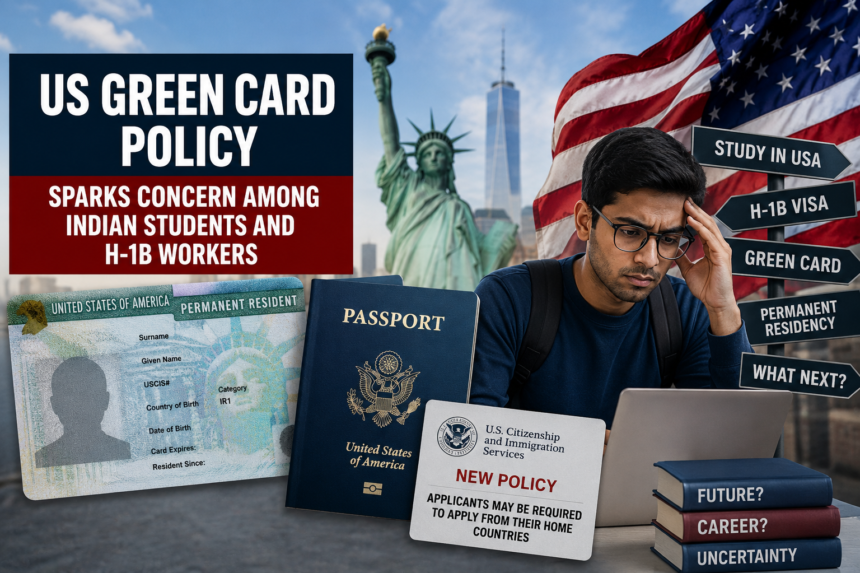
US Green Card Policy, For decades, the United States stood tall as the ultimate dream destination for Indian students and skilled professionals. The formula looked simple — earn a degree from a top American university, land a high-paying job, secure an H-1B visa, and eventually obtain a Green Card. That journey became the modern version of the American Dream for thousands of Indian families.
But now, that dream appears increasingly uncertain.
And honestly, that changes everything.
For Indian nationals already stuck in decade-long Green Card queues, the move feels less like a policy tweak and more like the ground shifting beneath their feet.
Why the New USCIS Policy Is Creating Panic
The new USCIS memo emphasizes that permanent residency is not an automatic right. Instead, it calls Green Cards a “discretionary benefit” that immigration authorities can grant on a case-by-case basis.
At first glance, the language may sound technical. But for international students and temporary workers, the implications are massive.
For years, many visa holders could legally remain in the United States while applying for permanent residency through a process called “adjustment of status.” This allowed students, H-1B workers, and even spouses of US citizens to continue working and living in America during the lengthy immigration process.
Now, the administration appears determined to tighten that pathway.
According to USCIS officials, temporary visas were never meant to become stepping stones toward permanent settlement. Instead, they argue that students and workers are expected to leave once their visa purpose ends.
That’s a dramatic philosophical shift in how America approaches immigration.
Indian Students Feel the Biggest Shockwaves
US Green Card Policy, Indian students are among the largest international student communities in the United States. Every year, hundreds of thousands of young Indians invest enormous sums of money into American education.
Why?
Because studying in the US was never just about a degree. It was about opportunity.
Families often spent their life savings believing a US education could lead to long-term stability, global careers, and permanent residency. But repeated visa uncertainty is now making many students rethink that investment.
The latest policy comes on top of existing worries surrounding:
- OPT restrictions
- STEM OPT scrutiny
- H-1B visa lottery uncertainty
- Long Green Card waiting periods
- Rising visa rejection fears
For many students, the future now feels foggy.
Imagine training for years to run a marathon, only to discover the finish line keeps moving farther away. That’s exactly how many Indian students describe the current immigration climate.
The American Dream No Longer Feels Guaranteed
For years, the US held an unmatched advantage over countries like Canada, Australia, and the UK because it offered a relatively predictable path from education to employment and eventually settlement.
That certainty is now fading fast.
Education experts say students and parents are beginning to ask difficult questions:
- Is studying in America still worth the enormous cost?
- What happens if visa rules change again?
- Will students actually be able to settle after graduation?
- Is there any long-term security anymore?
These concerns are no longer hypothetical.
Repeated policy changes over the past few years have created an atmosphere of instability. And when families invest lakhs or even crores into overseas education, uncertainty becomes a major risk factor.
H-1B Workers Face a New Layer of Anxiety
US Green Card Policy, The new policy is especially alarming for Indian H-1B professionals working in America’s tech industry.
Indian nationals dominate the H-1B visa system, particularly in sectors like:
- Information Technology
- Software Engineering
- Artificial Intelligence
- Data Science
- Healthcare Technology
- Financial Services
However, because of country-specific Green Card quotas, many Indians already wait decades for permanent residency approval.
Some estimates suggest highly skilled Indian workers could face waiting periods stretching beyond 50 years under current backlogs.
Now imagine being told you may need to leave the US during the process.
That’s the nightmare scenario many families fear.
Careers could be interrupted. Children studying in American schools may face disruption. Mortgages, businesses, and long-term financial plans could suddenly collapse under immigration uncertainty.
For workers who have spent years building lives in America, the emotional impact is enormous.
USCIS Says It Is Restoring the ‘Original Intent’ of Immigration Law
The Trump administration argues the policy is necessary to restore order to the immigration system.
USCIS officials claim temporary visas were designed for short-term stays, not as automatic routes to citizenship.
According to the administration, requiring applicants to process Green Cards from their home countries will help:
- Reduce visa overstays
- Prevent misuse of temporary visas
- Strengthen immigration enforcement
- Preserve the integrity of the system
Supporters of stricter immigration policies say the government is simply enforcing laws more aggressively.
But critics argue the move unfairly targets legal immigrants who followed every rule.
And that distinction matters.
This debate isn’t centered on undocumented immigration. It’s about students and professionals who entered legally, studied legally, worked legally, paid taxes legally, and still face growing barriers.
Immigration Experts Warn of ‘Massive Disruption’
US Green Card Policy, Immigration lawyers and advocacy groups have strongly criticized the policy shift.
Many experts warn that forcing applicants to leave the US could create widespread chaos for families and employers alike.
The biggest concern is unpredictability.
Because the policy relies heavily on discretionary decisions, many immigration attorneys say nobody fully understands how aggressively it will be enforced.
That uncertainty alone can discourage talented students and professionals from choosing America.
And in today’s global economy, talent has options.
Countries such as Canada and Australia are actively simplifying immigration systems to attract skilled workers. Meanwhile, America risks appearing increasingly difficult and unpredictable.
It’s a bit like two companies competing for the same employee — one offers clarity and stability, while the other constantly changes the contract. Which one would most people choose?
Indian-American Leaders Push Back Against the Policy
Several Indian-American lawmakers have openly criticized the administration’s approach.
Congressman Ami Bera, whose parents immigrated from India, condemned the move and warned that it creates unnecessary fear among law-abiding immigrants.
He emphasized that many applicants are already trapped in a painfully slow immigration backlog despite following every legal requirement.
That frustration is shared widely within the Indian diaspora.
For many families, the immigration process already feels exhausting and emotionally draining. The new rules may deepen feelings of insecurity even further.
Students May Start Choosing Other Countries Instead
US Green Card Policy, This could become the biggest long-term consequence of all.
Education industry experts believe Indian students may increasingly turn toward countries offering clearer immigration pathways after graduation.
Canada, in particular, has emerged as a strong alternative because of its comparatively transparent permanent residency process.
Australia and the United Kingdom have also introduced policies aimed at attracting international graduates and skilled workers.
The US still offers world-class universities and unmatched job opportunities in many industries. But prestige alone may no longer be enough.
Students today are thinking beyond education. They’re evaluating long-term return on investment.
And if settlement pathways become too uncertain, many may simply look elsewhere.
The Financial Stakes Are Huge for Indian Families
Studying in America is incredibly expensive.
A typical Indian student may spend anywhere between ₹40 lakh to over ₹1 crore on tuition, housing, living expenses, and loan repayments.
Families justify that cost because they believe the investment can eventually lead to stable careers and global opportunities.
But when immigration policies become unpredictable, the financial risk rises sharply.
Parents now worry whether their children will actually get enough time to recover those costs through employment in the US.
That concern is slowly reshaping how Indian families approach overseas education planning.
Will America Lose Its Edge in Global Talent?
The United States has long benefited from attracting the world’s brightest minds.
Indian engineers, doctors, scientists, entrepreneurs, and researchers have played a huge role in America’s economic growth and innovation ecosystem.
From Silicon Valley startups to Fortune 500 companies, immigrants remain deeply woven into the fabric of American success.
But immigration uncertainty could gradually weaken that advantage.
Talented students and professionals may still admire America, but admiration alone doesn’t build careers. Stability does.
And right now, stability feels increasingly difficult to guarantee.
What This Means for Indians Planning to Study or Work in the US
The latest policy does not automatically cancel Green Card applications or end immigration opportunities altogether. But it does signal a much stricter and less predictable environment.
For Indian students and H-1B visa workers, the message is clear:
The immigration pathway is becoming harder.
That doesn’t mean the American Dream is dead. But it does mean achieving it may require far more patience, flexibility, and risk tolerance than before.
Students considering the US must now think carefully about long-term immigration realities alongside university rankings and salary expectations.
Because in today’s immigration climate, the biggest question is no longer “Can you get into America?”
It’s “Can you actually stay?”
Read More: India-US Trade Deal 2026: Key Negotiations, Opportunities, and Challenges
Conclusion
US Green Card Policy, The new USCIS Green Card policy has added another layer of uncertainty to an already complicated US immigration system. For Indian students and H-1B professionals, the fear isn’t just about paperwork — it’s about careers, families, financial security, and future dreams.
As immigration rules tighten and settlement pathways become less predictable, many Indians are beginning to reconsider whether the United States still offers the stability it once promised. While America remains one of the world’s strongest education and employment destinations, growing uncertainty may slowly push global talent toward countries with simpler and clearer immigration systems.
In the end, the future of the American Dream for Indian immigrants may depend not only on opportunity, but on whether the system still feels welcoming enough to pursue it.