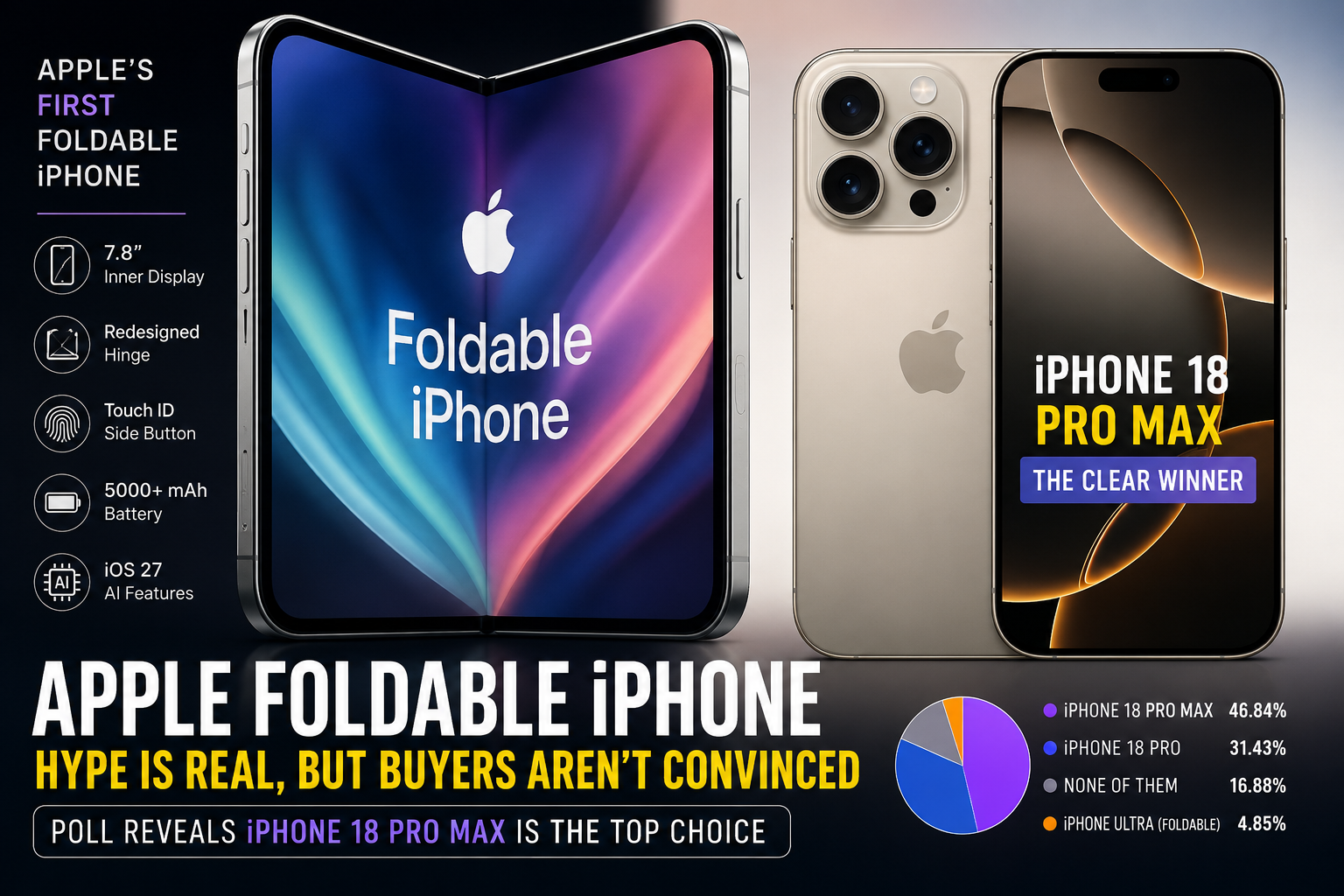
Apple Foldable iPhone, Apple fans have been waiting for one product more than almost any other—the company’s first foldable iPhone. Rumors have called it the iPhone Ultra, a premium foldable smartphone expected to take on the best foldable devices from Samsung, Google, Honor, and others.
On paper, it sounds like the kind of product that should dominate headlines. A sleek folding design, Apple’s software polish, premium hardware, and the company’s loyal customer base seem like a recipe for success.
But there’s a twist.
Recent consumer sentiment suggests that excitement doesn’t always translate into buying intentions. While the Apple Foldable iPhone has generated enormous buzz online, many Apple enthusiasts appear hesitant to spend what is expected to be well over $2,000 on a first-generation device. Instead, buyers are overwhelmingly leaning toward the more familiar and proven iPhone 18 Pro Max, viewing the iPhone 18 Pro Max as a safer upgrade thanks to its established design, premium features, and reliable performance.
So, is Apple’s first foldable already in trouble? Or is this simply the calm before the storm?
Let’s break it all down.
The Foldable iPhone Has Been Years in the Making
Apple has never been known for rushing into new product categories.
Instead of being the first company to launch a new technology, Apple typically prefers to wait until the market matures before introducing its own version. The strategy has worked before. The company wasn’t the first to launch smartphones, smartwatches, or wireless earbuds, yet each eventually became hugely successful Apple products.
The same cautious strategy appears to be guiding Apple’s approach to foldable smartphones.
While Android manufacturers have spent the past several years refining foldable technology, Apple has remained on the sidelines, reportedly waiting until durability, software optimization, and manufacturing challenges could be addressed.
Now, industry reports suggest the company is finally ready to enter the foldable smartphone market with the iPhone Ultra.
Consumer Poll Reveals Surprisingly Low Interest
Apple Foldable iPhone, Despite months of speculation and anticipation, a recent consumer poll paints a very different picture.
When users were asked which upcoming iPhone they planned to purchase after launch, the results were striking:
- iPhone 18 Pro Max – 46.84%
- iPhone 18 Pro – 31.43%
- None of them – 16.88%
- iPhone Ultra – 4.85%
Those numbers tell an interesting story.
Even though the foldable iPhone is expected to be Apple’s most innovative product in years, fewer than five percent of respondents selected it as their preferred purchase.
That doesn’t necessarily mean people dislike the idea of a foldable iPhone. Instead, it highlights a growing trend among smartphone buyers—they’re becoming increasingly cautious about expensive first-generation devices.
Price Could Be the Biggest Obstacle
If one factor stands out above everything else, it’s pricing.
Rumors indicate Apple’s foldable iPhone could start at more than $2,000, making it one of the most expensive smartphones ever released.
For many consumers, that’s a difficult investment to justify.
At that price point, buyers begin asking tough questions:
- Will it last several years?
- Is the folding display durable enough?
- Will Apple support it long term?
- Is it significantly better than a regular flagship iPhone?
When a smartphone costs as much as a premium laptop, expectations naturally become much higher.
Even Apple’s loyal customer base may think twice before becoming early adopters.
Why Buyers Trust the iPhone 18 Pro Max More
Apple Foldable iPhone, The overwhelming popularity of the iPhone 18 Pro Max isn’t particularly surprising.
Large-screen smartphones have become the preferred choice for millions of users worldwide. As mobile devices continue replacing laptops for everyday tasks, bigger displays simply make more sense.
Whether people are:
- editing photos,
- watching Netflix,
- attending video meetings,
- gaming,
- or managing work,
larger screens provide a noticeably better experience.
Unlike the foldable iPhone, the Pro Max also carries something extremely valuable: familiarity.
Consumers already know what to expect from Apple’s flagship lineup. Each generation typically delivers predictable improvements without dramatically changing the overall user experience.
That level of confidence matters when spending premium prices.
Android Foldables Have Already Matured
Apple isn’t entering an empty market.
Companies like Samsung, Google, Honor, Oppo, Vivo, Huawei, and Motorola have spent years improving foldable smartphones.
The earliest foldables were exciting but flawed.
Users complained about:
- noticeable display creases,
- fragile hinges,
- poor battery life,
- excessive thickness,
- and durability concerns.
Fast forward to today, and many of those issues have largely been addressed.
Modern foldables feature:
- stronger hinge mechanisms,
- brighter displays,
- slimmer bodies,
- better water resistance,
- improved battery efficiency,
- and significantly reduced screen creases.
Apple now faces competitors that have already gone through multiple generations of refinement.
That raises the bar considerably.
What Rumors Suggest About Apple’s Foldable iPhone
Apple Foldable iPhone, Although Apple hasn’t officially confirmed the device, multiple reports suggest some impressive hardware could be on the way.
Expected specifications include:
Book-Style Folding Design
Instead of a flip-phone design, Apple is reportedly developing a book-style foldable similar to premium Android competitors.
Large Inner Display
The device may include a 7.8-inch internal display, offering tablet-like functionality while remaining compact enough for everyday use.
5.5-inch External Display
A smaller cover screen would allow users to perform common tasks without opening the device.
Minimal Display Crease
Perhaps the biggest engineering challenge is reducing the visible crease.
Reports indicate Apple is investing heavily in advanced ultra-thin glass and redesigned hinge technology to deliver one of the smoothest foldable displays available.
If successful, this could become one of the product’s biggest selling points.
Touch ID Could Make a Comeback
One surprising rumor involves biometric security.
Instead of Face ID, Apple’s foldable may use a side-mounted Touch ID fingerprint sensor.
At first glance, this might seem like a step backward.
However, foldable phones present unique engineering challenges.
The internal layout leaves less room for Apple’s advanced Face ID hardware, making a side-mounted fingerprint reader a practical alternative.
Many Android foldables already use this approach successfully.
Performance Could Match Apple’s Premium Flagships
Apple Foldable iPhone, Performance is unlikely to be an issue.
Industry reports suggest the foldable iPhone may feature:
- up to 12GB RAM
- storage options reaching 1TB
- battery capacity between 5,000 and 5,500mAh
- premium Apple silicon
- flagship-level efficiency
This would place the device comfortably among the highest-performing smartphones available.
Heavy multitasking, gaming, AI processing, and professional applications should all benefit from Apple’s latest chipset.
Camera System May Be Simpler Than Expected
One interesting rumor suggests Apple may not include a dedicated telephoto camera.
Instead, the rear setup could consist of:
- dual 48MP cameras
- advanced computational photography
- AI-powered image processing
Apple has consistently relied on software optimization to compensate for hardware limitations.
Even with fewer camera sensors, image quality could remain highly competitive thanks to computational photography.
Still, some photography enthusiasts may prefer the more versatile camera system expected on the iPhone 18 Pro Max.
Software Could Be Apple’s Secret Weapon
Hardware alone won’t determine the success of Apple’s foldable phone.
Software will likely play an even bigger role.
Reports suggest iOS 27 is being redesigned with foldable devices in mind.
Potential improvements include:
- enhanced multitasking
- better split-screen functionality
- improved app continuity
- AI-powered productivity tools
- optimized window management
- smoother transitions between folded and unfolded modes
Historically, Apple’s strength has always been the integration between hardware and software.
If the company can deliver an experience that feels polished from day one, it may gain a significant advantage over Android competitors.
Why Consumers Are Hesitant About First-Generation Products
Apple Foldable iPhone, Buying first-generation technology always involves a certain level of uncertainty.
Consumers remember products that launched with unexpected issues.
Questions naturally arise:
- Could there be durability problems?
- Will the hinge hold up after years of use?
- Will future generations improve dramatically?
- Should buyers simply wait another year?
Many Apple customers appear willing to let early adopters test the waters before making their own purchase.
It’s a common pattern across the technology industry.
Could Opinions Change After Launch?
Absolutely.
Pre-launch polls rarely tell the entire story.
Many buyers prefer waiting for:
- professional reviews,
- long-term durability tests,
- camera comparisons,
- battery benchmarks,
- software demonstrations,
- and real-world user experiences.
If reviewers praise Apple’s execution, public confidence could grow quickly.
Positive word-of-mouth has transformed many products that initially received cautious reactions.
The foldable iPhone could easily follow the same path.
Apple’s Brand Loyalty Shouldn’t Be Underestimated
Apple Foldable iPhone, One major advantage Apple enjoys is its incredibly loyal ecosystem.
Millions of users already own:
- iPhones,
- Apple Watches,
- Macs,
- iPads,
- AirPods,
- Apple TVs,
- and other Apple devices.
The seamless integration between these products often encourages customers to stay within the ecosystem.
Even if buyers skip the first foldable generation, many may eventually upgrade once Apple proves the technology over several product cycles.
The Foldable Market Is Still Growing
Foldable smartphones remain a relatively small portion of the global smartphone industry.
However, adoption continues to increase every year.
As prices gradually decline and durability improves, more consumers are becoming comfortable with foldable devices.
Apple’s entry could dramatically accelerate mainstream adoption.
The company has repeatedly demonstrated its ability to popularize technologies that already existed but hadn’t yet reached mass-market appeal.
If Apple delivers a compelling experience, the foldable smartphone segment could see substantial growth.
Should Apple Fans Wait or Upgrade?
For buyers considering an upgrade, the decision depends largely on priorities.
The iPhone 18 Pro Max offers a familiar flagship experience with fewer unknowns, making it an attractive option for users who prioritize reliability and established performance.
The rumored Apple iPhone Ultra, meanwhile, targets those who enjoy cutting-edge technology and are willing to pay a premium for innovation.
Early adopters may embrace the foldable form factor despite its high cost, while more cautious consumers could choose to wait for the second or third generation, when both pricing and technology are likely to improve.
Ultimately, Apple’s challenge isn’t convincing people that foldable phones are exciting—it’s convincing them they’re worth the investment.
Read More: iPhone 18 Release Date: Latest Leaks, Rumors, Price, and iPhone 18 Pro Features
Conclusion
Apple Foldable iPhone, Apple’s rumored foldable iPhone is shaping up to be one of the most anticipated smartphone launches in recent memory. Yet early consumer sentiment suggests excitement alone may not guarantee strong sales.
The expected price tag exceeding $2,000, combined with the uncertainty surrounding a first-generation product, has many buyers leaning toward the more established iPhone 18 Pro Max. Consumers appear to value reliability and familiarity over experimentation, especially when making such a significant purchase.
That said, it would be premature to write off the iPhone Ultra. Apple’s reputation for refining technology, its tightly integrated hardware and software ecosystem, and the potential of an optimized foldable version of iOS could significantly shift public opinion after launch. Positive reviews, strong real-world performance, and long-term durability could transform initial skepticism into widespread demand.
In the end, Apple’s first foldable iPhone may not become an overnight blockbuster, but it still has every opportunity to reshape the foldable smartphone market. Whether it becomes an instant success or a slow-burning hit will depend on how well Apple delivers on quality, innovation, and value.