
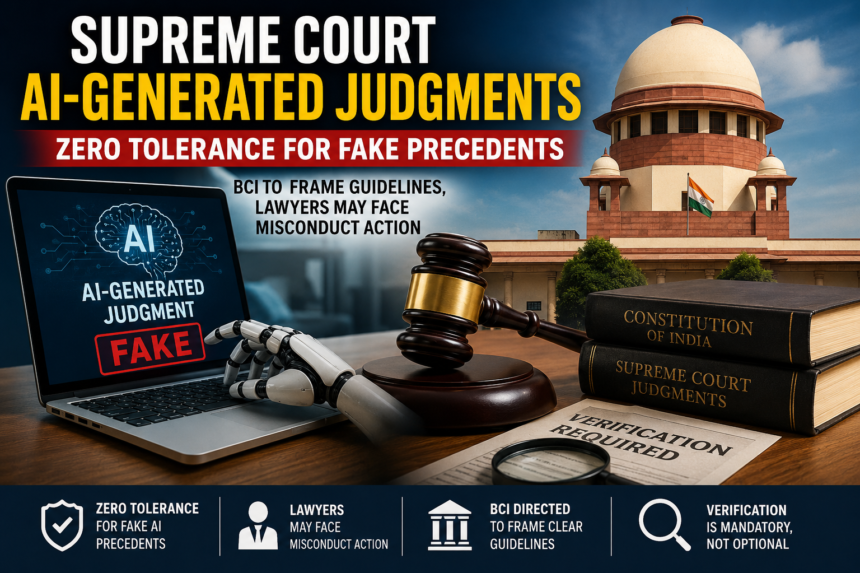
Supreme Court AI-Generated Judgments, Artificial intelligence is rapidly transforming industries across the globe, from healthcare and education to finance and legal research. But what happens when AI-generated misinformation finds its way into a courtroom? India’s Supreme Court has delivered a landmark answer.
In a significant ruling that could reshape the future of legal practice in the AI era, the Supreme Court of India has declared a “zero-tolerance” policy against the use, production, or citation of fake AI-generated judicial precedents. The judgment comes after the Court discovered that non-existent and AI-hallucinated case laws had been relied upon during insolvency proceedings, raising serious concerns about the integrity of India’s judicial system.
A Landmark Judgment Against AI Hallucinations in Indian Courts
The Supreme Court’s ruling came in the case of Pooja Ramesh Singh vs Jammu & Kashmir Bank, where the Bench comprising Justices PS Narasimha and Alok Aradhe examined irregularities in an insolvency matter involving Essel Infraprojects.
During the proceedings, the Court found something deeply troubling. Several judicial precedents cited in earlier tribunal decisions simply did not exist. Some case laws were entirely fabricated, while others included AI-generated passages falsely attributed to genuine Supreme Court judgments.
Recognizing the serious implications, the Court ruled that judicial institutions must adopt a zero-tolerance approach toward fake AI-generated legal precedents.
The judgment marks one of India’s strongest judicial warnings against the misuse of artificial intelligence within the legal system.
How the Problem Came to Light
The issue surfaced while the Supreme Court reviewed earlier decisions passed by the National Company Law Tribunal (NCLT) and later affirmed by the National Company Law Appellate Tribunal (NCLAT).
Upon independent verification, the Supreme Court discovered multiple irregularities, including:
- Judicial decisions that never existed.
- Fabricated legal extracts inserted into authentic Supreme Court judgments.
- AI-generated text presented as genuine legal precedent.
- Incorrect citations that escaped scrutiny during earlier proceedings.
These findings prompted the Court to closely examine how such fabricated material entered the judicial process in the first place.
The discovery exposed a growing challenge faced by courts worldwide—the increasing reliance on AI-generated legal research without adequate human verification.
The Supreme Court’s Zero-Tolerance Policy Explained
Supreme Court AI-Generated Judgments, The Court made its position crystal clear.
Any production, citation, or reliance on AI-generated precedents without proper verification is unacceptable.
According to the Bench, the legal system depends entirely on the authenticity of judicial precedents. Once fabricated judgments begin influencing legal reasoning, the very foundation of justice becomes vulnerable.
The Court emphasized that every legal citation must undergo independent verification before being relied upon by lawyers or judges.
Simply trusting AI-generated outputs without checking official legal records is no longer acceptable.
Why AI Hallucinations Are a Serious Threat
Artificial intelligence tools have become remarkably capable of summarizing judgments, explaining legal concepts, and assisting research.
However, these systems also suffer from what experts call AI hallucinations.
Unlike human mistakes, AI hallucinations occur when an AI confidently generates information that appears completely authentic but is entirely false.
Imagine asking an AI assistant to provide a Supreme Court judgment supporting a legal argument. Instead of admitting it doesn’t know, the AI may generate:
- A realistic-looking case title.
- Fake citations.
- Invented paragraphs.
- Fabricated legal reasoning.
Everything appears genuine—until someone checks the official records.
That is precisely what happened in this case.
The Supreme Court warned that such fabricated legal material poses a direct threat to the administration of justice.
Lawyers Could Face Professional Misconduct Charges
Supreme Court AI-Generated Judgments, One of the most significant aspects of the judgment concerns advocates.
The Supreme Court categorically held that lawyers who cite fake or AI-generated judgments without proper verification may be guilty of professional misconduct.
This means advocates can no longer defend themselves by claiming that AI tools produced the incorrect information.
Legal professionals remain personally responsible for verifying:
- Case citations.
- Judgment authenticity.
- Legal extracts.
- Quotations relied upon before courts.
Professional responsibility cannot be outsourced to artificial intelligence.
The ruling reinforces the long-standing ethical principle that advocates owe a duty of honesty and diligence to the courts.
Judges Are Not Exempt Either
The Court’s observations did not stop with lawyers.
It also delivered a strong reminder to judges across the country.
According to the Bench, it represents a serious judicial lapse if a court relies upon fake or hallucinated AI-generated precedents while deciding cases.
Judges must independently verify every precedent before incorporating it into judicial reasoning.
The Court emphasized that judicial independence also carries a corresponding duty to ensure the authenticity of legal authorities being relied upon.
In other words, responsibility exists at every level of the justice delivery system.
A Decision Based on Fake AI Material Has No Legal Value
Supreme Court AI-Generated Judgments, Perhaps the strongest statement in the judgment was the Court’s declaration regarding decisions influenced by fabricated legal material.
The Bench ruled that any judicial determination based upon fake or AI-generated precedents becomes “no decision in the eyes of law.”
The Court explained that even if only a tiny portion of fabricated material influences judicial reasoning, the entire decision stands legally compromised.
As a result, such decisions must be set aside.
This strict standard reflects the judiciary’s commitment to preserving public confidence in the legal system.
Justice must not only be delivered—it must also be based upon authentic legal foundations.
The Bar Council of India Asked to Frame New Rules
Recognizing that artificial intelligence is becoming increasingly common in legal practice, the Supreme Court stopped short of banning AI altogether.
Instead, it directed the Bar Council of India (BCI) to constitute a dedicated committee to examine the issue.
The committee has been asked to develop:
- Professional guidelines for AI use.
- Verification standards for legal research.
- Ethical rules governing AI-generated legal material.
- Disciplinary measures against advocates using fake precedents.
These recommendations are expected to establish a national framework governing responsible AI usage in India’s legal profession.
As AI tools continue evolving, such guidelines may become essential for maintaining legal ethics.
The Court’s Powerful Methyl Isocyanate Analogy
Supreme Court AI-Generated Judgments, In one of the judgment’s most striking observations, the Supreme Court compared fake AI-generated precedents to the release of methyl isocyanate, the highly toxic gas responsible for one of history’s worst industrial disasters.
The Court remarked that fake AI-generated legal precedents represent a similarly dangerous by-product within the legal system.
The comparison underscores the scale of the threat.
Just as a toxic gas can contaminate an entire environment, fabricated legal authorities can contaminate judicial reasoning, undermine public trust, and compromise the rule of law.
The analogy highlights how seriously the Court views AI-generated misinformation in legal proceedings.
What Happened in the Essel Infraprojects Insolvency Case?
The controversy arose during insolvency proceedings involving Essel Infraprojects.
While reviewing tribunal orders, the Supreme Court found that:
- The NCLT had relied upon fabricated judicial precedents.
- Some judgments cited never existed.
- Other genuine Supreme Court cases had fake paragraphs inserted into them.
- These irregularities went unnoticed before the NCLAT.
The Court also considered an affidavit submitted by Jammu & Kashmir Bank.
According to the affidavit, the bank’s legal counsel had never cited the disputed judgments.
Instead, the tribunal itself relied upon those precedents through its own legal research.
This revelation shifted attention toward the broader issue of judicial research practices in the age of artificial intelligence.
Supreme Court Sets Aside Earlier Tribunal Orders
Supreme Court AI-Generated Judgments, After identifying the fabricated legal material, the Supreme Court concluded that the judicial process had become fundamentally tainted.
Consequently, it:
- Set aside the orders passed by the NCLT.
- Quashed the subsequent NCLAT decision.
- Restored the insolvency application filed under Section 7 of the Insolvency and Bankruptcy Code.
- Directed the NCLT to hear the matter afresh.
- Requested the tribunal to dispose of the case preferably within two weeks.
- Ordered all parties to maintain status quo until fresh adjudication.
The ruling ensures that the matter will now be reconsidered entirely on the basis of authentic legal precedents.
What This Means for the Future of AI in the Legal Profession
The judgment is not a rejection of artificial intelligence.
Rather, it establishes an important principle: AI may assist legal professionals, but it cannot replace independent legal verification.
Going forward, law firms, advocates, judges, researchers, and even law students are expected to exercise greater caution while using AI-powered research tools.
Many legal experts believe this ruling may encourage:
- Better AI governance in legal practice.
- Development of specialized legal AI systems.
- Stronger fact-checking protocols.
- Greater emphasis on professional accountability.
- Enhanced judicial training regarding AI technologies.
The judgment may also influence courts in other jurisdictions facing similar concerns over AI-generated misinformation.
Why This Judgment Matters Beyond the Courtroom
Supreme Court AI-Generated Judgments, The implications extend far beyond India’s legal system.
Today, AI-generated content is used across journalism, education, business, finance, medicine, and public administration.
The Supreme Court’s message is relevant for every profession:
Artificial intelligence is a powerful assistant—but it is not an unquestionable authority.
Blindly accepting AI-generated outputs without verification can produce serious consequences, whether in courtrooms, hospitals, universities, or corporate boardrooms.
The ruling serves as an important reminder that technology should enhance human judgment, not replace it.
Growing Global Concern Over AI-Generated Legal Errors
India is not alone in confronting this challenge.
Around the world, courts have encountered instances where lawyers relied on AI chatbots that produced entirely fictional judgments. These incidents have prompted judges in several jurisdictions to warn legal professionals about the dangers of using generative AI without rigorous fact-checking.
As AI tools become more sophisticated, distinguishing genuine legal authorities from fabricated content may become increasingly difficult. This makes verification through official legal databases, court records, and authenticated sources more important than ever.
The Supreme Court’s decision positions India among the jurisdictions taking a firm stance on preserving the integrity of legal proceedings in the age of artificial intelligence.
Read More: EPF Scheme 2026 Withdrawal Rules: New Eligibility, Limits and 25% Balance Rule
Conclusion
Supreme Court AI-Generated Judgments, The Supreme Court’s landmark judgment establishes a clear precedent for the responsible use of artificial intelligence in India’s legal system. By adopting a zero-tolerance approach toward fake AI-generated judgments, the Court has reinforced that the credibility of justice depends on authentic legal authorities, careful verification, and professional accountability.
The ruling not only protects the integrity of judicial decisions but also places equal responsibility on lawyers, judges, and legal institutions to ensure that AI remains a tool for assistance—not a substitute for human diligence. With the Bar Council of India now tasked with framing comprehensive guidelines, the legal profession is set to enter a new era where innovation and ethics must go hand in hand.