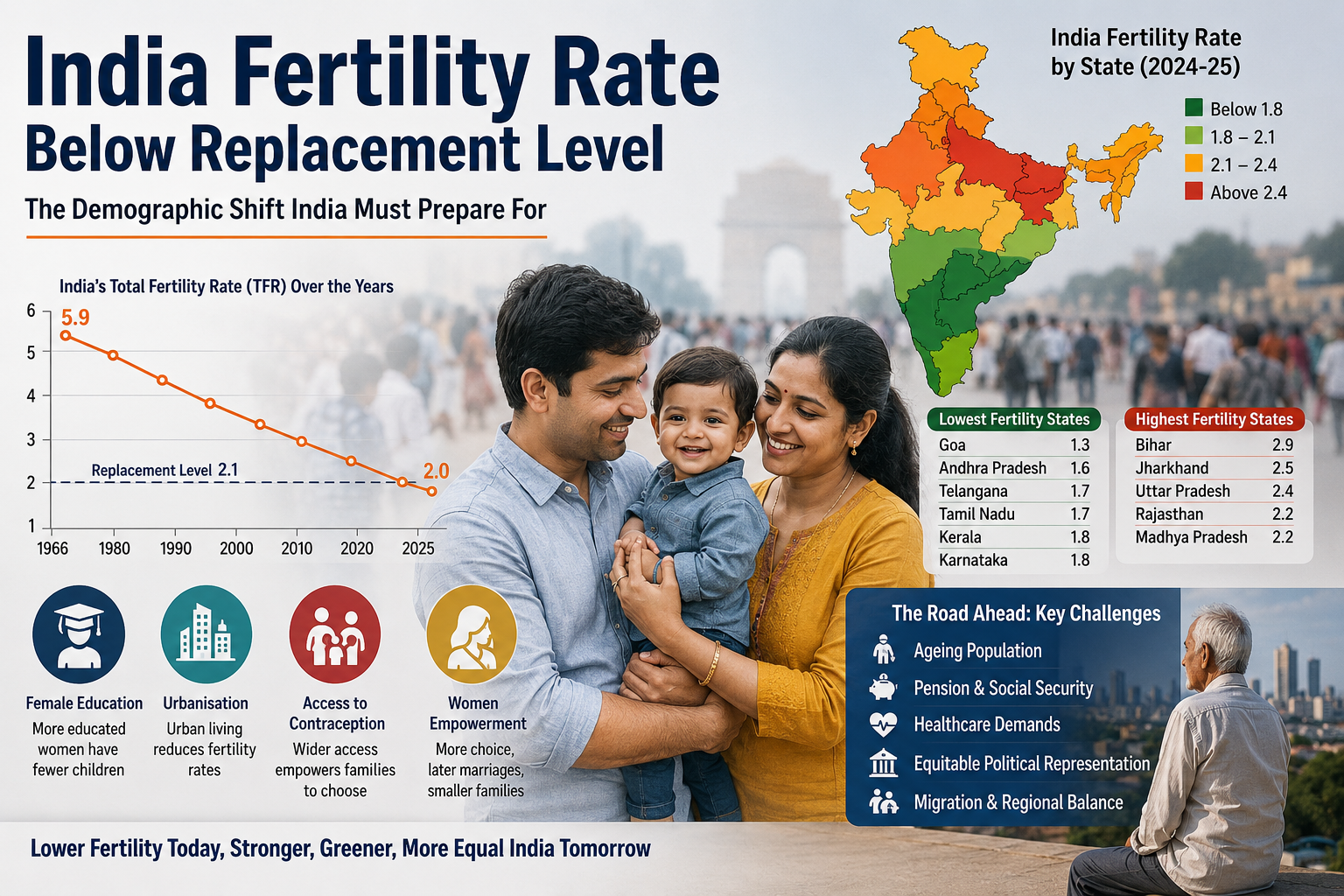
India Fertility Rate, India is simultaneously the world’s most populous country — having surpassed China in 2023 — and a country where several states are already beginning to experience population decline because of falling birth rates. India’s Total Fertility Rate (TFR), which measures the average number of children a woman is expected to have during her lifetime, has now fallen to nearly 2.0 at the national level. This is below the replacement rate of 2.1 required to maintain a stable population over the long term.
Moreover, southern states such as Kerala, Tamil Nadu, Andhra Pradesh, and Telangana have remained below replacement fertility levels for more than two decades. As a result, India’s demographic story is changing rapidly.
Although India’s total population will continue to grow for several more decades because of demographic momentum, the country is gradually moving toward an ageing society. At the same time, regional fertility disparities, internal migration, and future population decline in some states are creating serious economic, political, and social policy challenges.
This article explains India’s fertility transition, why birth rates are falling, the differences between states, and what the long-term consequences could be for the country.
India’s Fertility Rate: The National Picture
India’s fertility rate has been falling steadily for more than six decades. In 1966, India’s TFR stood at nearly 5.9 children per woman. However, by 2025, it had declined to approximately 2.0.
Key National Fertility Statistics
- National TFR (2024–25): Approximately 2.0
- Replacement Fertility Level: 2.1
- Urban TFR: Approximately 1.6
- Rural TFR: Approximately 2.2
- Population Peak Projection: Around 1.7 billion in the 2060s before eventual decline
Importantly, urban India has already moved far below replacement level. Rural India, meanwhile, remains slightly above replacement fertility. Nevertheless, the long-term national trend clearly points toward slower population growth and eventual stabilisation.
South India: The Demographic Frontier
Southern India has become the country’s demographic frontier. These states transitioned to low fertility much earlier than northern India and now face the possibility of population ageing and decline.
States with the Lowest Fertility Rates in India
Andhra Pradesh
TFR is approximately 1.6, making it one of the lowest fertility states in India.
Telangana
The state’s TFR is around 1.7, reflecting rapid urbanisation and rising educational attainment.
Tamil Nadu
Tamil Nadu has remained below replacement fertility since the 1990s and currently records a TFR of around 1.7.
Kerala
Kerala’s TFR stands near 1.8. The state became India’s first major success story in achieving replacement fertility due to strong investments in education and healthcare.
Karnataka
Karnataka also records a TFR close to 1.8, particularly influenced by urban centres such as Bengaluru.
Goa
Goa has the lowest fertility rate in India at approximately 1.3, raising long-term demographic concerns regarding ageing and workforce shortages.
Unless offset by migration from higher-fertility regions, several of these states could begin experiencing absolute population decline within the next 15 to 20 years.
The North-South Fertility Divide
While South India has largely completed its demographic transition, many northern and central states continue to record significantly higher fertility levels.
High-Fertility States in India
Bihar
Bihar remains India’s highest-fertility large state with a TFR of approximately 2.9.
Uttar Pradesh
India’s most populous state has a TFR of nearly 2.4 and continues to contribute substantially to national population growth.
Rajasthan
Rajasthan’s fertility rate remains slightly above replacement level at around 2.2.
Madhya Pradesh
The state records a TFR of approximately 2.2.
Jharkhand
Jharkhand continues to have relatively high fertility at nearly 2.5.
Consequently, India’s demographic future is becoming increasingly uneven. Southern states are ageing rapidly, while northern states continue to supply much of the country’s young workforce.
Why Is India’s Fertility Rate Falling?
India Fertility Rate, India’s fertility decline is not the result of a single policy. Instead, it reflects broad social, economic, and educational changes that have unfolded over decades.
Female Education and Empowerment
Globally, female education is one of the strongest predictors of falling fertility rates. India is no exception.
As girls remain in school longer, they tend to marry later, participate more actively in the workforce, and exercise greater control over reproductive decisions. Consequently, family sizes decline.
India’s female literacy rate has increased dramatically, rising from roughly 39% in 1991 to nearly 73% in 2024. Educated women generally have fewer children, delay childbirth, and invest more resources in each child’s education and health.
Therefore, improvements in female education have become one of the biggest drivers of India’s demographic transition.
Urbanisation
Urbanisation has also contributed significantly to declining fertility.
In cities, raising children is far more expensive because of higher housing costs, education expenses, and healthcare demands. Smaller homes and limited living space also discourage larger families.
Additionally, urban lifestyles often encourage delayed marriage and career-oriented aspirations, particularly among women. India’s urban population has increased from roughly 28% in 2001 to more than 40% by 2026, directly reducing national fertility levels.
Access to Contraception and Family Planning
India launched one of the world’s earliest family planning programmes in 1952. Since then, access to contraception has steadily expanded across the country.
Programmes such as Mission Parivar Vikas specifically target high-fertility districts in northern India by increasing awareness and access to modern contraceptive methods.
However, female sterilisation continues to dominate India’s family planning landscape, reflecting the historical structure of public health policy.
India’s Ageing Population: The Next Major Challenge
India Fertility Rate, While lower fertility brings economic and social benefits, it also creates long-term ageing challenges.
The Demographic Dividend Window Is Closing
India has long been described as having a “demographic dividend.” This refers to the economic advantage created when the working-age population is much larger than the dependent population.
A large workforce can boost productivity, savings, consumption, and economic growth — provided sufficient jobs exist.
However, India’s demographic dividend window is expected to narrow between 2040 and 2050. After that, the proportion of elderly citizens will rise sharply, increasing the old-age dependency ratio.
As a result, India must prepare for a future where fewer workers support a larger retired population.
Pension and Social Security Pressures
An ageing population places heavy strain on pension systems and social welfare infrastructure.
India’s National Pension System (NPS) mainly covers formal sector workers. Yet nearly 90% of India’s workforce remains employed in the informal sector, where retirement savings are often inadequate or nonexistent.
Consequently, elderly poverty and financial insecurity could become major policy challenges in the coming decades. Expanding retirement coverage while India is still relatively young remains one of the country’s most urgent long-term priorities.
Rising Healthcare Demands
Older populations require more healthcare support.
Chronic illnesses, cardiovascular disease, cancer, diabetes, and cognitive disorders become far more common as societies age. India’s healthcare system is already under pressure, even with a relatively young population.
Without major investment in hospitals, geriatric care, and preventive healthcare, the country may struggle to manage the healthcare demands of an ageing society.
Migration as India’s Demographic Adjustment Mechanism
Internal migration is already helping balance India’s demographic inequalities.
Millions of workers from high-fertility states such as Uttar Pradesh, Bihar, Jharkhand, and Odisha migrate to economically dynamic southern and western states for employment opportunities.
Factories in Tamil Nadu, construction projects in Kerala, technology firms in Bengaluru, and industries in Maharashtra increasingly depend on migrant labour.
Therefore, migration acts as a natural adjustment mechanism, transferring labour from demographically surplus regions to ageing and labour-deficit economies.
What India Should Do Next
India Fertility Rate, India still has time to prepare for its demographic future. However, policy action must begin now.
Invest in Elderly Care Infrastructure
India needs stronger geriatric healthcare systems, day-care centres, home-care services, and assisted living infrastructure before ageing accelerates further.
Expand Pension Access
Retirement savings systems must become accessible to informal workers, who make up the overwhelming majority of India’s labour force.
Continue Investing in Female Education
Higher female education levels continue to produce long-term demographic and economic benefits. More educated women lead to lower fertility, higher workforce participation, and stronger human capital formation.
Manage Delimitation Fairly
India must find a political compromise that balances representation with development achievements so that low-fertility states are not penalised for successful population stabilisation.
Encourage Productive Internal Migration
Rather than restricting migration, policymakers should facilitate it through portable welfare benefits, affordable urban housing, and flexible labour markets.
The Political Economy of Fertility
India’s demographic changes are not only economic — they are deeply political as well.
Delimitation and Political Representation
India froze parliamentary constituency boundaries using 1971 population data. This prevented states with faster population growth from automatically gaining more parliamentary seats.
However, the next delimitation exercise following the 2026 Census could dramatically alter political representation.
States such as Uttar Pradesh, Bihar, and Rajasthan may gain significantly more seats because of their larger populations. Meanwhile, southern states with lower fertility and slower population growth could lose political influence.
As a result, southern states have increasingly argued that representation should reward development success, not simply population size.
Do Two-Child Policies Work?
Several states, including Rajasthan, Uttar Pradesh, and Assam, have proposed or implemented two-child policies linked to government jobs and welfare benefits.
However, global evidence suggests such policies rarely reduce fertility effectively. Instead, they often create harmful unintended consequences, particularly for women and girls.
Experts generally agree that fertility falls most sustainably through education, healthcare access, women’s empowerment, and economic opportunity — not punitive restrictions.
Read More: Sleep Health India 2026: Why Millions of Indians Are Sleep Deprived
Conclusion
India Fertility Rate, India’s falling fertility rate represents a major developmental achievement. It reflects rising literacy, improved healthcare, increasing female autonomy, and changing economic aspirations.
At the same time, however, India is entering a far more complex demographic era. Ageing populations, workforce transitions, pension pressures, healthcare demands, and political disputes over representation will shape the country’s future over the next several decades.
Planning for an ageing India while the country is still relatively young may ultimately become one of the most important policy priorities of the 21st century.