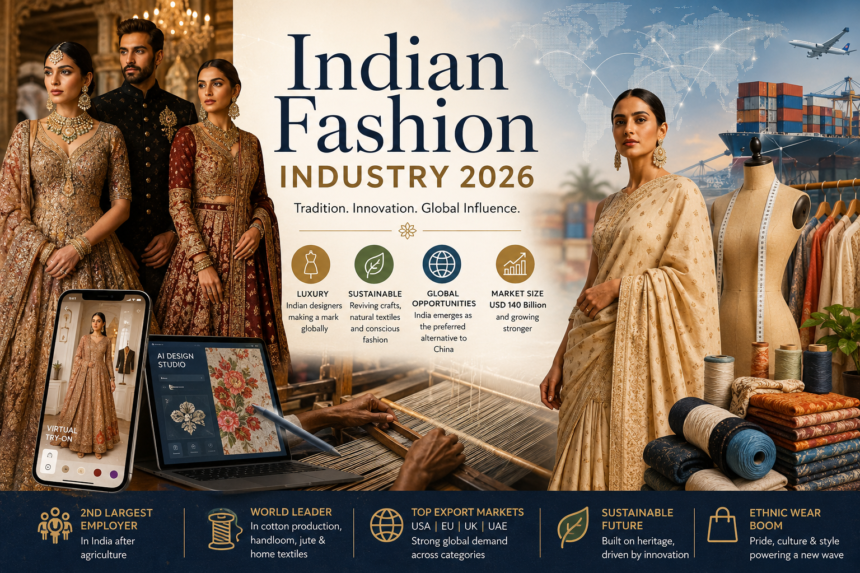
Indian Fashion Industry 2026 is having a moment unlike any in its history. At the luxury end, designers like Sabyasachi Mukherjee have broken into the global conversation as genuine international luxury brands — not just exporters to the diaspora, but creators of cultural objects coveted by fashion enthusiasts worldwide. In the mass market, ethnic wear is experiencing a renaissance driven by pride in Indian identity, festival culture, and the mainstreaming of Indian fashion on social media. And at the emerging edge, sustainable fashion startups are building businesses on Indian craft traditions that Western luxury houses are beginning to acknowledge with uncomfortable admiration.
Indian Luxury Fashion: Going Global
Sabyasachi Mukherjee — India’s First Global Luxury Fashion Brand
Sabyasachi Mukherjee has achieved what no Indian fashion designer has before — building a brand that is genuinely recognised as luxury by international fashion arbiters, not just by the Indian diaspora. His jewellery line, in particular, has found customers across markets. The collaboration with H&M in 2021 brought Sabyasachi’s aesthetic to a mass global audience. In 2026, Sabyasachi operates multiple flagship stores in India and has international presence through select retail partnerships.
What makes Sabyasachi remarkable is that he has built luxury on deeply Indian foundations — Bengal heritage, traditional textile techniques, handcrafted embroidery — rather than mimicking Western luxury codes. This has created an authenticity that Western luxury brands cannot replicate, establishing a genuine competitive moat.
Manish Malhotra — Bollywood to Commercial Success
Manish Malhotra’s expansion into jewellery, cosmetics, and pret-a-porter collections has transformed what was primarily a celebrity couturier into a comprehensive luxury lifestyle brand. His understanding of the Indian consumer — what occasions demand what aesthetic, what combinations of tradition and modernity resonate — has made him commercially successful across price points.
Tarun Tahiliani — Craft Meets Modernism
Tarun Tahiliani’s work represents perhaps the most sophisticated fusion of Indian textile craftsmanship with international silhouette. His bridal couture, in particular, has achieved iconic status among India’s urban premium market. The 2023 Indian team uniforms for the G20 summit — designed by Tahiliani — brought his aesthetic to the highest diplomatic stage.
Ethnic Wear Boom: India’s Proudest Fashion Moment
Indian Fashion Industry 2026, One of the most significant fashion trends in India in 2026 is the mainstream resurgence of ethnic and traditional Indian wear — not just for festivals and weddings, but for everyday office, social, and casual occasions. Younger Indians who once aspired exclusively to Western fashion are now wearing kurtas to work, sarees at parties, and traditional jewellery as daily accessories.
Drivers of the Ethnic Wear Renaissance
- Cultural pride: Post-COVID and in a period of growing national confidence, Indian identity in fashion is a statement of pride rather than limitation
- Bollywood and OTT influence: Films and web series featuring period settings and ethnic fashion have made traditional wear aspirational for younger audiences
- Social media: Instagram reels of saree styling, kurta combinations, and traditional jewellery have made ethnic fashion content among India’s most engaged categories
- Modi government promotion: The government’s active promotion of khadi, handlooms, and ‘Vocal for Local’ has given traditional fashion both commercial and cultural momentum
Top Ethnic Wear Brands 2026
- Fabindia: India’s largest ethnic retail chain — Rs 2,000+ crore revenue; fabric, clothing, accessories, home
- W for Woman: Premium ethnic pret-a-porter — office-friendly, contemporary Indian wear
- BIBA: Mass-premium ethnic wear — highly accessible price points, pan-India distribution
- Manyavar-Mohey: Wedding occasion wear — India’s most profitable ethnic brand by revenue
- Anita Dongre: Premium sustainable ethnic brand — strong among upper-middle class women
Sustainable Fashion in India 2026
The Sustainability Imperative
India’s traditional textile industry is inherently sustainable — hand-weaving, natural dyes, artisan production, and zero-waste techniques were standard practice before industrialisation. The challenge has been market linkage and modernisation. In 2026, a new generation of sustainable fashion brands is reconnecting Indian craft with modern consumers — both domestically and internationally.
Top Sustainable Fashion Startups India 2026
- Doodlage: Upcycled fabric and zero-waste design — one of India’s most recognised sustainable fashion brands globally
- Okhai: Tribals craft collective bringing indigenous embroidery to contemporary products — social enterprise model
- Bebaak: Reviving endangered Indian weaving traditions — Maheshwari, Kota Doria, Chanderi
- Nicobar: Premium sustainable lifestyle brand — natural materials, Indian design sensibility, global aesthetic
- Raw Mango: High-end sustainable handloom brand — one of India’s most aesthetically consistent slow fashion labels
Why International Buyers Are Coming to India for Sustainable Fashion
Indian Fashion Industry 2026, European and American fashion brands facing pressure on sustainability credentials are increasingly sourcing from India’s artisan communities — handloom, block print, natural dye, embroidery. India’s Production-Linked Incentive (PLI) scheme for textiles and the government’s promotion of handloom exports are supporting this trend. For international brands, Indian sustainable sourcing is both ethical and commercially viable — labour costs, craft quality, and material diversity are all competitive.
India’s Textile Export Story in 2026
Position in Global Textile Trade
India is the world’s second-largest textile exporter — after China — and is actively working to capture market share as global buyers diversify away from China. The textile and apparel sector accounts for approximately 12% of India’s merchandise exports. With the China+1 sourcing strategy intensifying among global fashion brands, India has an unprecedented opportunity.
Key Export Markets
- USA: India’s largest textile export market — USD 8+ billion annually
- EU: Growing rapidly — India-EU FTA (if concluded) would provide preferential market access
- UK: Post-Brexit UK-India FTA likely to significantly increase textile trade
- UAE: Growing re-export hub — Indian textiles distributed across Middle East and Africa
Key Export Categories
- Cotton yarn, fabrics: India is world’s largest cotton producer and exporter
- Readymade garments: Growing in quality and design sophistication
- Home textiles: Bed linen, towels, curtains — India is world leader
- Technical textiles: Medical, industrial, agri-textiles — fastest-growing segment
Fashion Technology in India 2026
Technology is transforming India’s fashion industry at every level:
- Virtual try-on: Myntra, Ajio, and Nykaa Fashion use AR (Augmented Reality) virtual try-on — reducing return rates by 20-30%
- AI design: Tools like Adobe Firefly and Midjourney used by Indian fashion designers for mood boarding and print design
- Personalisation: Fashion startups using AI to personalise style recommendations based on body type, purchase history, and style preferences
- Resale platforms: LimeRoad, Poshmark India, Relove — India’s pre-owned fashion market is growing rapidly among value-conscious young consumers
- 3D prototyping: Reducing sample production cycles from weeks to days — accelerating time-to-market
Read More: Indian Skincare Brands 2026: Top Affordable and Premium Skincare Reviews
Conclusion
Indian Fashion Industry 2026 is simultaneously global and deeply rooted — a rare combination that creates genuine competitive advantage. As sustainable fashion becomes mandatory rather than optional for global brands, India’s artisan heritage and craft traditions become assets rather than anachronisms. As India’s own consumers grow in confidence and purchasing power, the domestic market for quality Indian fashion expands. The industry’s challenge is connecting these two trends — building brands that can serve both the domestic Indian consumer and the global sustainable fashion buyer simultaneously.
Taza Newsz covers India’s fashion industry, textile export news, designer brand launches, and sustainable fashion developments. Follow us for the latest from India’s dynamic fashion ecosystem.