
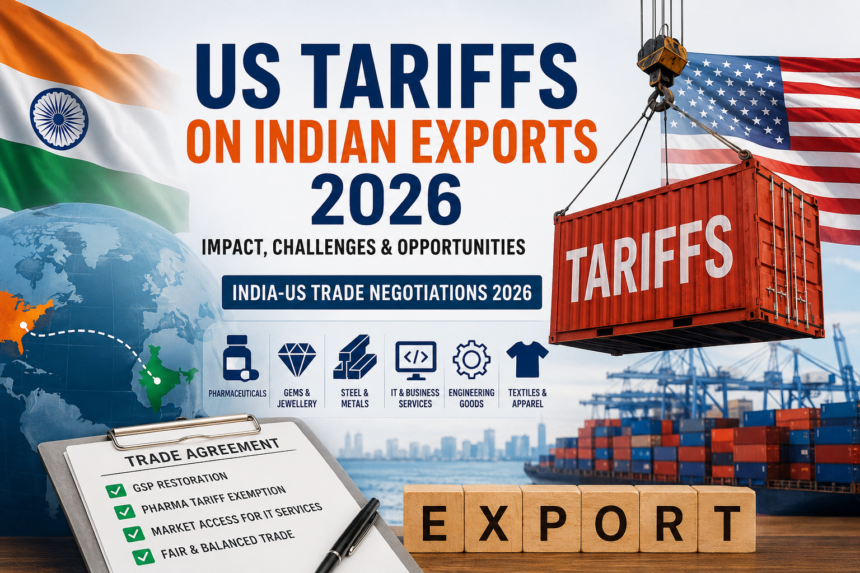
US Tariffs on Indian Exports 2026, The global trade landscape has been fundamentally disrupted by US tariff policy. While India has navigated US tariffs more carefully than many countries — and is actively negotiating a bilateral trade deal with the US — Indian exporters are feeling real pressure from tariff uncertainty, trade diversion effects, and the complex web of exemptions, exclusions, and retaliation mechanisms that characterise the current US trade environment.
US Tariff Landscape and India’s Exposure
India’s GSP Termination — Still Not Restored
US Tariffs on Indian Exports 2026, The most longstanding US trade action affecting India is the 2019 termination of India’s Generalized System of Preferences (GSP) status. GSP gave approximately USD 5.6 billion worth of Indian goods duty-free access to the US market. Since termination, these goods pay standard US MFN (Most Favoured Nation) duties — ranging from 2-15% depending on the product.
Restoration of GSP status is one of India’s key asks in bilateral trade negotiations. Products that previously benefited include chemicals, engineering products, auto components, textiles, and agricultural goods. The absence of GSP benefits has made Indian goods marginally less competitive compared to peers that retain GSP status.
Sector-Wide US Tariffs and India’s Exposure
- Steel and aluminium: US Section 232 tariffs of 25% on steel and 10% on aluminium affect Indian metal exports — India is a significant steel exporter to the US
- Reciprocal tariffs: US ‘reciprocal tariff’ proposals targeting countries with trade surpluses could affect India — negotiations are ongoing
- Pharmaceuticals: Currently largely exempt, but US is making ‘sectoral tariff’ threats on pharmaceuticals
- Electronics: Indian electronics exports benefit from some exemptions but face complex tariff classification issues
Most Affected Indian Export Sectors
1. Gems and Jewellery — Highest Absolute Exposure
Gems and jewellery is India’s second-largest goods export to the US — approximately USD 8-10 billion annually. The sector is highly labour-intensive, employing millions of artisans particularly in Gujarat (Surat, Ahmedabad). While jewellery enjoys relatively low US import duties, the sector is sensitive to overall US consumer sentiment and retail spending — which is affected by broader tariff-driven inflation.
The Surat diamond cutting industry — which processes 90% of the world’s rough diamonds — is particularly exposed to trade disruptions. Any slowdown in US luxury consumer spending directly impacts Surat’s polishing units.
2. Information Technology — Services vs Goods
India’s IT and software services exports to the US — valued at USD 45+ billion annually — are classified as services trade and are not directly subject to goods tariffs. However, several indirect pressures exist:
- H-1B visa restrictions reduce the ability of Indian IT companies to deploy engineers in the US
- Buy American executive orders restrict federal IT contracts from going to foreign vendors
- State-level anti-outsourcing provisions reduce IT services market access in some US states
A successful trade deal that addresses these service trade barriers would be worth far more to India’s IT sector than tariff changes.
3. Pharmaceuticals — The Critical Exemption
India supplies over 40% of US generic drug volume — providing billions of dollars in annual savings to American patients and healthcare systems. This dependence creates leverage for India: any significant tariff on Indian pharmaceuticals would directly and visibly increase US healthcare costs.
In 2026, pharmaceuticals remain largely exempt from US tariff actions — but US officials have made statements about ‘pharmaceutical sectoral tariffs’ that have created uncertainty. India’s pharmaceutical industry is watching these developments closely and engaging actively with US trade negotiators to secure long-term tariff exemptions.
4. Steel and Metal Products — Competitive Pressure
India’s steel exports to the US face US Section 232 tariffs of 25% — significantly reducing competitiveness against exempt suppliers. Indian steel manufacturers like Tata Steel, JSW, and SAIL have sought exclusions for specific products where US domestic supply is insufficient, with partial success. The broader impact is a reduction in India’s steel export volumes to the US and a redirection of steel to Asian and European markets.
How Indian Businesses Are Responding
Market Diversification
The most important strategic response from Indian exporters is market diversification — reducing dependence on the US market by building positions in the EU, UK, Middle East, ASEAN, and Africa. MSME exporters particularly are being supported by government schemes (ECGC export insurance, trade fair participation subsidies) to explore new markets. The India-UAE CEPA (Comprehensive Economic Partnership Agreement) and India-Australia ECTA provide preferential market access that Indian exporters are actively utilising.
China+1 Beneficiary
India’s response to US tariff pressure is partly offset by its position as a beneficiary of the China+1 diversification trend. As US companies seek to reduce supply chain dependence on China — both due to tariffs and geopolitical risk — many are turning to India for manufacturing of electronics, textiles, chemicals, and pharmaceuticals. India’s challenge is to absorb this diverted demand with adequate manufacturing capacity.
Quality and Value-Addition
Rather than competing purely on price — which becomes more difficult when tariffs eat into margins — Indian exporters are increasingly competing on quality, specialisation, and value-addition. Indian pharmaceutical companies with USFDA-approved facilities command premium pricing. Indian textile companies with sustainable certification and traceability documentation command higher prices from Western brands seeking ethical sourcing.
India’s Leverage in US Tariff Negotiations
India is not a passive recipient of US trade policy — it has genuine leverage:
- Pharmaceutical dependence: 40%+ of US generic drug supply comes from India — tariffs raise US healthcare costs
- Strategic partnership: India is the US’s most important counterbalance to China in Asia — trade pressure risks the broader relationship
- WTO membership: India can pursue WTO dispute settlement for tariff measures that violate WTO rules
- Import retaliation: India has previously imposed retaliatory tariffs on US goods (walnuts, apples, motorcycles) — a negotiating tool
- Market size: India’s USD 3.5 trillion economy growing at 7% is a prize for American exporters — market access is a bargaining chip
What the Trade Negotiations Mean for Indian Exporters
GSP Restoration — The Priority Ask
If trade negotiations successfully restore GSP status for Indian goods, the direct benefit is approximately USD 5-6 billion in annual tariff savings on currently dutiable Indian exports. This would immediately improve the competitiveness of Indian goods in the US market and could be a catalyst for further export growth.
Pharmaceutical Tariff Certainty
Long-term tariff exemptions for Indian pharmaceutical exports — codified in a trade agreement rather than left to executive discretion — would provide the certainty that pharma companies need to continue investing in US-market-oriented manufacturing. For India’s pharmaceutical sector, this is an existential trade policy concern.
IT Services Market Access
If trade negotiations address H-1B visa terms, Buy American provisions, and state-level outsourcing restrictions — even partially — the benefit to India’s IT sector would far outweigh any tariff concession India makes on goods. Services trade liberalisation is India’s highest-value ask in bilateral negotiations.
Read More: India-US Trade Deal 2026: Key Negotiations, Opportunities, and Challenges
Conclusion
US Tariffs on Indian Exports 2026 creates genuine challenges for Indian exporters — particularly in gems, steel, and specific goods categories. But India’s strategic position, its indispensability to the US in pharmaceuticals and IT, and the geopolitical logic of deepening India-US economic ties create the conditions for a negotiated resolution that protects India’s most critical export interests. The optimal outcome is a comprehensive bilateral trade deal that provides long-term tariff certainty for both sides. Taza Newsz covers India’s trade policy, export industry news, and international economic relations comprehensively.