
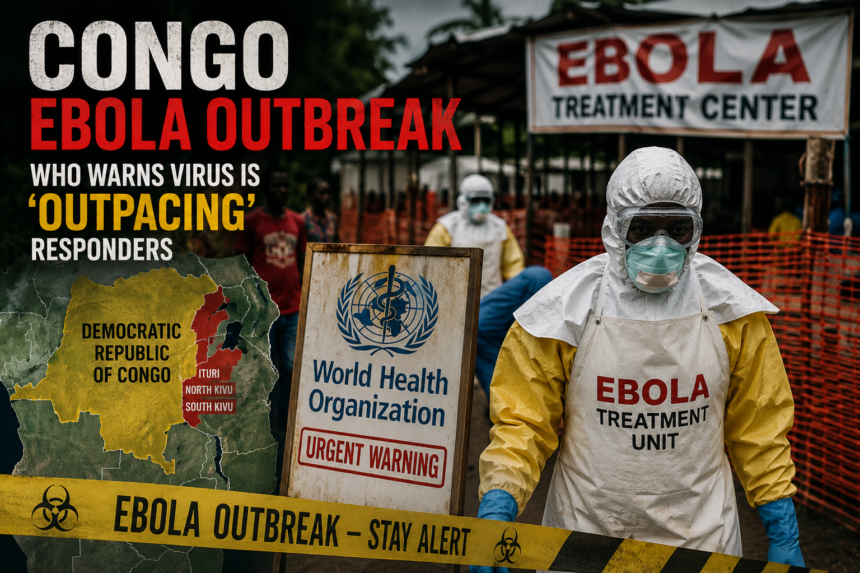
The deadly Congo Ebola Outbreak in the Democratic Republic of Congo is rapidly turning into one of the country’s most alarming public health emergencies in recent years. Health officials are now racing against time as the virus spreads faster than medical teams can contain it. Even more worrying? Violence, fear, and mistrust are making an already dangerous situation far worse.
Eastern Congo, already scarred by years of armed conflict and displacement, is now facing a double nightmare — war on one side and a deadly virus on the other.
Ebola Cases Continue to Rise Across Eastern Congo
According to the latest figures released by Congo’s health ministry, the outbreak has already recorded:
- 101 confirmed Ebola infections
- 930 suspected cases
- 221 suspected deaths
Authorities have also identified more than 2,200 people who may have come into contact with infected patients. These contacts are spread across 11 health zones in the eastern provinces of Ituri, North Kivu, and South Kivu.
That’s a huge challenge for health workers. Tracking every contact during an Ebola outbreak is like trying to stop sparks from spreading during a wildfire. Miss one person, and the chain of transmission can explode again.
WHO Says Health Teams Are Playing “Catch-Up”
Congo Ebola Outbreak, WHO Director-General Tedros Adhanom Ghebreyesus did not hide the seriousness of the situation during a virtual briefing with African health ministers.
“We are now playing catch-up with a very fast-moving epidemic,” he said. “At the moment, the epidemic is outpacing us.”
Those words reveal just how dangerous the situation has become.
Normally, Ebola outbreaks are controlled through rapid isolation, contact tracing, safe burials, and public awareness campaigns. But in eastern Congo, every one of those measures is being disrupted by instability and violence.
Hospitals and Isolation Centers Attacked by Crowds
In one of the most shocking developments, treatment centers in Ituri province were attacked over the weekend. According to local officials, angry crowds stormed hospitals and burned isolation tents while demanding the release of bodies for burial.
At least 25 Ebola patients reportedly fled treatment facilities during the chaos.
Imagine trying to stop one of the world’s deadliest viruses while infected patients disappear into nearby communities. It’s the kind of scenario public health experts fear the most.
Even worse, one confirmed Ebola patient was reportedly still missing in the community after the attacks.
Unsafe Burials Are Fueling the Spread of Ebola
Congo Ebola Outbreak, Burial traditions have become a major challenge during Ebola outbreaks across Africa for years. Families often want to wash, touch, or prepare bodies before funerals — practices deeply rooted in culture and emotion.
But Ebola spreads through direct contact with bodily fluids, including from deceased victims. That means traditional burials can unintentionally become super-spreader events.
Health officials say attacks on hospitals and demands for the return of bodies are now accelerating the virus’s transmission.
It’s a heartbreaking dilemma. Families want dignity and tradition. Medical teams want safety and containment. In the middle of that tension, the virus keeps spreading.
Conflict and Distrust Make the Crisis Worse
Eastern Congo is no stranger to instability. Armed militias, political violence, and mass displacement have plagued the region for years. Entire communities have grown deeply suspicious of government authorities and international organizations.
That distrust is now becoming one of the biggest obstacles in fighting Ebola.
Many residents fear treatment centers, believing patients who enter never return. Others see health workers as outsiders rather than helpers. Rumors and misinformation are spreading almost as fast as the virus itself.
Think about it this way: fighting Ebola without public trust is like trying to sail through a storm with holes in the boat.
The Rare Bundibugyo Ebola Strain Adds Another Layer of Concern
Congo Ebola Outbreak, This outbreak is not caused by the more common Zaire strain of Ebola. Instead, it involves the much rarer Bundibugyo strain.
That detail matters a lot.
Currently, there are no fully approved vaccines or treatments specifically designed for the Bundibugyo variant. Existing Ebola vaccines were mainly developed for other strains, which means doctors are entering unfamiliar territory.
WHO officials are now discussing experimental vaccines and emergency clinical trials involving antiviral medicines and monoclonal antibody treatments.
In other words, scientists are being forced to improvise while the outbreak continues to grow.
Why Ebola Is One of the World’s Most Feared Viruses
Ebola remains one of the deadliest viruses known to humans. Symptoms often begin suddenly and can include:
- High fever
- Severe weakness
- Muscle pain
- Vomiting
- Diarrhea
- Internal and external bleeding
The virus spreads through direct contact with infected bodily fluids or contaminated materials.
Without rapid medical intervention, Ebola can kill a large percentage of infected patients. Some outbreaks in the past have recorded mortality rates exceeding 50%.
That’s why every delay in response can have devastating consequences.
International Attention Increases as American Doctor Is Infected
The outbreak gained even more international attention after American surgeon Peter Stafford contracted the Bundibugyo Ebola strain while working in Congo.
He was later transferred to a high-security isolation unit in Berlin for specialized treatment.
According to Germany’s Charité hospital, Stafford was severely weakened but not considered critically ill. Meanwhile, his wife and four children were placed in quarantine after possible exposure.
Cases involving foreign medical workers often highlight the global risk of outbreaks like this. Viruses do not recognize borders, passports, or politics.
Can Congo’s Health System Handle Another Major Ebola Emergency?
Congo Ebola Outbreak, That question is becoming harder to answer every day.
Congo has battled multiple Ebola outbreaks over the years and has built considerable experience in containment efforts. But this crisis is unfolding under especially difficult conditions.
Health workers are not just fighting a virus. They are also dealing with:
- Armed conflict
- Population displacement
- Damaged infrastructure
- Community resistance
- Limited medical resources
It’s like trying to extinguish a fire while explosions continue around you.
Medical teams now face enormous pressure to regain control before infections spread into more densely populated urban areas.
Global Health Experts Fear Regional Spread
One of the biggest concerns is the possibility of cross-border transmission.
The affected provinces sit near several neighboring countries, and movement across borders is common. If infected individuals travel undetected, the outbreak could quickly evolve into a broader regional emergency.
Neighboring governments and international health agencies are already increasing surveillance and preparedness efforts.
Airports, border checkpoints, and health screening centers may soon face tighter monitoring as officials attempt to prevent wider spread.
The Human Cost Behind the Numbers
Congo Ebola Outbreak, Statistics can sometimes feel cold and distant. But behind every suspected case or death is a real family facing unimaginable fear.
Parents are losing children. Children are losing parents. Communities are watching hospitals burn while desperately trying to protect loved ones.
That emotional reality often gets lost behind headlines and infection charts.
Ebola outbreaks are not only medical emergencies — they are human tragedies that test entire societies.
Experimental Vaccines Could Become a Turning Point
Despite the grim situation, health experts still see hope.
WHO officials are evaluating experimental vaccines and treatments that could help slow transmission of the Bundibugyo strain. Researchers are also considering emergency clinical trials for antiviral drugs and monoclonal antibodies.
If these measures prove effective, they could become a major breakthrough not only for Congo but also for future outbreaks involving rare Ebola variants.
Still, vaccines alone won’t solve the crisis.
Without security, community trust, and cooperation, even the best medical tools can fail.
Read More: Nipah Virus Outbreak: Early Symptoms, High Fatality Risk and Why Detection Matters
Conclusion
The Congo Ebola Outbreak in the Democratic Republic of Congo is escalating at a deeply alarming pace, with WHO officials warning that the epidemic is now moving faster than emergency responders can contain it. Rising infections, attacks on treatment centers, unsafe burials, and widespread distrust are creating the perfect storm for further transmission.
The situation has become even more dangerous because the outbreak involves the rare Bundibugyo strain, for which no approved vaccines currently exist. As health workers struggle to isolate patients and track contacts, violence and fear continue undermining response efforts.
For now, the world is watching closely as Congo battles one of its toughest public health crises in years. Whether international support, experimental treatments, and community cooperation can slow the outbreak may determine how severe this emergency ultimately becomes.