
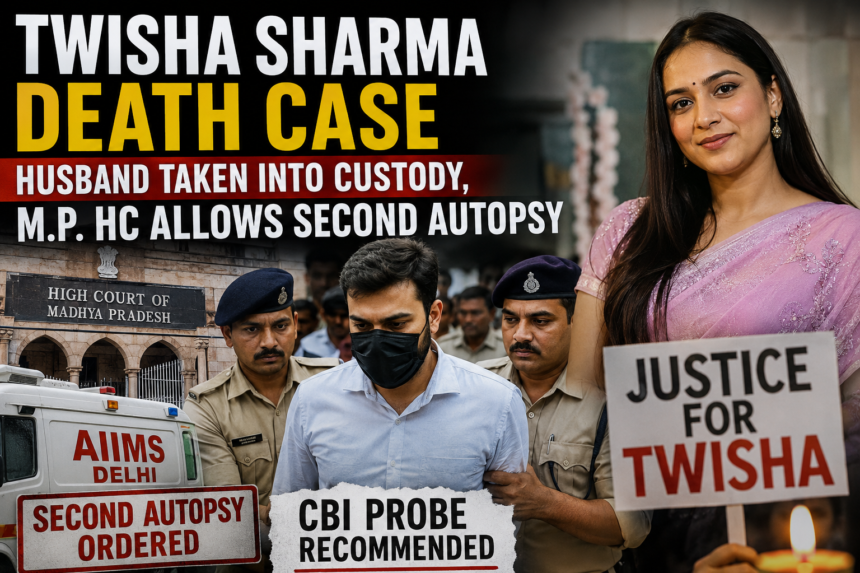
Twisha Sharma Death Case, The tragic death of 33-year-old Twisha Sharma has shaken Madhya Pradesh and sparked a nationwide conversation about dowry harassment, domestic abuse, and the functioning of the justice system. What initially appeared to be a heartbreaking personal tragedy has now transformed into a high-profile legal battle involving police investigations, court proceedings, and even a recommended Central Bureau of Investigation (CBI) probe.
The case continues to unfold rapidly, raising difficult questions. Was justice delayed? Was the first investigation enough? And why has this case triggered such massive public attention?
Who Was Twisha Sharma?
Twisha Sharma was a 33-year-old woman from Madhya Pradesh whose sudden death inside her marital home in Bhopal shocked both her family and the wider public. She had married Samarth Singh on December 25, 2025, meaning her death occurred less than six months after her wedding.
That detail alone changed the legal gravity of the situation. Under Indian law, deaths of married women within seven years of marriage—especially under suspicious circumstances—often invite deeper scrutiny, particularly when allegations of dowry harassment emerge.
According to her family, Twisha had been subjected to continuous mental pressure and financial demands after marriage. These allegations later became central to the police investigation.
Samarth Singh Taken Into Custody After Days Missing
Twisha Sharma Death Case, One of the biggest developments in the case came when Samarth Singh, Twisha’s husband, was finally detained by the police after reportedly remaining absconding for several days.
Singh, who practices as a lawyer, arrived at the Jabalpur District Court on May 22 intending to surrender. However, by the time he reached the court premises, proceedings for the day had reportedly ended.
Soon after, local police detained him and transferred him into the custody of the Bhopal Police.
Bhopal Police Commissioner Sanjay Kumar confirmed the arrest and stated that Singh would be presented before the court within the legally mandated 24-hour period.
The arrest marked a turning point in the investigation, especially because public criticism had been mounting over the pace of police action.
Why the High Court Ordered a Second Autopsy
In another dramatic development, the Madhya Pradesh High Court ordered a second autopsy on Twisha Sharma’s body.
The directive came while hearing a petition filed by Sharma’s father, Navnidhi Sharma, who sought a fresh medical examination to eliminate doubts surrounding the original post-mortem findings.
Justice Avanindra Kumar Singh observed that since the death occurred within six months of marriage, conducting another autopsy was necessary in the interest of transparency and justice.
The court clarified something important—it was not accusing the earlier medical team of wrongdoing. Instead, it emphasized that a second examination would help ensure that no questions remained unanswered.
Think of it like replaying a controversial moment in a cricket match using ultra-edge technology. The goal is not to blame the umpire immediately, but to ensure the final decision is beyond dispute.
AIIMS Delhi Team to Conduct Fresh Examination
Twisha Sharma Death Case, The High Court requested the Director of AIIMS Delhi to immediately form a specialized medical team for the second autopsy.
According to court directions, the State government will arrange special transportation so that the expert team can conduct the examination in Bhopal as quickly as possible.
This move has significantly elevated the seriousness of the case. When a premier institution like AIIMS becomes involved, it signals that authorities want the findings to carry maximum credibility and scientific backing.
For Sharma’s family, the decision represented hope that unanswered questions may finally receive clear answers.
Madhya Pradesh Government Recommends CBI Probe
The State government also made headlines by recommending a CBI investigation into the matter.
A formal notification issued by the Madhya Pradesh Home Department granted consent under the Delhi Special Police Establishment Act, 1946, allowing the Central Bureau of Investigation to investigate the case across the State.
The decision came only two days after Chief Minister Mohan Yadav reportedly met Twisha Sharma’s family.
That timing matters.
Public pressure surrounding the case has been growing steadily, especially on social media platforms where users demanded an independent investigation free from political or institutional influence.
A CBI inquiry often enters the picture when cases become highly sensitive or when concerns arise regarding the neutrality of local investigations.
Allegations Against Husband and Mother-in-Law
Twisha Sharma’s family has accused both Samarth Singh and his mother, retired judge Giribala Singh, of harassment and dowry-related abuse.
The allegations include mental cruelty and repeated financial demands made after marriage.
These accusations became even more controversial because Giribala Singh previously served in the judiciary, leading to intense public scrutiny over possible influence and institutional pressure.
Police officials stated that multiple notices had been issued to her during the investigation.
According to Commissioner Sanjay Kumar, authorities also informed the court that she had allegedly not cooperated fully with the investigation process.
The police additionally mentioned allegations that influential individuals and judicial contacts were approached after Twisha’s death.
That revelation intensified debates around whether power and influence could impact the investigation.
High Court Questions Anticipatory Bail
Twisha Sharma Death Case, Another crucial legal battle revolves around the anticipatory bail granted to Giribala Singh by a local Bhopal court.
Twisha Sharma’s family challenged the relief before the Madhya Pradesh High Court. Interestingly, the State government also supported the challenge.
The High Court has now directed Giribala Singh to appear before it on or before May 25, 2026.
This indicates that the court intends to closely examine whether the anticipatory bail was justified under the circumstances.
Legal experts believe the outcome could significantly influence the direction of the investigation moving forward.
Police Defend Their Investigation
As criticism mounted online and among activists, the Bhopal Police defended their handling of the case.
Police Commissioner Sanjay Kumar stated that an FIR had been registered within two days of the incident and insisted that authorities acted promptly.
He emphasized that the investigation remained active and ongoing.
However, public skepticism continues to linger. In emotionally charged cases involving allegations of dowry death, delays—even small ones—often become magnified in public perception.
The recommendation for a CBI probe appears partly aimed at restoring confidence in the investigative process.
Controversial Claims About Twisha Sharma’s Mental Health
Twisha Sharma Death Case, The case took an even uglier turn after statements made publicly by Samarth Singh’s mother.
She claimed that Twisha Sharma had mental health issues, was allegedly taking medication associated with schizophrenia treatment, and had a history involving marijuana use.
Those remarks triggered widespread outrage online.
Many social media users accused the family of attempting to shift blame onto the deceased woman rather than addressing the allegations being investigated.
Mental health advocates also criticized the public use of medical claims without verified evidence, arguing that such statements can stigmatize mental illness and distract from the core investigation.
Why This Case Has Captured National Attention
Sadly, India has witnessed many cases involving allegations of dowry harassment and suspicious deaths of married women.
But the Twisha Sharma case has drawn extraordinary national attention for several reasons:
- The death occurred within months of marriage
- The accused husband reportedly remained missing initially
- The mother-in-law is a retired judge
- The High Court intervened directly
- A second autopsy was ordered
- The State government recommended a CBI probe
Together, these elements transformed the case from a local tragedy into a national legal and social issue.
People are not just following a criminal investigation—they are watching a larger test of institutional accountability.
What Happens Next in the Investigation?
Several major developments are expect in the coming days:
- Samarth Singh will face court proceedings after police custody
- AIIMS Delhi experts will conduct the second autopsy
- The High Court will hear arguments regarding anticipatory bail
- Authorities may formally transfer the case to the CBI
- Fresh forensic and medical findings could reshape the investigation
At this stage, the investigation remains highly active and legally sensitive.
Every new development could alter the direction of the case dramatically.
The Larger Debate Around Dowry Harassment in India
Beyond the courtroom drama, the case has reignited debate about dowry practices and emotional abuse within marriages.
Despite stricter laws and decades of awareness campaigns, dowry-related harassment continues to surface across India.
Many women suffer silently behind closed doors, often facing emotional pressure that gradually escalates into psychological trauma.
Cases like Twisha Sharma’s become painful reminders that legal reform alone cannot eliminate deeply rooted social problems.
Real change requires cultural transformation, stronger support systems, and faster access to justice.
Read More: Women’s Health India 2026: PCOS, Menopause, Mental Health & Government Schemes
Conclusion
The Twisha Sharma Death Case has evolved far beyond a routine criminal investigation. It now sits at the intersection of law, politics, gender justice, and public accountability.
The detention of Samarth Singh, the High Court’s order for a second autopsy, and the recommendation for a CBI probe collectively signal that authorities understand the seriousness of public concern surrounding the matter.
For Twisha Sharma’s family, the fight is about seeking answers and justice. For the wider public, the case represents something larger—a demand for transparency and fairness in cases involving alleged domestic abuse and dowry harassment.
As the investigation continues, the country will be watching closely to see whether the legal system can deliver clarity, accountability, and ultimately, justice.