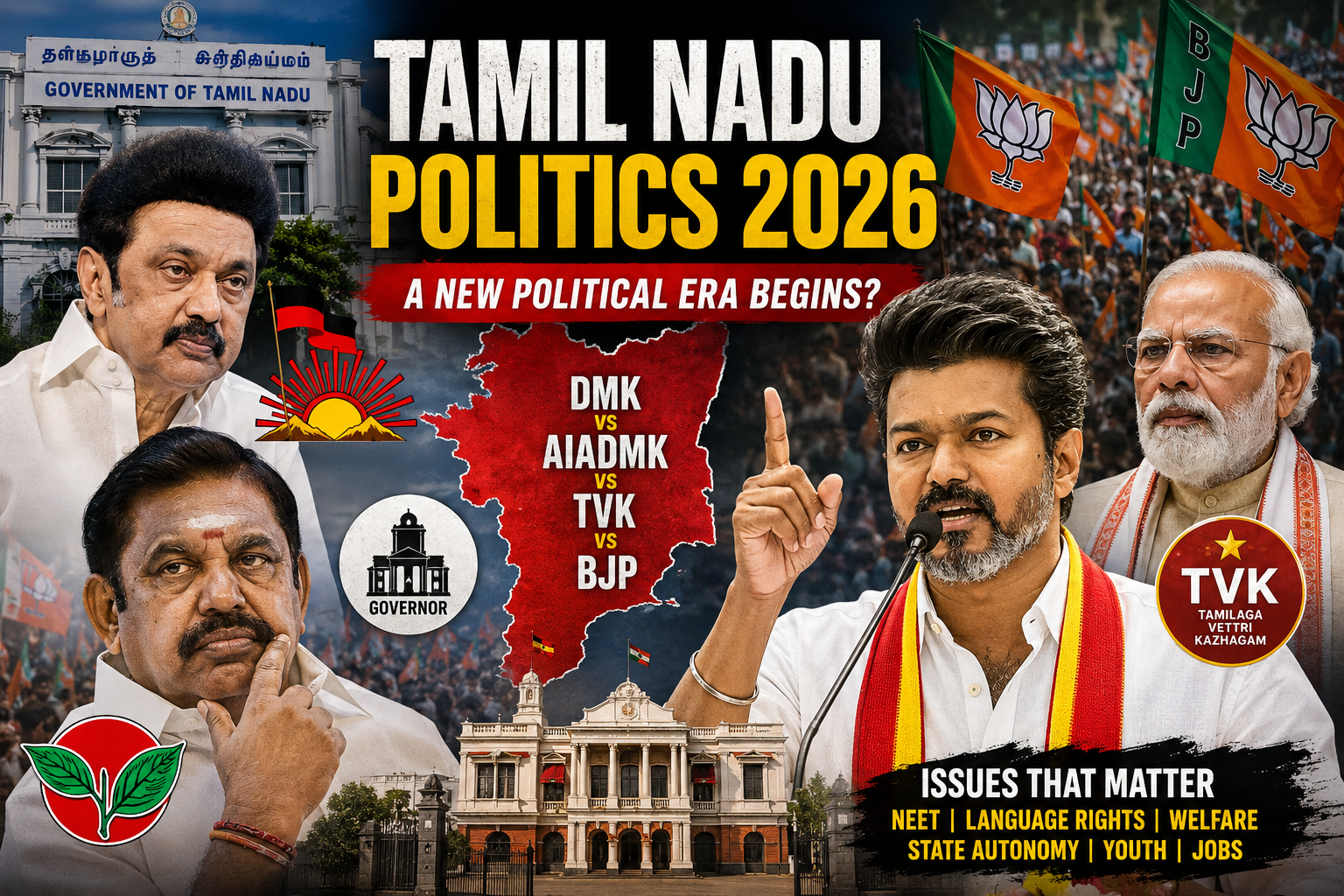
Tamil Nadu Politics 2026, Tamil Nadu has always been India’s most electorally distinctive state. Its politics revolve around Dravidian ideology, film-star influence, welfare economics, and deeply rooted caste coalition structures that often defy national political trends. Unlike many other states, Tamil Nadu has largely resisted direct dominance by national parties for decades.
However, in 2026, the state’s political landscape is entering one of its most unpredictable phases in recent history. Film superstar Vijay’s Tamilaga Vettri Kazhagam (TVK) is emerging as a serious third force. At the same time, the DMK government under Chief Minister MK Stalin is locked in a constitutional confrontation with Governor RN Ravi’s successor, Rajendra Vishwanath Arlekar. Meanwhile, the BJP is making its strongest attempt yet to establish a durable foothold in South India’s most politically resistant state.
Political tensions escalated further on May 7, 2026, when Vijay visited Tamil Nadu Governor Rajendra Vishwanath Arlekar at Lok Bhavan twice within 24 hours. The meetings took place amid an intensifying dispute over constitutional procedures, pending state Bills, and government formation issues. Soon after, the DMK and its ally VCK issued statements supporting Vijay’s position while accusing the Governor’s office of insulting Tamil Nadu’s democratic mandate.
This evolving situation highlights how Tamil Nadu’s politics are no longer limited to the traditional DMK-AIADMK rivalry. Instead, the state is witnessing the rise of a complex three-way political contest that could reshape southern Indian politics for years to come.
Vijay and TVK: The Superstar’s Political Gamble
Who Is Vijay and Why Does He Matter?
Thalapathy Vijay remains Tamil cinema’s biggest contemporary superstar. His films consistently dominate the box office across Tamil Nadu, Kerala, and the global Tamil diaspora. More importantly, his fan clubs have long functioned like proto-political organisations. They possess district-level structures, disciplined volunteer networks, and extraordinary mobilisation capacity.
Therefore, when Vijay officially launched Tamilaga Vettri Kazhagam (TVK) in 2024, it immediately became one of the most anticipated political developments in Tamil Nadu’s modern history.
Unlike many celebrity politicians, Vijay has attempted to position himself carefully. He presents TVK as a welfare-oriented, people-centric alternative to the established Dravidian parties. At the same time, he avoids aggressive caste rhetoric while quietly benefiting from his broad cross-caste appeal among younger voters and urban middle-class communities.
His political messaging focuses on:
- Tamil rights
- Farmers’ welfare
- Good governance
- Anti-corruption politics
- Youth empowerment
- Social justice within a modern governance framework
As a result, TVK has managed to attract attention across multiple voter blocs without immediately alienating existing political identities.
TVK’s Current Strengths and Weaknesses
In 2026, TVK remains a relatively young political party preparing for its first major Assembly election. Nevertheless, its organisational advantages are already significant.
TVK’s Major Strengths
- Vijay’s unmatched popularity and mass appeal
- A pre-existing fan club network functioning as grassroots infrastructure
- Strong social media engagement among young voters
- Cross-caste recognition across urban and semi-urban Tamil Nadu
- Ability to dominate political discourse through celebrity influence
Furthermore, no new political party in Tamil Nadu’s recent history has entered politics with this level of statewide recognition and mobilisation capability.
However, the party also faces major structural challenges.
TVK’s Key Limitations
- Limited administrative and governance experience
- Overdependence on Vijay’s personal charisma
- Weak booth-level electoral machinery in some regions
- Lack of experienced district-level political leadership
- Difficulty navigating Tamil Nadu’s complex caste arithmetic
Most importantly, Tamil Nadu’s electoral system rewards deeply entrenched coalition structures built over decades. Fan clubs alone cannot automatically translate into Assembly seats.
Therefore, TVK’s transition from a celebrity movement into a durable political organisation remains its biggest test.
The DMK-Governor Constitutional Crisis
Background of the Standoff
Tamil Nadu’s ongoing constitutional confrontation between the DMK government and Governor Rajendra Vishwanath Arlekar reflects a broader national pattern visible across several Opposition-ruled states.
In multiple states, Governors appointed by the Central government have been accused of:
- Delaying assent to Bills passed by elected Assemblies
- Withholding administrative approvals
- Creating procedural delays
- Interfering in legislative functioning
- Expanding gubernatorial authority beyond constitutional conventions
The DMK government argues that these actions amount to indirect political interference by the BJP-led Centre.
In Tamil Nadu specifically, several important Bills have remained pending with the Governor’s office for extended periods. These include:
- The NEET exemption Bill
- Amendments related to university administration
- Disaster Management Act-related proposals
- State autonomy and education policy measures
The Supreme Court has repeatedly observed that Governors cannot indefinitely delay decisions on Assembly-passed legislation. However, implementation of those constitutional principles continues to generate conflict between state governments and Raj Bhavans.
May 7, 2026: Vijay’s Governor Visit and Political Fallout
Tamil Nadu Politics 2026, The political situation intensified dramatically on May 7, 2026, when Vijay visited the Governor twice within 24 hours.
These meetings immediately triggered speculation across Tamil Nadu’s political ecosystem. Opposition parties, media commentators, and political strategists interpreted the visits through multiple lenses:
- Was TVK positioning itself as a mediator?
- Was Vijay signalling political independence?
- Was the Governor attempting to politically engage TVK?
- Or was this part of broader alliance calculations ahead of the Assembly election?
Interestingly, the DMK and VCK responded by publicly supporting Vijay’s stance rather than attacking him. Their statements argued that Tamil Nadu itself had been insulted through the Governor’s actions.
This response revealed an important political calculation.
At least for now, the DMK appears to view TVK less as an immediate electoral enemy and more as a potentially useful partner in resisting BJP expansion and defending Tamil Nadu’s state autonomy narrative.
Consequently, Vijay’s meetings with the Governor demonstrated how central TVK has already become within Tamil Nadu politics despite being a newly formed party.
Tamil Nadu Assembly Election 2026: The Political Battlefield
DMK’s Position Ahead of the Election
The DMK under MK Stalin secured a decisive victory in the 2021 Assembly elections, ending the AIADMK’s decade-long rule. Since then, Stalin’s government has focused heavily on welfare expansion, administrative branding, and Dravidian ideological consolidation.
The DMK’s core political strengths remain powerful:
- Strong welfare delivery systems
- Organised cadre structure
- Deep rural presence
- Dravidian social justice messaging
- Administrative continuity
- Strong alliance network
However, as the 2026 election approaches, the party also faces familiar anti-incumbency pressures.
Some constituencies are witnessing dissatisfaction over:
- Local governance inefficiencies
- Employment concerns
- Urban infrastructure gaps
- Corruption allegations
- Rising political competition from TVK
Even so, the DMK remains the strongest political force in Tamil Nadu heading into the election cycle.
AIADMK’s Continuing Struggles
The AIADMK has struggled to regain stability since the death of J Jayalalithaa in 2016.
Although Edappadi K Palaniswami (EPS) eventually emerged as the dominant leader after years of factional conflict with O Panneerselvam (OPS), the party still faces major structural problems.
AIADMK’s Current Challenges
- Leadership vacuum after Jayalalithaa
- Declining ideological clarity
- Erosion of urban support
- Organisational fatigue
- Competition from both TVK and BJP
Additionally, TVK threatens to attract younger anti-DMK voters who may previously have gravitated toward the AIADMK.
At the same time, the BJP is attempting to occupy parts of the right-of-centre political space that AIADMK once dominated through alliance politics.
As a result, the AIADMK enters 2026 under significant pressure.
BJP’s Southern Expansion Strategy
The BJP still has limited electoral strength in Tamil Nadu. Nevertheless, the party is investing heavily in long-term political expansion across the state.
Prime Minister Narendra Modi’s repeated Tamil Nadu visits, Tamil-language outreach campaigns, temple diplomacy, and cultural initiatives such as the Kashi Tamil Sangamam all form part of a broader strategy to improve the BJP’s cultural acceptance among Tamil voters.
The BJP understands that outright victory in Tamil Nadu remains difficult. Instead, its immediate objective appears more strategic:
- Increase vote share substantially
- Expand urban presence
- Build caste alliances
- Improve Lok Sabha performance
- Prevent DMK dominance
- Establish a sustainable organisational base
However, the Governor controversy may also be strengthening the DMK’s narrative that the BJP is attempting to undermine Tamil Nadu’s autonomy through constitutional institutions.
That perception remains politically sensitive in a state with strong regional identity consciousness.
Key Issues Dominating Tamil Nadu Politics
NEET and Education Politics
Tamil Nadu’s opposition to NEET remains one of the state’s most emotionally powerful political issues.
The state government argues that the national medical entrance examination disadvantages:
- Rural students
- Tamil-medium students
- Government school students
- Economically weaker families
Critics of NEET believe the system disproportionately benefits affluent students with access to expensive coaching infrastructure.
The issue has become even more politically charged because several Tamil Nadu students have died by suicide after struggling with NEET-related pressure. These tragedies have intensified public anger and transformed NEET into a larger debate about educational justice and federal autonomy.
Consequently, the Governor’s delay in approving the NEET exemption Bill has become a major symbol of Centre-state conflict.
Dravidian Identity and Language Rights
Tamil Nadu Politics 2026, Language politics continues to remain central to Tamil Nadu’s political identity.
Across party lines, Tamil Nadu strongly opposes:
- Hindi imposition
- Mandatory three-language policies
- Centralised language control
- Perceived cultural homogenisation
The state’s political establishment insists on protecting Tamil language primacy in education, administration, and cultural identity.
Therefore, BJP efforts promoting Hindi as a national integration language are often viewed in Tamil Nadu as linguistic centralisation rather than cultural unity.
Any party perceived as compromising on Tamil identity risks immediate political backlash.
Welfare Politics and Governance
Tamil Nadu possesses one of India’s most extensive welfare ecosystems.
Over decades, successive governments have built expansive social support programmes, including:
- Free rice distribution
- Subsidised canteens
- Free bus travel schemes
- Electricity subsidies
- Cash transfer programmes
- Education support initiatives
The DMK has continued expanding this welfare-oriented political model.
As a result, any political party hoping to compete seriously in Tamil Nadu must engage with welfare politics on Tamil Nadu’s own terms. This creates a high financial and administrative benchmark that many national parties struggle to match effectively.
TVK’s Electoral Strategy: Alliance or Independence?
Tamil Nadu Politics 2026, Vijay and TVK now face the most important strategic decision in the party’s short history.
Under Tamil Nadu’s first-past-the-post electoral system, fragmented opposition votes can dramatically alter results. Therefore, TVK has three broad options:
1. Alliance with DMK
This would:
- Maximise anti-BJP vote consolidation
- Provide organisational support
- Offer easier entry into governance
However, it could also reduce TVK’s independent political identity and limit seat allocation.
2. Alliance with AIADMK
This would:
- Position TVK directly against the DMK
- Strengthen opposition arithmetic
Yet ideologically and politically, such an alliance could appear awkward to many Vijay supporters.
3. Contest Independently
This approach would:
- Preserve TVK’s long-term identity
- Build independent grassroots credibility
- Establish Vijay as a standalone political force
However, it also carries the highest electoral risk. Vote splitting could indirectly benefit rival parties while limiting TVK’s immediate seat conversion.
At present, the DMK’s relatively soft public positioning toward Vijay suggests that alliance possibilities remain open.
Ultimately, Vijay’s coalition decision may become the single most consequential factor shaping Tamil Nadu’s 2026 election outcome.
Read More: West Bengal Election 2026 Results BJP Creates History With Massive Victory
Conclusion
Tamil Nadu Politics 2026 is more fluid and unpredictable than it has been in decades.
The traditional DMK-AIADMK binary is facing its first serious disruption in years. Vijay’s TVK has already demonstrated that celebrity influence, organisational mobilisation, and youth-driven politics can no longer be dismissed as symbolic phenomena.
At the same time, the DMK-Governor constitutional conflict has intensified debates around federalism, state autonomy, and Centre-state relations. Meanwhile, the BJP continues pursuing an ambitious long-term strategy to expand its influence in India’s most politically resistant southern state.
Whether TVK ultimately becomes a kingmaker, coalition partner, or independent political force will depend on candidate selection, alliance negotiations, organisational depth, and Vijay’s ability to transform cinematic popularity into electoral durability.
One thing, however, is already clear: Tamil Nadu’s 2026 election is no longer a routine Dravidian contest. It is evolving into one of the most consequential political battles in contemporary Indian politics.