
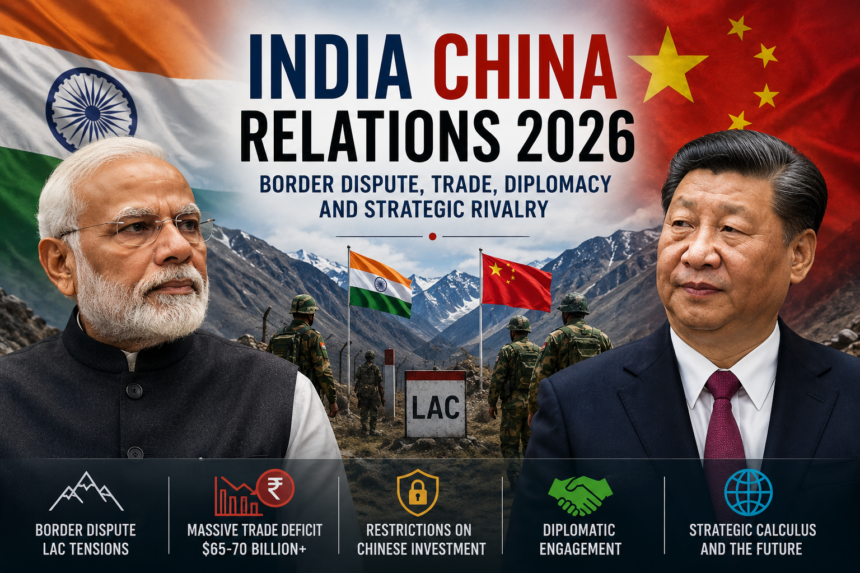
India China Relations 2026 — the world’s two most populous nations, sharing one of the world’s longest and most contested borders — are navigating one of the most complex bilateral relationships in global geopolitics. The October 2024 border patrolling agreement, which resolved some of the most contentious friction points along the Line of Actual Control (LAC) that emerged from the 2020 Galwan Valley clash, has created the conditions for a cautious diplomatic reset. But the fundamental tensions — military, economic, and strategic — between the two Asian giants remain unresolved.
The Border Situation: After the 2024 Patrolling Agreement
The October 2024 Agreement
After more than four years of military standoff following the June 2020 Galwan Valley clash — which resulted in the deaths of 20 Indian soldiers and an unknown number of Chinese troops — India and China reached a border patrolling agreement in October 2024. The agreement restored patrolling access to several friction points including Depsang and Demchok in eastern Ladakh, where India’s patrolling rights had been effectively denied by Chinese forward positioning since 2020.
The agreement was a significant diplomatic achievement for India — restoring the pre-Galwan status quo at most friction points and allowing Indian soldiers to resume patrols that had been blocked for four years. External Affairs Minister S. Jaishankar described the agreement as a step toward normalisation, while emphasising that relations cannot be fully normal while the broader border situation remains disputed.
Current LAC Situation in 2026
In 2026, the border remains militarised at significantly elevated levels compared to pre-2020. Both sides maintain substantial troop and equipment deployments in forward areas. India has invested heavily in border road infrastructure — accelerating the Border Roads Organisation’s programme to build all-weather roads and tunnels connecting Ladakh, Arunachal Pradesh, and other border areas. The Sela Tunnel (Arunachal) and multiple new strategic roads have significantly improved India’s ability to supply and reinforce its border positions.
India-China Trade: The Rs 7 Lakh Crore Deficit Problem
The Scale of Bilateral Trade
India China Relations 2026, Despite the military tensions and diplomatic friction, India-China trade has continued to grow — a paradox that reflects economic interdependence that political tensions have not been able to overcome. In 2025-26, bilateral trade reached approximately USD 100+ billion — with India importing approximately USD 85 billion from China and exporting only USD 15-20 billion to China. This USD 65-70 billion trade deficit is one of India’s largest bilateral deficits and a persistent source of strategic concern.
What India Imports from China
- Electronics: Smartphones, laptops, televisions, components — China dominates India’s electronics import market
- Solar panels and equipment: Despite strategic tensions, India imported significant quantities of Chinese solar panels for its renewable energy programme
- Chemicals and pharmaceuticals API: Active Pharmaceutical Ingredients — China supplies 60-70% of India’s API requirements, creating a strategic vulnerability in India’s critical pharma sector
- Machinery and industrial equipment: Textiles machinery, power equipment, construction equipment
- Consumer goods: Toys, home goods, clothing
India’s Strategy to Reduce Chinese Dependence
India China Relations 2026, India has been actively pursuing import substitution and supply chain diversification to reduce its economic dependence on China:
- PLI for electronics: Apple and its supplier ecosystem has significantly expanded India manufacturing, reducing reliance on China for final assembly
- Bulk drug parks: Government-funded API manufacturing parks to reduce pharmaceutical China dependence
- Solar manufacturing: Adani Solar and other Indian manufacturers are building domestic solar panel production to reduce Chinese solar imports
- Restricting Chinese FDI: Investment from Chinese entities requires government approval — effectively blocking most new Chinese investment
Chinese Investment Restrictions: The Policy Framework
Following Galwan, India implemented one of the world’s most comprehensive restrictions on Chinese investment. Any investment from countries sharing a land border with India — primarily China — requires prior government approval through the Foreign Investment Facilitation Portal. This effectively blocks automatic route FDI from China.
In 2026, select approvals for Chinese participation have been granted in sectors where China’s technology or capital is genuinely irreplaceable — but the general posture remains restrictive. Chinese apps — including TikTok (ShareChat and others have partially filled the gap), UC Browser, and CamScanner — remain banned under IT security concerns.
Impact on Indian Industry
The Chinese investment restrictions have created real costs for some Indian industries. Indian smartphone manufacturers that relied on Chinese investment (Xiaomi, OPPO, Vivo) have faced compliance challenges. EV battery technology — where China leads globally — has been harder to access. However, the restrictions have also accelerated Indian companies’ efforts to develop domestic capabilities and seek technology partnerships from non-Chinese sources.
Diplomatic Engagement in 2026
India China Relations 2026, Following the October 2024 patrolling agreement, India and China have resumed several diplomatic channels that had been suspended after 2020:
- Special Representative talks on the border: Resumed after multi-year gap
- Foreign Minister meetings: Regular at multilateral forums including BRICS, SCO, and G20
- Visa normalisation: Both countries have partially resumed normal visa issuance for business and cultural exchange
- Direct flights: Some international routes between Indian and Chinese cities have resumed
The diplomatic reset is cautious and limited — both sides emphasise that ‘normalisation’ of the broader relationship requires progress on the boundary question, not just restoration of pre-Galwan military positions.
What India-China Relations Mean for Indian Businesses
- Companies operating in China face ongoing uncertainty — market access challenges, regulatory complexity, and potential for sudden policy changes
- Chinese competitors in India face FDI restrictions and regulatory scrutiny — creating opportunities for Indian and non-Chinese alternatives
- Supply chains dependent on Chinese inputs face strategic vulnerability — diversification is a business risk management imperative
- Trade opportunity: Despite tensions, USD 15-20 billion in Indian exports to China represents a real market — particularly for pharmaceuticals, IT services, and agricultural commodities
The Strategic Context: India, China and the Emerging World Order
Competing Visions for Asia
India and China have fundamentally different visions for the Asian order. China’s Belt and Road Initiative seeks to build a China-centred infrastructure network across Asia. India’s own connectivity initiatives — the India-Middle East-Europe Economic Corridor (IMEC), the International North-South Transport Corridor — offer alternative linkages that reduce BRI dependence. India’s membership in the Quad (with USA, Japan, Australia) is seen by China as part of a containment strategy; India presents it as a positive agenda for a free and open Indo-Pacific.
The Taiwan Factor
Any conflict in the Taiwan Strait would have immediate implications for India-China relations. India has maintained studied ambiguity on Taiwan — not recognising Taiwan as a state but also not endorsing Chinese sovereignty claims. India’s economic interests — global supply chains heavily dependent on TSMC and Taiwan’s semiconductor industry — give it strong motivation to support a peaceful Taiwan Strait.
Read More: India-Bangladesh Relations 2026: Trade, Teesta Dispute & Diplomatic Challenges
Conclusion
India China Relations 2026 are neither normalised nor in open conflict — they exist in an uneasy middle space of competitive coexistence. The October 2024 patrolling agreement has created breathing room for diplomatic engagement. But the fundamental territorial dispute, the massive trade imbalance, and the competing strategic visions for Asia’s future mean that full normalisation remains distant. India’s strategy — engaging where possible, competing where necessary, and deterring where threatened — reflects a sophisticated understanding of a relationship that will define Asia’s future. Taza Newsz covers India’s foreign policy, strategic affairs, and international relations comprehensively.