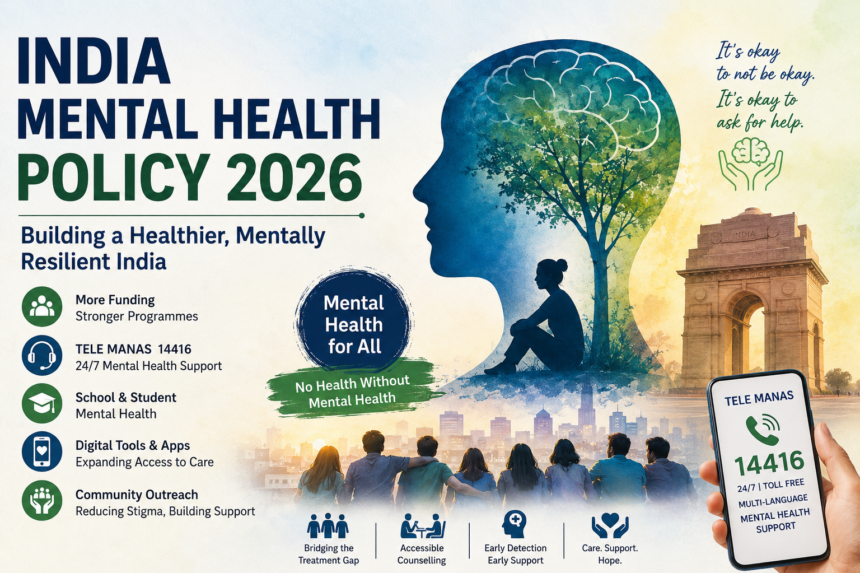
India Mental Health Policy 2026, India has an estimated 150 million people living with mental health conditions requiring active care. Of these, fewer than 30 million — 20% — receive any form of treatment. This treatment gap — one of the largest of any major country — is the central challenge of India’s mental health policy in 2026. It exists not because Indians do not suffer from mental illness, but because stigma, inadequate infrastructure, insufficient trained professionals, and years of catastrophically low public investment have left the majority of those who need help unable to access it.
India’s Mental Health Landscape: The Scale of the Challenge
- Estimated people with mental health conditions: 150 million in India
- Treatment gap: Over 80% of those who need care do not receive it
- Psychiatrists: India has approximately 0.3 psychiatrists per 100,000 people (WHO recommends 1-2 per 100,000)
- Psychologists: Even fewer — India has a severe shortage of clinical psychologists
- Mental health beds: 0.3 per 100,000 population (WHO recommends 10-14 per 100,000)
- Mental health share of health budget: Less than 1% of India’s total health budget
- Suicide rate: India has one of the world’s highest absolute numbers of suicide deaths — approximately 180,000 per year
Budget 2026: Mental Health Allocation
Budget 2026-27 allocated Rs 920 crore for the National Mental Health Programme (NMHP) — a significant increase from previous years but still far below what mental health professionals argue is needed. The allocation funds:
- National Institute of Mental Health and Neurosciences (NIMHANS): Bengaluru — India’s premier mental health institution
- District Mental Health Programme (DMHP): Extending mental health services to district hospitals across India
- TELE MANAS: The national tele-mental health programme providing remote counselling services
- Mental health integration: Training general practitioners and ASHA workers to identify and refer mental health cases
Mental health advocates have noted that while the increase in allocation is welcome, India’s mental health budget per capita remains far below global benchmarks — and the implementation of allocated funds through district programmes is frequently incomplete.
TELE MANAS: India’s National Mental Health Helpline
India Mental Health Policy 2026, Tele Mental Health Assistance and Networking Across States — was launched in 2022 and has expanded significantly in 2026. It is India’s national mental health helpline, available through the number 14416 (toll-free, 24/7, across India, in multiple languages). The service provides:
- Immediate telephone counselling for anyone experiencing psychological distress
- Triage to appropriate services — from basic counselling to specialist referral
- Follow-up care coordination for users who need ongoing support
- Regional language availability: 22+ languages including Hindi, English, Tamil, Telugu, Kannada, Marathi, Bengali
In 2026, TELE MANAS has received over 10 million calls since its launch — a number that powerfully demonstrates both the demand for mental health support and the accessibility gap that existed before the service was created. The challenge is scale — with 150 million people potentially needing care, even 10 million calls represents a fraction of the need.
School Mental Health: The Most Critical Intervention
The Mandate for School Counsellors
In 2026, the NEP (National Education Policy) implementation guidelines include mandates for mental health support in schools. The government has directed that all schools with 500+ students should have at least one trained school counsellor. The Manodarpan initiative — launched during COVID for student mental health — has been expanded and institutionalised.
The Reality on the Ground
The implementation gap between policy mandate and ground reality is stark. Most government schools do not have dedicated counsellors. Private schools vary enormously — elite urban private schools may have full-time psychologists; budget private schools have none. The teacher-student ratio leaves classroom teachers with no time to provide emotional support even when they recognise a student’s distress.
Several states — Delhi, Karnataka, Tamil Nadu, and Kerala — have made more meaningful progress in school mental health. Delhi’s ‘Happiness Curriculum’ — which dedicates the first period of every school day to mindfulness, emotional regulation, and social-emotional learning — has been independently evaluated as producing measurable improvements in student well-being.
College and University Mental Health
India’s higher education sector — where students face competitive pressure from entrance exams, academic performance, and uncertain career prospects — is experiencing a mental health crisis. Student suicides at IITs, IIMs, and other prestigious institutions have generated national conversation and prompted institutional responses:
- IITM has established a dedicated student wellness centre with resident psychiatrists
- IIT Delhi and IIT Bombay have increased counselling staff and extended helpline hours
- UGC (University Grants Commission) has issued guidelines for mental health services in higher education — requiring designated mental health officers at all universities
- Student-run mental health initiatives — peer support networks, mental health awareness clubs — are growing across campuses
Digital Mental Health: Apps and AI-Assisted Support
India Mental Health Policy 2026, Technology is playing an increasingly important role in bridging India’s mental health treatment gap:
Mental Health Apps
- Wysa: AI-powered mental health chatbot — evidence-based CBT (Cognitive Behavioural Therapy) techniques delivered through conversation. Free basic tier.
- YourDOST: Online counselling platform connecting users to therapists via text, voice, and video. Affordable pricing.
- Vandrevala Foundation: 24/7 free helpline (1860-2662-345) plus online counselling.
- Manastha: Community mental health platform with peer support and professional resources.
AI-Assisted Mental Health Screening
Several startups are developing AI-powered mental health screening tools that can identify risk factors for depression, anxiety, and suicidal ideation through voice analysis, text patterns, and questionnaire responses. While these tools are promising, clinical experts emphasise they must be used as screening and referral tools — not replacements for professional diagnosis and treatment.
What Is Still Missing: The Gaps in India’s Mental Health Response
Inadequate Workforce
Training psychiatrists, psychologists, and counsellors takes years. India’s current mental health workforce can serve perhaps 30-40 million people — against a need of 150 million. Even with aggressive expansion of training programmes, building adequate mental health workforce will take 10-15 years minimum. In the interim, task-sharing — training community health workers, teachers, and general practitioners to provide basic mental health support and referrals — is essential.
Stigma
Despite growing urban awareness, mental health stigma remains the most powerful barrier to care-seeking in India. In many communities — particularly outside metros — mental illness is still associated with weakness, ‘pagalpan’ (madness), or divine punishment. Families conceal mental health conditions. Individuals suffer in silence. Changing this requires sustained, culturally sensitive public communication campaigns — not just policy.
Implementation Gap
India has reasonable mental health legislation (Mental Healthcare Act 2017), a national programme (NMHP), and increasingly adequate funding. The gap is in implementation — converting policy intent into actual services that reach people who need them, particularly in rural areas and low-income communities.
What You Can Do: Accessing Mental Health Support in India
- TELE MANAS: 14416 — free, 24/7, national, multiple languages — first point of contact
- iCall (TISS): 9152987821 — professional counselling, especially for students
- Vandrevala Foundation: 1860-2662-345 — 24/7 multilingual support
- NIMHANS Telemedicine: For complex cases requiring specialist consultation
- Your nearest government district hospital: DMHP provides free psychiatric services
Read More:
Conclusion
India Mental Health Policy 2026, India’s mental health policy is moving in the right direction — more funding, more helplines, more school counsellors, more digital tools. But the gap between what is needed and what is available remains vast. Every Indian deserves access to mental health support — not just those wealthy enough to afford private therapists. Taza Newsz covers mental health policy, support resources, and wellness guidance for Indian audiences with sensitivity and commitment.