
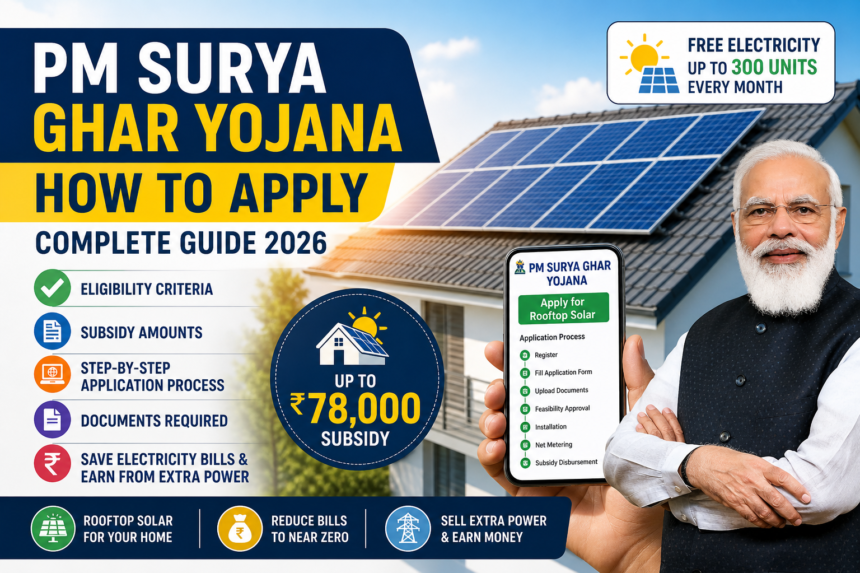
PM Surya Ghar Yojana How to Apply, Imagine generating your own electricity at home, drastically cutting your power bills, and even earning money by selling excess power back to the grid—all while receiving substantial financial support from the Indian government. That is exactly what the PM Surya Ghar Yojana (also known as the PM Surya Ghar: Muft Bijli Yojana or Free Electricity Scheme) is designed to deliver.
Launched with an ambitious target of installing rooftop solar panels on one crore homes across India, this scheme stands as one of the most transformative energy initiatives in the country’s history. In this comprehensive guide, we break down everything you need to know—eligibility, subsidy amounts, how to apply online, required documents, and what happens after approval.
What Is PM Surya Ghar Yojana?
PM Surya Ghar Yojana is a central government scheme that offers financial subsidies to Indian households for installing rooftop solar photovoltaic (PV) systems. With a total outlay of Rs 75,021 crore, the scheme aims to fundamentally reshape residential energy consumption in India.
Specifically, the scheme intends to:
- Install rooftop solar systems on 1 crore homes across India
- Provide up to 300 units of free electricity per month to eligible households
- Reduce electricity bills to near-zero levels in many cases
- Generate employment in solar installation and maintenance sectors
- Support India’s long-term renewable energy goals
Importantly, the scheme is focused on residential consumers. This means individual homeowners, apartment residents, and housing society members are all eligible to participate.
Who Is Eligible for PM Surya Ghar Yojana?
PM Surya Ghar Yojana How to Apply, The eligibility criteria are intentionally broad, ensuring maximum participation across the country. To qualify, applicants must meet the following conditions:
- Must be an Indian citizen with a residential property
- The property must have a valid electricity connection
- No prior solar subsidy should have been claimed for the same property
- The rooftop must be structurally suitable and have adequate space for solar installation
- The electricity connection must be in the applicant’s name
Additionally, both urban and rural households are eligible. Notably, there is no income restriction, which makes the scheme accessible to all income groups. However, the subsidy amount remains fixed regardless of income level.
How Much Subsidy Do You Get Under PM Surya Ghar Yojana?
The subsidy structure is clearly defined and depends on the size of the solar system installed:
- 2 kW system — Rs 30,000 per kW = Rs 60,000 total subsidy
- 3 kW system — Rs 60,000 for first 2 kW + Rs 18,000 for the 3rd kW = Rs 78,000 total
- Above 3 kW — Subsidy capped at Rs 78,000
For housing societies and Resident Welfare Associations (RWAs), the subsidy is calculated differently. In such cases, it is Rs 18,000 per kW for systems up to 500 kW, specifically for common facilities.
Step-by-Step Guide: How to Apply for PM Surya Ghar Yojana Online
Step 1: Register on the National Portal
First, visit the official PM Surya Ghar portal at pmsuryaghar.gov.in. Click on “Apply for Rooftop Solar” and register using your mobile number along with your electricity consumer number. An OTP will be sent for verification.
Step 2: Fill the Application Form
Next, log in and complete the application form. You will need to enter details about your property, electricity usage, and preferred system capacity. At this stage, the portal will also display an estimated subsidy amount.
Step 3: Document Submission
After filling in the form, upload all required documents. Ensure that the files are clear, complete, and in the accepted formats (typically PDF or JPEG).
Step 4: Technical Feasibility Assessment
Subsequently, your local electricity distribution company (DISCOM) will assess technical feasibility. This includes evaluating rooftop strength, connection capacity, and determining optimal system size.
Step 5: Vendor Selection and Installation
Once approved, you can choose from empanelled solar vendors listed on the portal. The platform provides vendor ratings, pricing, and installation history. After finalizing a vendor, installation is usually completed within 30–60 days.
Step 6: Inspection and Net Metering
Following installation, DISCOM conducts a system inspection and installs a net meter. This device measures both electricity consumption and surplus power exported to the grid, enabling you to earn from excess generation.
Step 7: Subsidy Disbursement
Finally, after successful inspection and net metering, the subsidy amount is credit directly to your bank account. This process typically takes around 30 days after submission of the subsidy claim.
Documents Required for PM Surya Ghar Yojana
PM Surya Ghar Yojana How to Apply, keep the following documents ready:
- Aadhaar Card (identity and address proof)
- Latest electricity bill (showing consumer number)
- Bank account details (for subsidy transfer)
- Passport-size photograph
- Property ownership documents (if required by DISCOM)
How Many Solar Panels Do You Need for an Indian Home?
System size depends largely on your daily electricity consumption. Here is a general guideline:
- 1 BHK flat (2–3 units/day) — 1 to 2 kW system (4–8 panels)
- 2 BHK home (4–6 units/day) — 2 to 3 kW system (8–12 panels)
- 3 BHK home (7–10 units/day) — 3 to 5 kW system (12–20 panels)
- Large bungalow (10+ units/day) — 5 kW or higher
However, it is important to note that a certified solar vendor will perform a detailed consumption analysis before recommending the final system size.
Is Solar Energy Worth It for Indian Homes in 2026?
Without a doubt, solar energy presents a compelling financial case in 2026. To illustrate, a typical 3 kW solar system costs around Rs 1.5–2 lakh before subsidy. After applying the government subsidy of Rs 78,000, the effective cost reduces to approximately Rs 72,000–Rs 1.22 lakh.
Moreover, such a system can generate around 12–15 units of electricity per day. As a result, most households can significantly reduce—or even eliminate—their electricity bills.
Considering an average tariff of Rs 7–8 per unit, the system generally recovers its cost within 4–6 years. Beyond that period, homeowners essentially enjoy free electricity for the remaining lifespan of the panels, which typically exceeds 20 years.
Read More: New Labour Code India 2026 Salary Impact Explained: What Will Change for Your Pay?
Conclusion
PM Surya Ghar Yojana How to Apply, PM Surya Ghar Yojana represents one of the most valuable opportunities for Indian homeowners in 2026. With attractive subsidies, a streamlined digital application process, and the potential for near-zero electricity bills, the benefits are both immediate and long-term.
Furthermore, demand for the scheme is rapidly increasing, and applications are being processed on a first-come, first-served basis. Therefore, applying early can significantly accelerate your transition to solar energy.
Ultimately, there has never been a better time to invest in rooftop solar and take control of your energy future.