
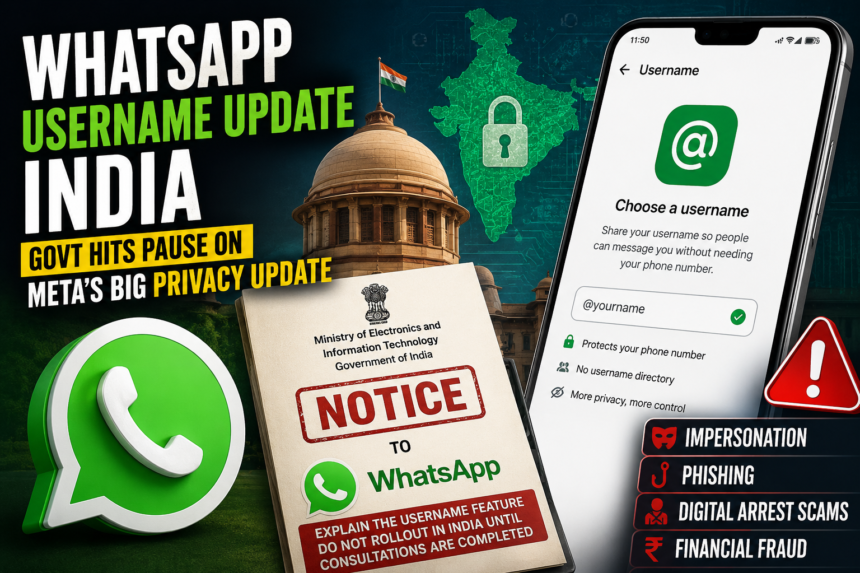
WhatsApp Username Update India, India’s digital rulebook just collided with one of WhatsApp’s biggest privacy changes in years. The Union government has sent a notice to Meta-owned WhatsApp over its upcoming username feature, asking the company to explain how the tool will work and to hold back its India rollout until consultations are completed. The concern is simple but serious: while usernames may protect phone numbers, they may also open a new door for impersonation, phishing, spam, “digital arrest” scams, and financial fraud. Reports say the Ministry of Electronics and Information Technology, or MeitY, asked WhatsApp to provide a detailed explanation within three days and not proceed with the feature until the government is satisfied after consultations.
What Is the WhatsApp Username Feature?
The proposed WhatsApp username feature allows users to connect and chat without immediately sharing their mobile phone numbers. In everyday language, it works like a digital nickname or handle. Instead of giving someone your number at a conference, college event, apartment group, business meeting, or online sale, you could simply share your username.
Meta has described usernames as a privacy feature designed to reduce the need to expose phone numbers. According to the company’s own announcement, WhatsApp users can reserve usernames before the feature becomes available more widely later this year. WhatsApp also says there will be no public directory and no username suggestions, meaning someone would need to know your exact username to message you for the first time.
Think of it like giving someone your office extension instead of your home address. You are still reachable, but you are not handing over the most personal identifier attached to your digital life: your phone number.
Why Did the Government Send a Notice to WhatsApp?
WhatsApp Username Update India, The Indian government’s worry is not that usernames are useless. In fact, the privacy benefit is obvious. The concern is what bad actors might do with them once the feature becomes available at WhatsApp’s enormous India scale.
According to reports, MeitY warned that usernames could increase risks linked to fraud, phishing, digital arrest scams and impersonation attacks. The fear is that scammers may create usernames that look almost identical to banks, government offices, public authorities, celebrities, businesses, or ordinary individuals. One extra dot, one missing letter, one cleverly placed underscore — and suddenly a fake account can look real enough to fool someone in a hurry.
That is the heart of the issue. Phone numbers are messy, personal and inconvenient, but they also act as a familiar identity marker. Usernames may feel cleaner, but they can also become masks.
The Real Fear: Impersonation at WhatsApp Scale
Impersonation is not new. Fake accounts already exist on social media platforms. Fraudsters already pretend to be customer care agents, police officers, bank officials, delivery executives and relatives in distress. But WhatsApp is different because it sits inside daily life in India.
People use WhatsApp to talk to family, doctors, schools, housing societies, local stores, office teams, political groups, banks, government services and small businesses. It is not just another app; for many users, it is the default communication layer of the internet.
That is why the government is treating this feature with caution. A fake Instagram account may be irritating. A fake WhatsApp account pretending to be a bank, police officer, court official or government department could become dangerous very quickly. A username that looks official can work like a fake uniform. It does not need to be perfect; it only needs to look convincing for a few minutes.
Digital Arrest Scams: Why This Term Keeps Coming Up
WhatsApp Username Update India, One phrase in the government’s concern stands out: digital arrest scams. These scams have become a major cybercrime worry in India. In such cases, fraudsters pretend to be police, CBI officers, court officials, customs officers or other authorities. They frighten victims by claiming they are under investigation, then pressure them into transferring money or sharing sensitive information.
WhatsApp has already been under scrutiny over such scams. Earlier this year, WhatsApp told the Supreme Court that it disabled more than 9,400 accounts linked to digital arrest frauds during a 12-week enforcement effort beginning in January 2026. Reports said many of these accounts used official-sounding names and symbols to appear legitimate.
Now imagine that same trick with usernames. A scammer no longer needs to rely only on a profile picture or display name. They might try to grab a handle that looks close to a real police unit, government helpline, court registry, bank team or company support account. That is exactly the type of “identity fog” regulators are worried about.
WhatsApp’s Defence: The Feature Is Not Fully Live Yet
WhatsApp has pushed back by saying the feature is not fully live and will roll out slowly later this year. The company has also said users will still need a phone number to use WhatsApp, so usernames are not replacing account registration altogether. In other words, WhatsApp is saying: this is not a move into total anonymity; it is a privacy layer on top of the existing phone-number-based system.
The company has also described several safeguards. These include reserving high-profile names for legitimate owners, holding lookalike versions of famous names, limiting how many new people an account can contact, blocking repeated attempts to guess username keys, and using systems to detect impersonation and abusive behaviour. WhatsApp has also said first-time recipients may receive context such as whether the sender is new, in their contacts, in a mutual group, or located in another country.
So, Meta’s message is clear: usernames are meant to improve privacy, not create a free-for-all. But the government wants proof that those safety nets are strong enough before India’s massive user base is exposed to the change.
What Is a Username Key and Why Does It Matter?
WhatsApp Username Update India, One of the more interesting safeguards is the optional username key. WhatsApp says users can choose to require this key so that people need both the exact username and the key before messaging them. That makes the system less like a public handle and more like a locked gate.
Here is a simple analogy. Your username is the address of your house. The username key is the gate code. If you share only the address, someone might still show up. If you require the gate code too, only people you trust can enter.
This matters because the biggest fear around usernames is cold outreach. If scammers can guess or collect usernames easily, they can spam users at scale. But if many users activate a username key, random outreach becomes harder. The question, however, is whether average users will understand and use this extra protection — or whether they will simply reserve catchy names and leave themselves open to unwanted messages.
The Privacy Argument: Phone Numbers Are Too Personal
Let’s be honest: phone numbers have become overloaded. Your number is tied to your bank account, Aadhaar-linked services, delivery apps, UPI, work groups, school groups, doctor appointments, shopping accounts, and sometimes even your identity verification trail.
Sharing your number with a stranger can feel like giving out a master key. Once someone has it, they may call, spam, add you to groups, search for you across platforms, or try social engineering attacks.
That is why WhatsApp’s username feature has real value. It gives users a way to communicate without exposing a phone number immediately. This can help students, freelancers, creators, small business owners, women, journalists, activists, and anyone who does not want every casual contact to become a permanent phone contact.
Privacy advocates often argue that users should not be forced to surrender their phone number just to speak to someone once. On that point, the feature is a step forward. The problem is that privacy tools can also create new blind spots if they are not designed carefully.
The Safety Argument: Names Can Be Weaponised
WhatsApp Username Update India, The government’s position comes from another reality: names can be weaponised. A scammer does not need to hack your phone if they can hack your trust.
Suppose a user receives a message from a handle that looks like a bank’s fraud department. Or a small business gets a message from a username resembling a government tax office. Or a parent receives a message from an account pretending to be a school administrator. In stressful situations, people do not always inspect every character carefully.
That is how impersonation works. It does not break the lock; it convinces you to open the door.
This is why lookalike usernames are such a sensitive issue. The difference between a genuine handle and a fake one may be tiny. But the consequences can be huge — lost money, stolen credentials, leaked documents, panic, harassment, or reputational damage.
Why Businesses and Public Figures Should Pay Attention
The username debate is not only about ordinary users. It also matters deeply for businesses, creators, financial institutions, media houses, government departments and public figures.
For businesses, WhatsApp is already a customer service channel. Many customers message shops, banks, airlines, clinics and delivery services through WhatsApp. If fraudsters can create similar-looking usernames, customer support scams may become more convincing.
For public figures, the danger is reputational. A fake handle can send misleading messages, spread rumours or solicit money. For government agencies, impersonation can create panic or trick citizens into sharing sensitive details. For banks and fintech companies, the risk is direct financial fraud.
WhatsApp says it has reserved high-profile names and lookalike derivatives for legitimate owners, which is a useful start. But the real challenge is the long tail: local businesses, district-level offices, small creators, NGOs, schools, clinics and regional brands. They may not be famous enough to receive automatic protection, but they are trusted enough to be impersonated.
The Telegram Shadow Over the WhatsApp Debate
WhatsApp Username Update India, The WhatsApp notice did not happen in isolation. It comes shortly after India’s temporary restrictions on Telegram linked to NEET-UG 2026 concerns. The government temporarily blocked Telegram until June 22, 2026, after concerns that the platform was being used to spread claims around exam paper leaks and that certain features could help create misleading posts.
The Delhi High Court later upheld the temporary Telegram restrictions, with legal reporting noting that the court treated the blocking and disabling of message editing as proportionate in the context of protecting the integrity of the NEET-UG 2026 re-examination.
This matters because Telegram also allows people to communicate through usernames while hiding phone numbers. That does not mean WhatsApp and Telegram are identical. They are different platforms with different designs, user behaviours and moderation tools. But from a regulator’s point of view, the lesson is obvious: features that reduce visible identity markers can create both privacy gains and enforcement headaches.
Is the Government Trying to Stop the Feature Permanently?
At this stage, the government appears to be pressing the pause button, not necessarily the delete button. Reports say WhatsApp has be aske not to roll out the username feature in India until consultations are complete. The company has also be aske to explain how the system will work and what safeguards are in place.
That means the feature may still launch in India if Meta can satisfy the government’s concerns. The final outcome could take several forms. WhatsApp may proceed with stronger safeguards. It may delay the rollout. It may introduce India-specific restrictions. Or the government may seek further legal or technical commitments.
In practical terms, this is now a negotiation between privacy design and regulatory risk management. Meta wants to modernise WhatsApp identity. India wants to make sure that the change does not become a fraud factory.
What Could Meta Be Asked to Explain?
WhatsApp Username Update India, The government’s questions are likely to focus on practical safety. For example: How will WhatsApp prevent fake bank, police, court or government handles? How will it detect lookalike usernames in Indian languages? Will there be verified badges? How will users report impersonation? How fast will takedowns happen? What happens if a scammer uses a username to contact thousands of people?
Meta may also need to explain how it will handle usernames linked to public institutions, businesses and high-risk categories. Reserving names for celebrities and verified Meta accounts is useful, but India’s risk environment is much wider. A local police station, a district hospital, a regional cooperative bank or a school may not be globally famous, but people may still trust its name.
The hard part is scale. India has hundreds of millions of WhatsApp users, countless languages, thousands of institutions and millions of businesses. Moderating that naming universe is like trying to police every shop sign in a giant digital city.
What This Means for Ordinary WhatsApp Users
For everyday users, nothing dramatic changes immediately if the feature is paused or still waiting for rollout. But the debate is a reminder that usernames should not be treated casually.
If the feature becomes available, users should avoid obvious usernames that reveal too much personal information. A username based on your full name, birth year, workplace or location may be easy for friends to remember, but it may also be easy for strangers to guess. A more unique handle may be safer.
Users should also consider activating the optional username key if WhatsApp provides it. If you do not want strangers messaging you, the key could act like a second lock. And as always, never trust a message simply because the name looks official. Banks do not need your OTP. Police do not conduct real arrests through panic-inducing chat threats. Government departments do not ask you to transfer money to “clear” a case over WhatsApp.
What Businesses Should Do If Usernames Roll Out
Businesses should reserve their official usernames as early as possible if WhatsApp permits it. They should keep handles consistent across platforms where possible, but also communicate clearly to customers which username is authentic.
A business should not rely only on a profile picture or display name. It should update its website, invoices, customer emails and social media pages with the correct WhatsApp identity. If verification options exist, companies should use them. If impersonation appears, they should report it quickly and warn customers.
Small businesses often underestimate brand impersonation. But scammers love small brands because customers trust them and security teams are usually smaller. A fake handle pretending to be a local clinic, courier office, tuition centre, travel agent or jewellery store can cause real damage.
The Bigger Debate: Privacy Versus Accountability
WhatsApp Username Update India, This controversy sits inside a much larger debate: how do digital platforms protect privacy without weakening accountability?
Phone numbers are not perfect identifiers. They can be spoof, recycled, stolen, SIM-swapped or misuse. But they give users and regulators a familiar anchor. Usernames reduce exposure of phone numbers, which is good for privacy. But they also create a new identity layer that can be manipulated.
The challenge is not to choose privacy or safety. Users need both. A good system should let people hide their phone numbers from strangers while still making impersonation difficult, reporting easy, and enforcement fast.
In that sense, WhatsApp’s username feature is like a new flyover in a crowded city. It may reduce traffic in one place, but if poorly planned, it can create jams somewhere else. The design details matter.
Could India Get a Different Version of the Feature?
It is possible. Large platforms often adjust features for different markets when regulators raise concerns. India is too important for WhatsApp to ignore. The country is one of WhatsApp’s most important markets, and the platform plays a central role in communication, commerce and public messaging.
An India-specific version could include stricter username rules, stronger protection for public institutions, mandatory username keys for unknown contacts, visible warnings for new accounts, limits on outreach, more aggressive takedowns, or improved reporting channels for impersonation.
Would that reduce the feature’s convenience? Maybe. But convenience is not the only goal. In a country where messaging scams can reach vulnerable users in seconds, safety friction may be necessary. Sometimes the extra speed bump prevents a crash.
What Happens Next?
The immediate next step is WhatsApp’s response to the government’s notice. Meta will likely explain its safeguards, rollout plan, abuse detection systems, reporting tools and protection for high-profile names. The government will then assess whether those measures are enough.
If MeitY is satisfied, WhatsApp may be allowed to proceed after consultation. If not, the rollout could be delayed further or subjected to additional conditions. Either way, the episode shows that India is no longer waiting for Big Tech features to arrive first and asking questions later. Regulators want a seat at the design table before major platform changes affect millions of users.
For WhatsApp, that means privacy innovation now comes with a regulatory exam. And for users, it means one of the most anticipated privacy upgrades may take longer to arrive in India than expected.
Read More: RBI Digital Fraud Compensation 2027: Victims Can Claim Up to ₹25,000 Under New Rules
Conclusion
WhatsApp Username Update India, The government notice to WhatsApp over its username feature is not just a small tech-policy dispute; it is a preview of the future of digital regulation in India. WhatsApp wants to give users more privacy by letting them chat without exposing phone numbers, while the government fears the same feature could give scammers a sharper mask for fraud, phishing, impersonation and digital arrest scams. The truth sits somewhere in the middle: usernames can protect users, but only if the guardrails are strong, easy to understand and fast enough to stop abuse. For now, India has asked Meta to slow down, explain the system and prove that privacy will not come at the cost of public safety.