
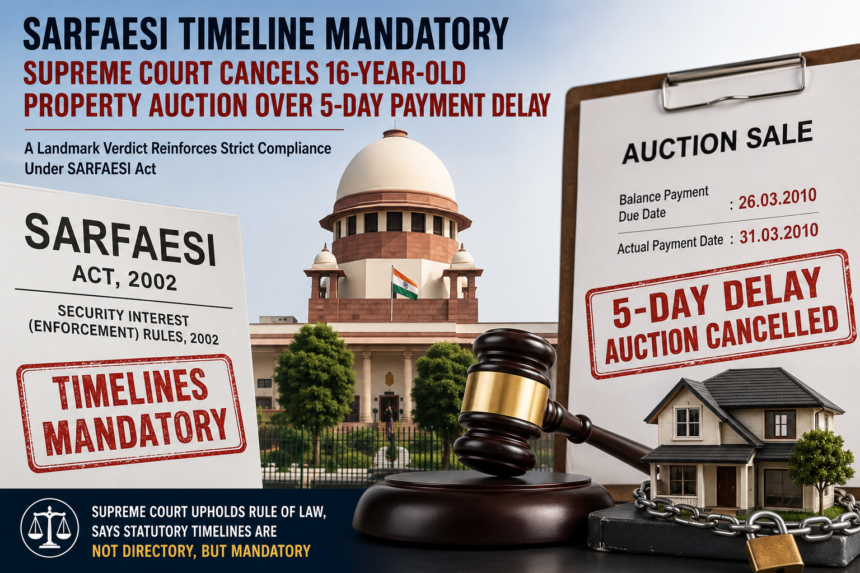
SARFAESI Timeline Mandatory, In a significant ruling that could have far-reaching implications for banks, borrowers, guarantors, and auction purchasers across India, the Supreme Court has set aside a property auction conducted under the SARFAESI Act after finding that mandatory legal timelines were not followed.
The judgment, delivered by a bench comprising Justice Dipankar Datta and Justice Augustine George Masih, underscores a critical legal principle: statutory procedures cannot be ignored, even when the delay appears minor.
As a result, the verdict serves as a powerful reminder that compliance with the Security Interest (Enforcement) Rules, 2002, is not optional but mandatory.
How a Four-Decade-Old Loan Dispute Reached the Supreme Court
The roots of the case stretch back more than four decades.
In 1984, a borrower obtained a loan for which G. Ramanujam acted as guarantor. To secure the loan, he mortgaged his property.
However, the borrower eventually defaulted on repayment obligations. Consequently, recovery proceedings followed.
Years later, Indian Bank initiated action under the SARFAESI Act, a law designed to help financial institutions recover bad loans without lengthy court intervention.
As part of the recovery process, the bank auctioned the mortgaged property on March 11, 2010. The highest bidder successfully acquired the property for approximately ₹2.11 crore.
At first glance, the auction appeared complete. However, a crucial procedural issue would eventually bring the entire transaction under judicial scrutiny.
The Core Dispute: Was the Balance Payment Made Within the Legal Time Limit?
The challenge to the auction sale was brought by the daughter of the deceased guarantor.
Her primary argument centered on Rule 9 of the Security Interest (Enforcement) Rules, 2002.
According to the rules applicable at the time, an auction purchaser had to deposit 25% of the bid amount immediately. The remaining 75% had to be paid within fifteen days from the confirmation of the sale.
Importantly, the law permitted an extension only if both parties agreed to it in writing.
The appellant argued that the successful bidder failed to meet this mandatory legal requirement. Therefore, she contended that the entire auction stood vitiated.
Supreme Court Closely Examines the Payment Timeline
SARFAESI Timeline Mandatory, After carefully reviewing the records, the Supreme Court found that the auction purchaser had deposited the initial 25% of the bid amount as required.
However, the remaining 75% was paid only on March 31, 2010.
The statutory deadline for making the payment expired on March 26, 2010.
In simple terms, the balance payment was delayed by five days.
Although five days may appear insignificant in everyday life, the Court emphasized that legal deadlines prescribed by statute cannot be treated casually.
More importantly, the bench found no evidence showing that the purchaser had sought an extension of time.
Likewise, there was no written agreement on record extending the payment deadline.
Without such documentation, the delayed payment amounted to a direct violation of Rule 9.
Why the Supreme Court Viewed the Delay as a Serious Violation
The Supreme Court made it clear that Rule 9 is not merely a procedural formality.
Rather, the provisions governing auction sales under the SARFAESI framework are fundamental safeguards designed to ensure transparency, fairness, and credibility in the recovery process.
The judges observed that these requirements go to the very heart of the auction mechanism.
In other words, the rules form the foundation upon which the entire auction process rests.
Just as a small crack in a building’s foundation can weaken the entire structure, even a seemingly minor deviation from mandatory legal requirements can undermine the legitimacy of an auction sale.
Therefore, the Court held that any deviation from these mandatory requirements, unless legally justified, would render the auction process invalid.
Court Says Statutory Compliance Cannot Be Replaced by Equity
SARFAESI Timeline Mandatory, One of the key arguments raised during the proceedings was that the sale should be preserved on equitable grounds.
After all, the borrower had defaulted. The bank had followed recovery proceedings. Moreover, the auction purchaser had ultimately paid the full amount.
Despite these circumstances, the Supreme Court firmly rejected the argument.
The bench held that statutory violations cannot be cured merely through appeals to fairness, equity, or practical considerations.
The judges emphasized that when a legal process becomes fundamentally flawed because of non-compliance with mandatory provisions, courts cannot validate it simply because one party may face inconvenience or hardship.
Thus, the rule of law must prevail over equitable considerations.
Auction Purchaser’s Rights Deserve Protection, But Have Limits
The Court acknowledged that auction purchasers often act in good faith and invest substantial amounts of money.
For that reason, their interests deserve protection.
However, the judges clarified that the rights of an auction purchaser cannot supersede the legal validity of the auction itself.
If the sale process suffers from a serious legal defect, the purchaser’s interests must necessarily yield.
This principle reflects a broader judicial approach. No individual can derive permanent rights from a transaction that is legally defective from its inception.
Supreme Court Sets Aside Orders of Multiple Forums
The ruling also overturned several earlier decisions.
Specifically, the Supreme Court set aside the orders passed by:
- The Debts Recovery Tribunal (DRT)
- The Debts Recovery Appellate Tribunal (DRAT)
- The Madras High Court
All three forums had previously upheld the auction sale.
However, the apex court disagreed with their conclusions and reaffirmed the importance of strict statutory compliance in SARFAESI proceedings.
As a result, the judgment sends a strong message that procedural safeguards cannot be overlooked merely because lower authorities have approved a transaction.
Relief Granted to the Auction Purchaser
SARFAESI Timeline Mandatory, Although the Court invalidated the auction sale, it also ensured that the purchaser would not suffer undue financial loss.
Accordingly, Indian Bank was directed to refund the entire auction amount paid by the purchaser.
In addition, the bank was ordered to pay interest at the rate of 7% per annum from the dates of deposit until the refund is made.
The Court directed that this payment must be completed within six weeks.
Therefore, the judgment strikes a balance between enforcing legal compliance and protecting the interests of a bona fide purchaser.
One-Time Opportunity Granted to Redeem the Mortgaged Property
Invoking its extraordinary powers under Article 142 of the Constitution, the Supreme Court granted special relief to the appellant.
The Court provided a one-time opportunity to redeem the mortgaged property.
To regain ownership, the appellant must pay ₹95.42 lakh, which corresponds to the amount specified in the bank’s Section 13(2) notice.
Additionally, she must pay interest at 5% per annum from the date of the notice until the date of payment.
Upon payment of the required amount, the property will be restored free from all encumbrances arising out of the loan transaction.
According to the Court, this relief was necessary to ensure complete justice in the matter.
What Happens If the Appellant Fails to Make the Payment?
The Supreme Court also outlined the next course of action if the appellant does not redeem the property within the stipulated period.
In such a scenario, Indian Bank will be free to conduct a fresh auction of the property.
However, before proceeding with a new sale, the bank must obtain a fresh valuation report from a government-empanelled valuer.
This requirement ensures that any future auction reflects the property’s current market value and safeguards the interests of all stakeholders.
Limitation Issue Left Open for Future Cases
Interestingly, the Supreme Court chose not to decide another important legal issue raised during the proceedings.
The appellant had argued that the SARFAESI proceedings themselves might have been barred by limitation.
According to her contention, the bank initiated SARFAESI proceedings nearly twelve years after the preliminary decree.
However, since the Court resolved the dispute on the basis of procedural irregularities in the auction process, it did not examine this larger question.
Consequently, the issue remains open for determination in future cases.
Why This Judgment Matters for Banks, Borrowers, and Auction Buyers
This ruling is likely to become an important precedent in future SARFAESI disputes.
For banks, it highlights the need for strict compliance with statutory procedures during asset recovery and auction sales.
For borrowers and guarantors, it demonstrates that procedural safeguards remain effective tools for protecting legal rights.
Similarly, for auction purchasers, the decision serves as a reminder to verify compliance with every statutory requirement before finalizing a transaction.
Above all, the judgment reinforces a fundamental legal principle: when the law prescribes a procedure, that procedure must be followed exactly.
Read More: Higher Ethanol Blended Petrol Gets Major Tax Relief as India Boosts Biofuel Adoption
Conclusion
SARFAESI Timeline Mandatory, The Supreme Court’s decision to cancel a 16-year-old auction sale over a five-day delay in payment underscores the judiciary’s unwavering commitment to statutory compliance.
By declaring the timelines under the SARFAESI framework mandatory, the Court has reinforced the integrity of the auction process and ensured that legal safeguards are not treated as mere technicalities.
Furthermore, the verdict balances the interests of banks, borrowers, guarantors, and auction purchasers while reaffirming that adherence to the rule of law remains the cornerstone of India’s legal system.