
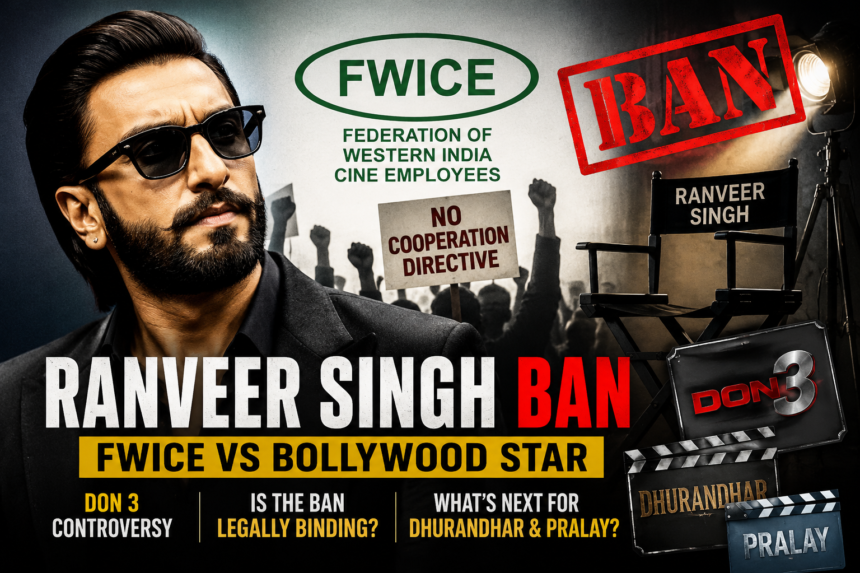
Can a film workers’ body actually stop an actor from working? Is such a “ban” legally enforceable? And more importantly, what happens next for Ranveer Singh and his upcoming films, including the much-discussed Dhurandhar and Pralay? The growing Don 3 controversy has now turned this Bollywood dispute into one of the industry’s biggest talking points.
The controversy has quickly become one of Bollywood’s biggest talking points because it goes far beyond a simple disagreement. At its core, this battle is about power, contracts, influence, and the complicated machinery that keeps the Indian film industry running.
Let’s break it down.
How The Ranveer Singh-FWICE Controversy Started
The issue reportedly began after Ranveer Singh exited Don 3, the much-awaited continuation of the iconic franchise directed by Farhan Akhtar.
According to reports, the producers and filmmakers associated with the project raised concerns over financial losses and disrupted schedules caused by the actor’s sudden departure. Film productions operate like giant moving trains — once the wheels start turning, even one unexpected stop can cost crores.
Naturally, the matter escalated.
FWICE later claimed it tried to contact Ranveer Singh privately to understand his side of the story before taking any public action. However, things apparently became tense after the actor responded by stating that the federation had no jurisdiction over the dispute because the issue was contractual and should be handled legally, not through industry mediation.
That response didn’t sit well with the federation.
Soon after, FWICE held a press conference and issued a Non-Cooperation Directive (NCD) against the actor.
And that’s where the storm truly began.
What Exactly Is FWICE?
Ranveer Singh Ban, To understand why this issue matters, you first need to understand the influence FWICE holds in Bollywood.
Federation of Western India Cine Employees is one of the largest film workers’ organizations in India. It represents thousands of professionals working across the entertainment industry through nearly 38 affiliated unions.
These include:
- Technicians
- Makeup artists
- Spot boys
- Lightmen
- Editors
- Camera crews
- Junior artists
- Directors’ associations
- Production staff
Think of FWICE as the backbone of Bollywood’s workforce. While stars grab headlines, these workers are the invisible engine powering every film set.
Without them, movie production simply stops.
What Does A Non-Cooperation Directive Actually Mean?
A Non-Cooperation Directive sounds dramatic — and in practical terms, it often is.
When FWICE issues such a directive, it instructs its members not to work on projects involving the targeted person. In Ranveer Singh’s case, that means crews and technicians affiliated with the federation could refuse participation in films starring the actor.
Now imagine trying to shoot a movie without lighting crews, makeup artists, assistant directors, or production workers.
It’s like trying to fly a plane without ground staff.
Technically, the star remains free to act. But practically, large-scale production becomes extremely difficult.
That’s why such directives carry enormous weight inside the industry.
Is This ‘Ban’ Legally Binding?
Here’s where things become legally complicated.
Ranveer Singh Ban, FWICE is not a government authority. It cannot legally “ban” someone in the way a court or regulatory body can impose restrictions.
Legally speaking, Ranveer Singh’s argument appears to have merit.
Disputes involving:
- Contract breaches
- Compensation claims
- Financial damages
- Multi-film agreements
are typically handled by civil courts or arbitration panels — not industry unions.
In simple terms, FWICE can pressure the industry socially and operationally, but it cannot legally decide whether Ranveer Singh violated a contract.
That authority belongs to the courts.
So while the directive may create obstacles, it does not automatically carry legal force.
Why Bollywood Still Takes FWICE Seriously
Even without legal authority, FWICE commands significant influence.
Why?
Because Bollywood is deeply relationship-driven.
The industry often functions less like a corporate system and more like a tightly connected ecosystem where cooperation matters just as much as contracts. Producers, distributors, actors, unions, and workers all depend on each other to keep projects moving.
That’s why many stars prefer resolving disputes quietly rather than openly challenging industry bodies.
A prolonged standoff can create:
- Delays in production
- Crew shortages
- Reputation damage
- Investor concerns
- Scheduling chaos
And in an industry where time literally equals money, even small disruptions can become expensive nightmares.
Ranveer Singh’s Silence Speaks Volumes
Interestingly, Ranveer Singh has largely maintained public silence throughout the controversy.
A statement issued through his spokesperson emphasized that the actor continues to respect the film fraternity and everyone associated with the Don franchise.
The statement suggested Ranveer believes professional disagreements should be handled with dignity and maturity instead of public confrontation.
That approach may be strategic.
Why pour fuel on the fire when negotiations could still happen behind closed doors?
In Bollywood, silence often says more than a press conference.
Can Ranveer Singh Challenge FWICE In Court?
Yes, potentially.
Since the Non-Cooperation Directive is essentially a trade-union action and not a legal punishment, Ranveer Singh could challenge it if he believes it unfairly restricts his right to work.
Ranveer Singh Ban, Indian courts have examined similar industry boycotts before, especially when they appear coercive or resemble blacklisting.
A legal challenge could argue that:
- The directive interferes with professional freedom
- The federation exceeded its authority
- The action creates unlawful pressure tactics
However, going to court could also intensify tensions inside the industry.
And that’s the tricky part.
Winning legally doesn’t always mean winning professionally.
How This Could Affect Ranveer Singh’s Upcoming Films
One major concern revolves around Ranveer Singh’s future projects.
His upcoming post-apocalyptic thriller Pralay, backed by Hansal Mehta and directed by Jai Mehta, is reportedly scheduled to begin filming in August 2026.
If the FWICE dispute remains unresolved by then, production logistics could become complicated.
Imagine trying to coordinate a massive film set while sections of the workforce refuse participation.
That creates uncertainty for:
- Producers
- Investors
- Crew managers
- Distributors
- Shooting schedules
Even rumors of instability can impact big-budget productions.
And in today’s highly competitive Bollywood environment, delays can hurt momentum fast.
Why This Case Matters Beyond Ranveer Singh
Ranveer Singh Ban, This controversy isn’t just about one actor or one film.
It highlights a larger issue inside India’s entertainment industry: the blurry line between legal authority and industry influence.
Bollywood has long operated through a mix of:
- Formal contracts
- Informal relationships
- Trade bodies
- Industry pressure
- Mutual dependence
The Ranveer-FWICE standoff exposes how those systems sometimes clash.
Legally, courts may hold ultimate authority.
But practically, industry organizations still wield enormous power because filmmaking depends on collective cooperation.
It’s a bit like a cricket team. Even if the captain is legally allowed to play, winning becomes nearly impossible if the entire support staff walks away.
What Happens Next?
Right now, the future remains uncertain.
Several outcomes are possible:
- Private mediation between both parties
- Withdrawal or softening of the directive
- Legal proceedings over contractual issues
- Temporary industry compromise
- Escalation into a larger legal battle
Much will depend on whether both sides decide to negotiate quietly behind the scenes.
For now, Bollywood is watching closely.
Because the outcome could shape how future disputes between stars, producers, and film bodies are handled across the industry.
Could Mediation Still Solve The Problem?
Absolutely.
Historically, many FWICE disputes eventually end through negotiation rather than courtroom battles.
That’s because both sides usually benefit from compromise.
The federation wants acknowledgment and cooperation.
The actor wants smooth production operations and professional stability.
In many past cases, tensions cooled once both parties resumed dialogue. Industry insiders believe this situation could also move toward mediation eventually.
After all, Bollywood thrives on collaboration — not prolonged warfare.
Read More: Upcoming Bollywood Movies 2026 List: Biggest Hindi Films Releasing This Year
Conclusion
Ranveer Singh Ban, The clash between Ranveer and FWICE is more than just another Bollywood controversy — it’s a fascinating power struggle between legal rights and industry influence.
While FWICE’s Non-Cooperation Directive may not function as a legally binding “ban,” its practical impact inside the film industry can still be significant. At the same time, Ranveer Singh appears to have a strong legal argument that contractual disputes belong in courtrooms, not union-led interventions.
Ultimately, this showdown reveals an uncomfortable truth about Bollywood: sometimes informal power structures carry just as much weight as formal law.
Whether the matter ends through mediation, compromise, or legal action, one thing is clear — the industry will be paying close attention to every next move.
And for Ranveer Singh, the road ahead may depend not just on legal strategy, but on rebuilding alignment within the ecosystem that powers Bollywood itself.