
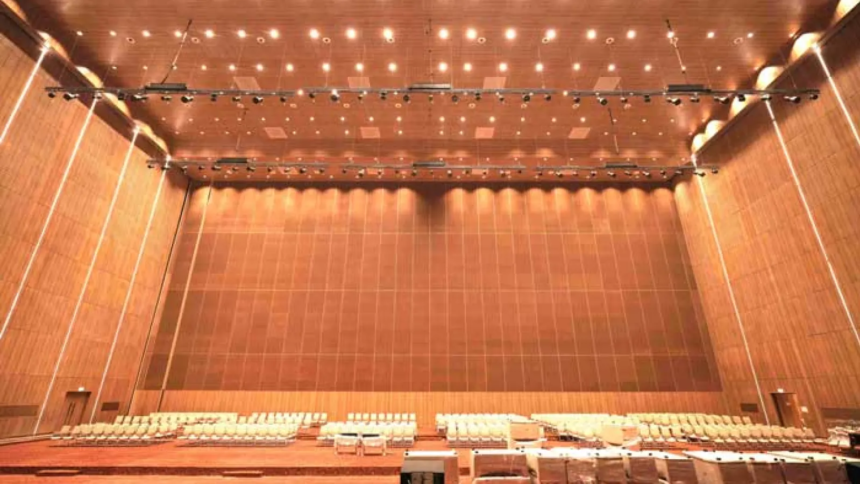
Hafele India Movable Wall, In a remarkable achievement for India’s infrastructure and architectural engineering sector, Hafele India has successfully delivered the world’s tallest movable wall at the ONGC Convention & Exhibition Centre in Goa. Standing at a staggering height of 22 metres and stretching across 48.1 metres in width, this engineering marvel is more than just a partition system — it is a symbol of innovation, precision, and the future of flexible architectural spaces.
From international expos to corporate events and large-scale conferences, modern venues need to evolve quickly depending on the occasion. And that’s exactly where this groundbreaking solution steps in.
A Record-Breaking Engineering Achievement
Imagine a wall as tall as a seven-storey building that can move effortlessly while maintaining stability and sound insulation. That’s precisely what Hafele India has accomplished at the ONGC Convention & Exhibition Centre in Goa.
The movable wall measures 22 metres in height and spans an incredible 48.1 metres in width, making it officially the tallest movable wall ever delivered globally. Such dimensions are not just impressive on paper — they demand extraordinary structural planning, precise execution, and flawless engineering coordination.
This wasn’t a standard interior installation. It was a large-format architectural challenge that required innovation at every level, from design and manufacturing to installation and operational functionality.
Why Movable Walls Are Becoming Essential in Modern Infrastructure
Hafele India Movable Wall, Today’s convention centres and exhibition halls are no longer static spaces. Organisers demand venues that can adapt within minutes to accommodate different events, crowd sizes, and functional requirements.
Movable wall systems solve this problem by allowing large halls to be divided into smaller functional areas whenever needed. Think of it like transforming a giant open theatre into multiple conference rooms with the push of a system.
For businesses and institutions, this means:
- Better space utilisation
- Increased operational flexibility
- Improved event management
- Higher revenue potential from multiple simultaneous events
- Enhanced visitor experience
The ONGC Convention Centre installation demonstrates how modern architecture is shifting toward intelligent, flexible design rather than rigid permanent structures.
Superior Acoustic Performance with 57 dB Sound Insulation
One of the standout features of the Hafele movable wall system is its exceptional acoustic performance.
The installation offers 57 dB sound insulation, ensuring that simultaneous events can take place without disturbing each other. In large convention centres, sound leakage can quickly become a nightmare. Imagine hosting a corporate seminar next to a musical performance — without proper acoustic separation, chaos is inevitable.
Hafele’s engineering solution tackles this challenge head-on through controlled sealing systems and precision-built panels designed to minimise sound transfer.
In simple terms, the wall doesn’t just divide space physically — it also creates acoustic privacy, which is critical for high-end event venues.
Massive Panels Engineered for Seamless Movement
Hafele India Movable Wall, Handling wall panels of this scale is no easy task. Hafele engineered the system using 1500 mm wide panels specifically designed for smooth operation despite their enormous size.
The real magic lies in the track-switching mechanism. The precision-based movement system allows operators to move and configure the panels efficiently without compromising stability or safety.
It’s similar to watching a giant sliding puzzle operate flawlessly — except this puzzle weighs significantly more and must perform with industrial-level precision every single time.
The engineering behind such movement systems involves careful calculations related to load distribution, balancing, alignment, and structural integrity.
How the Project Showcases India’s Growing Infrastructure Capabilities
For years, complex architectural engineering projects of this scale were often associated with Western markets or highly industrialised countries. However, projects like this highlight how India is rapidly emerging as a hub for advanced infrastructure innovation.
The successful execution of the world’s tallest movable wall reflects the country’s ability to handle sophisticated construction and engineering demands using collaborative expertise and advanced technology.
It also showcases how Indian projects are increasingly adopting smart-space solutions aligned with global standards.
As India continues investing heavily in convention centres, smart cities, hospitality, and large-scale infrastructure, flexible architectural technologies like movable walls are likely to become far more common.
Leadership Speaks on the Historic Milestone
Speaking about the achievement, Frank Schloeder, Managing Director of Hafele South Asia, described the project as a landmark moment for the company.
According to Schloeder, the project demonstrates Hafele India’s capability to execute complex and high-performance projects at scale while highlighting the strength of collaboration and engineering expertise.
He emphasised that the installation reflects the company’s commitment to supporting world-class infrastructure development in India through innovation and co-engineering solutions.
His statement underlines an important reality in modern construction — mega projects are no longer about a single company delivering a product. They are about ecosystems of architects, engineers, consultants, and technology providers working together seamlessly.
The Importance of Co-Creation and Co-Engineering
Hafele India Movable Wall, One of the defining aspects of this project was Hafele’s “Co-Creation & Co-Engineering” philosophy.
Rather than offering a one-size-fits-all product, the company worked closely with multiple stakeholders to develop a highly customised solution tailored specifically for the ONGC Convention Centre.
The project involved collaboration between:
- C. P. Kukreja Architects
- Engineers India Limited
- VRC
- Hafele India
This collaborative model ensured that architectural vision, structural requirements, operational needs, and engineering capabilities aligned perfectly.
It’s a bit like an orchestra. Even if one instrument misses a beat, the harmony breaks. But when every contributor performs in sync, the result is extraordinary.
Precision Planning Was the Key to Success
Delivering a movable wall of this magnitude wasn’t simply about manufacturing large panels. It demanded extensive planning, coordination, and technical precision across multiple stages.
Ashish Aundhkar, Business Head – Partitions & Automatics at Hafele India, highlighted how the project required close coordination across teams and interfaces to ensure flawless execution.
The engineering team focused on:
- Controlled sealing systems
- Structural stability
- Smooth panel movement
- Acoustic efficiency
- Precision track-switching mechanisms
- Long-term operational reliability
Such projects involve balancing architectural aesthetics with practical engineering performance — a task that becomes exponentially more difficult at larger scales.
Goa’s ONGC Convention Centre Gets a Global Landmark Feature
The ONGC Convention & Exhibition Centre in Goa now possesses a globally recognised architectural feature that sets it apart from many international venues.
Convention centres are increasingly competing on functionality and adaptability rather than sheer size alone. By incorporating the world’s tallest movable wall, the venue gains a major advantage in hosting diverse events with flexible spatial configurations.
This could potentially attract:
- International exhibitions
- Government summits
- Corporate conferences
- Cultural events
- Trade expos
- Multi-format conventions
In many ways, this installation transforms the venue into a future-ready event space capable of handling evolving global event requirements.
What This Means for the Future of Smart Architectural Solutions
Hafele India Movable Wall, The success of this project could pave the way for more advanced movable wall installations across India and other international markets.
As urban spaces become more expensive and multifunctional infrastructure becomes essential, architects and developers are increasingly looking for solutions that maximise space efficiency.
Movable wall systems are expected to play a critical role in:
- Smart convention centres
- Luxury hotels
- Airports
- Educational institutions
- Corporate offices
- Exhibition halls
- Government buildings
The Hafele-ONGC project proves that large-scale adaptable architecture is not just possible — it can also be executed at a world-record level.
A Milestone That Reflects India’s Engineering Future
At its core, this project is more than an engineering accomplishment. It reflects a broader shift in how India approaches innovation, infrastructure, and collaborative problem-solving.
The installation of the world’s tallest movable wall demonstrates that Indian infrastructure projects are no longer following global standards — they are helping define them.
With growing expertise in precision engineering, smart architecture, and customised infrastructure solutions, companies like Hafele India are contributing to a future where Indian-built innovations gain international recognition.
Read More: Viksit Bharat 2047: India’s Roadmap to Becoming a Developed Nation
Conclusion
Hafele India Movable Wall, The delivery of the world’s tallest movable wall by Hafele India at the ONGC Convention & Exhibition Centre in Goa is a defining moment in modern architectural engineering. Combining massive scale, advanced acoustics, seamless movement technology, and collaborative execution, the project sets a new benchmark for flexible infrastructure solutions.
More importantly, it highlights the growing sophistication of India’s engineering and construction capabilities on the global stage. As convention spaces and smart buildings continue evolving, projects like this showcase how innovation and co-engineering can transform ordinary infrastructure into world-class landmarks.
In a world where adaptability is becoming the cornerstone of architecture, Hafele India’s record-breaking installation stands tall — literally and symbolically — as a glimpse into the future of intelligent space design.