
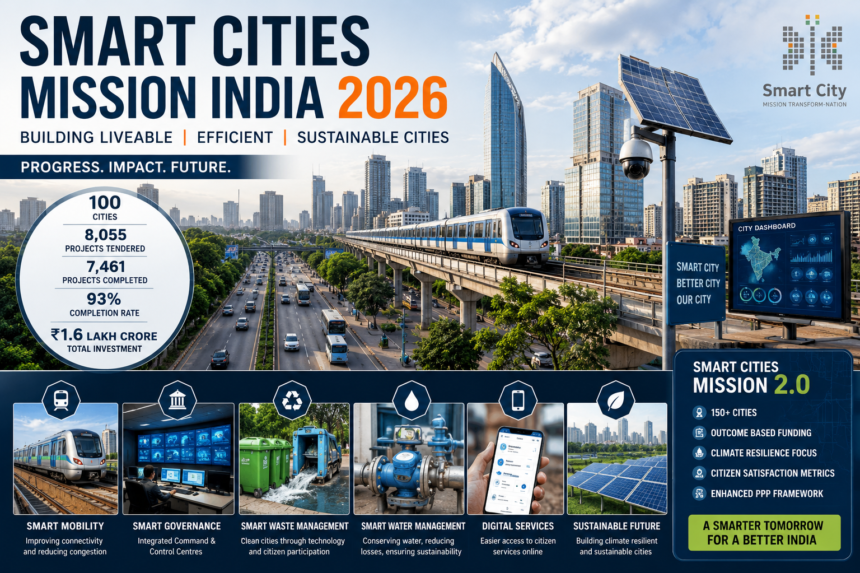
Smart Cities Mission India 2026, India’s Smart Cities Mission, launched in 2015 with the ambitious goal of transforming 100 cities through technology-driven governance and modern infrastructure, reaches a defining moment in 2026. With the mission’s primary funding phase nearing completion and the government proposing Smart Cities Mission 2.0 in Budget 2026, this is the right time to evaluate what has genuinely worked, what has failed, and what India’s urban future may look like over the next decade.
The Smart Cities Mission has delivered visible improvements in several cities, particularly in waste management, urban mobility, digital governance, and public infrastructure. However, the programme has also exposed deep structural issues in urban governance, institutional capacity, and long-term financial sustainability.
This comprehensive guide examines the Smart Cities Mission’s progress in 2026, the best-performing cities, the technologies that created meaningful impact, the major shortcomings, and the roadmap for India’s next phase of urban transformation.
Smart Cities Mission 2026: Key Numbers and Progress
The Smart Cities Mission originally targeted 100 Indian cities, with the Union Government allocating Rs 48,000 crore in central funding over five years. State governments, Urban Local Bodies (ULBs), and private sector participation significantly expanded the overall investment pool.
Current Status of the Mission in 2026
- Total projects tendered: 8,055 projects across 100 cities
- Projects completed: 7,461 projects
- Completion rate: 93%
- Total investment: Rs 1.6 lakh crore
- Projects still under implementation: Remaining projects expected to finish by December 2026
The scale of infrastructure execution is substantial. Roads, command centres, smart mobility systems, public surveillance networks, digital governance platforms, and water management systems have been implemented across multiple cities.
However, while project completion rates appear impressive on paper, the actual quality, usability, and long-term impact of these projects differ dramatically from one city to another.
Best Performing Smart Cities in India 2026
Surat — India’s Smart City Benchmark
Surat is widely regarded as the most successful Smart City in India and consistently ranks at the top of national urban governance assessments. The city’s success comes from a combination of strong municipal administration, operational efficiency, and practical technology integration rather than flashy infrastructure alone.
Major Achievements of Surat
- 100% household waste collection and processing
- Integrated Command and Control Centre (ICCC) for traffic, utilities, and emergency monitoring
- CCTV coverage across more than 90% of public areas with AI-powered analytics
- IoT-enabled flood management systems linked to real-time weather monitoring
- Digital property tax collection system with compliance rates exceeding 95%
Unlike many cities where technology became symbolic, Surat integrated digital systems directly into day-to-day urban operations.
Indore — India’s Cleanliness Champion
Indore continues to dominate India’s urban cleanliness rankings. The city has won the Swachh Survekshan award for eight consecutive years, an achievement unmatched by any other large Indian city.
The city’s success is based on consistent execution, strict enforcement, and strong citizen participation.
Key Strengths of Indore
- 100% door-to-door waste collection
- Strict source segregation enforcement
- Waste-to-energy plant processing nearly 800 tonnes of waste daily
- Extensive monitoring of sanitation systems using digital tools
- High levels of public awareness and citizen cooperation
Indore demonstrates that successful smart city development depends as much on behavioural change as on technology deployment.
Pune — Leader in Smart Mobility
Pune has emerged as one of India’s most advanced cities in sustainable urban transportation. Managing mobility remains one of the biggest challenges for Indian cities, and Pune has made measurable progress in this area.
Major Mobility Improvements in Pune
- Expansion of Pune Metro infrastructure
- Large-scale deployment of electric buses
- Dedicated cycling lanes on selected corridors
- Integrated mobility applications for multimodal transport planning
- AI-powered traffic management systems
Although congestion remains a challenge, Pune has shown that coordinated investments in public transport and intelligent traffic systems can significantly improve urban mobility.
Vadodara — Combining Heritage with Smart Infrastructure
Vadodara presents a different model of smart urban development by successfully integrating heritage preservation with modern infrastructure upgrades.
The city has modernised urban services while protecting culturally significant areas and architectural landmarks.
Key Initiatives in Vadodara
- Smart lighting systems in heritage zones
- Digital tourism interpretation tools
- Infrastructure modernisation in the urban core
- Preservation of historic precincts alongside smart upgrades
Vadodara proves that technological modernisation and cultural preservation can coexist effectively.
Urban Technologies Making the Biggest Difference
Integrated Command and Control Centres (ICCCs)
Integrated Command and Control Centres have become the operational backbone of most Smart Cities. These centres combine traffic management, CCTV surveillance, emergency response systems, weather monitoring, and utility management into a unified operations platform.
Cities such as Surat, Bhopal, and Varanasi have used ICCCs effectively to improve urban management.
However, results vary significantly between cities. Some ICCCs function as active operational hubs, while others remain largely underutilised display centres with limited real-world impact.
The difference often comes down to administrative capability rather than technology itself.
Smart Traffic Management Systems
AI-powered adaptive traffic signal systems are among the most practical smart city interventions deployed in India.
Unlike traditional fixed-timing traffic signals, adaptive systems adjust signal timing dynamically based on real-time traffic conditions.
Cities Showing Measurable Improvements
- Ahmedabad
- Chennai
- Pune
In well-managed corridors, these systems have reduced travel times by 15% to 25%, improved traffic flow, and reduced congestion during peak hours.
Smart Water Management
Water management is emerging as one of the most important applications of urban technology in India.
IoT-enabled systems now help cities monitor water pressure, detect leaks, automate valve operations, and reduce non-revenue water losses.
Cities Leading in Smart Water Management
- Surat
- Nagpur
These interventions are particularly critical for India because water scarcity and inefficient urban distribution systems remain major long-term challenges.
Digital Governance and Citizen Services
Digital governance platforms have transformed how citizens interact with municipal authorities.
Many cities now provide online access to:
- Birth and death certificates
- Property tax payments
- Building approvals
- Complaint registration systems
- Property mutation services
These systems reduce corruption opportunities, minimise bureaucratic delays, and improve administrative efficiency.
However, service quality still varies widely depending on local governance capacity and IT infrastructure.
What Has Not Worked: An Honest Assessment
Technology Without Governance Capacity
One of the biggest failures of the Smart Cities Mission has been the deployment of technology without sufficient institutional capability to operate and maintain it effectively.
Several cities installed expensive systems without investing adequately in staff training, maintenance, or operational integration.
Common Examples of Failure
- ICCCs with limited operational usage
- Smart waste bins without route optimisation systems
- Traffic monitoring data that was never analysed
- Sensors that stopped functioning due to poor maintenance
The mission revealed an important reality: urban transformation is fundamentally a governance challenge, not merely a technology procurement exercise.
Lack of Citizen Engagement
In many cities, Smart City projects were designed primarily by consultants and contractors rather than through meaningful citizen consultation.
As a result, several projects addressed theoretical urban problems instead of residents’ actual priorities.
The most successful initiatives, particularly in waste management and digital governance, were those that actively involved citizens and encouraged behavioural change.
Indore remains the strongest example of this approach.
Financial Sustainability Problems
Many smart city systems require continuous operational expenditure, including:
- Software licensing
- Sensor maintenance
- Data connectivity costs
- System upgrades
- Technical manpower
Once initial central funding declined, several cities struggled to sustain operations.
Cities without stable municipal revenue models or long-term budgeting strategies have already seen parts of their smart infrastructure fall into underuse.
Smart Cities Mission 2.0: What Budget 2026 Proposes
Budget 2026 proposed a significantly expanded Smart Cities Mission 2.0 with an estimated allocation of Rs 1 lakh crore.
The second phase aims to address many of the structural weaknesses identified during Mission 1.0.
Key Features of Smart Cities Mission 2.0
Expansion Beyond the Original 100 Cities
The proposed programme plans to include more than 150 cities, particularly Tier 2 and emerging urban centres that received limited support in the first phase.
Outcome-Based Funding Model
Instead of funding based mainly on project completion certificates, cities will receive funding in phases linked to measurable outcomes and service delivery performance.
Climate Resilience Focus
Climate adaptation and sustainability are expected to become mandatory components of future urban projects.
This includes:
- Flood resilience
- Heat mitigation strategies
- Sustainable water systems
- Renewable energy integration
- Green mobility infrastructure
Citizen Satisfaction Metrics
For the first time, resident feedback and citizen satisfaction surveys are proposed as formal performance indicators.
This reflects growing recognition that smart cities should ultimately improve quality of life rather than simply deploy technology.
Greater Private Sector Participation
Mission 2.0 also proposes expanded Public-Private Partnership (PPP) frameworks for urban infrastructure and services.
Given India’s massive urban financing requirements, private capital participation is becoming increasingly necessary.
India’s Urban Future: The Major Challenges Ahead
Rapid Urbanisation
India is expected to add nearly 400 million urban residents by 2050 — equivalent to adding the current population of the United States to Indian cities.
This scale of urban growth will place enormous pressure on infrastructure, housing, transport, sanitation, and utilities.
Massive Infrastructure Deficit
Even today, much of India’s urban infrastructure remains inadequate for current population levels.
Without major investment acceleration, urban systems could face severe stress in the coming decades.
Climate Vulnerability
Indian cities face growing risks from:
- Flooding
- Heatwaves
- Water scarcity
- Air pollution
- Coastal erosion
Climate resilience will likely become central to all future urban planning strategies.
Financing the Urban Transformation
India’s estimated urban infrastructure requirement exceeds Rs 70 lakh crore over the coming decades.
Government funding alone cannot bridge this gap. Future urban development will require:
- Municipal finance reform
- Stronger PPP frameworks
- Land value capture mechanisms
- Improved property tax systems
- Greater private investment participation
Read More: India Semiconductor Mission 2026: Can India Become a Global Chip Manufacturing Powerhouse?
Conclusion
India Smart Cities Mission has delivered meaningful progress in several areas of urban development. Cities like Surat, Indore, Pune, and Vadodara demonstrate that technology, when combined with strong governance and citizen participation, can significantly improve urban life.
At the same time, the mission has exposed serious weaknesses in institutional capacity, project planning, financial sustainability, and citizen engagement.
The biggest lesson from Smart Cities Mission 1.0 is clear: smart cities are not created by installing technology alone. They are built through capable governance systems, sustainable financing models, citizen cooperation, and long-term urban planning.
If these lessons are genuinely incorporated into Smart Cities Mission 2.0, India has the opportunity to create more liveable, resilient, efficient, and sustainable cities over the next decade.
Taza Newsz continues to cover India’s urban development, smart city initiatives, infrastructure projects, and policy reforms comprehensively. Follow us for the latest updates on India’s rapidly transforming urban future.