
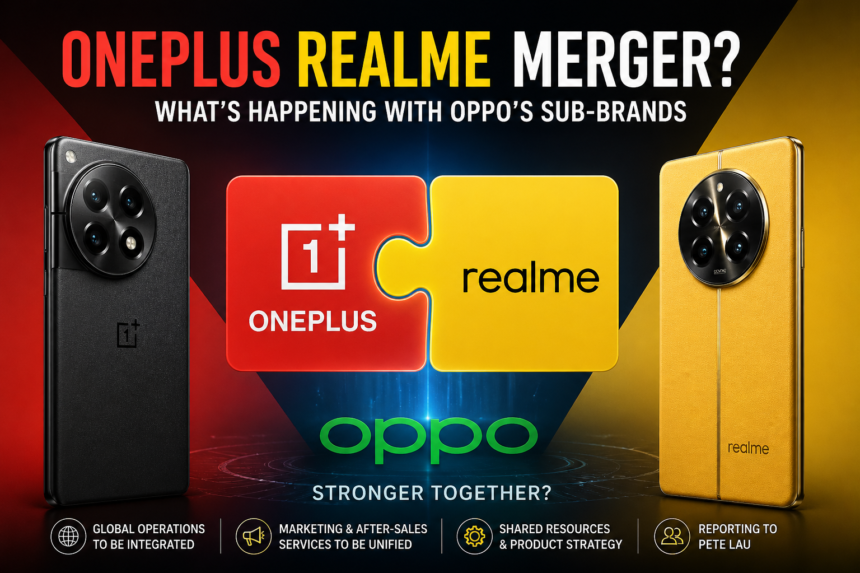
OnePlus Realme Merger, The smartphone world thrives on disruption—but even by those standards, the latest buzz around OnePlus and Realme has raised eyebrows. Are these two popular brands actually merging? Or is this just another industry rumor dressed up as breaking news?
Let’s unpack what’s really going on—without the fluff, without the speculation overload—and understand what it means for users like you and me.
The Big Question: Are OnePlus and Realme Merging?
In short—not exactly a full merger, but something very close to it.
Recent reports suggest that both brands are being reorganized under a unified structure within Oppo. Instead of operating as fully independent entities, they are now expected to function under a shared “sub-product center.”
Think of it like siblings who used to live in separate apartments but now share the same house—with common resources, shared responsibilities, and maybe even the same kitchen.
Where Did This News Come From?
OnePlus Realme Merger, The latest wave of reports originated from Chinese tipster Digital Chat Station, who claimed that the integration is already official. According to these updates:
- OnePlus and Realme will combine domestic and global operations
- Marketing and after-sales services will be centralized
- Product development may lean toward shared designs and platforms
While there’s no formal press release confirming all details, the pattern aligns with how Oppo has been restructuring its ecosystem.
Understanding Oppo’s Strategy: Why This Move Makes Sense
To understand this shift, you need to look at the bigger picture.
Oppo has been gradually tightening control over its sub-brands. OnePlus was already deeply integrated with Oppo’s R&D and software divisions. Realme, once more independent, has also been pulled closer recently.
So why unify them further?
Because running multiple brands with overlapping products is like running three restaurants serving the same menu—inefficient and costly.
By merging operations:
- Costs can be reduced
- Product overlap can be minimized
- Innovation can be streamlined
In corporate terms, this is called “resource optimization.” In simple terms, it’s about doing more with less.
Pete Lau’s Role: The Man Behind the Shift
OnePlus Realme Merger, At the center of this restructuring is Pete Lau, who has long been a key figure connecting OnePlus with Oppo.
Reports suggest that the combined teams will now report directly to him, signaling tighter leadership control and a more unified strategy.
If Oppo is the engine, Pete Lau is increasingly becoming the driver steering all sub-brands in the same direction.
What Happens to OnePlus as a Brand?
Now here’s where things get interesting.
Despite the integration, OnePlus is not shutting down. The brand still carries strong recognition, especially in markets like India and the United States.
However, its identity may evolve.
Instead of being a fiercely independent “flagship killer” brand, OnePlus could become:
- More aligned with Oppo’s ecosystem
- Less experimental
- More efficiency-driven
In other words, it might trade some of its rebellious DNA for stability and scale.
The Europe Factor: A Strategic Retreat?
OnePlus Realme Merger, One of the biggest triggers behind this restructuring appears to be uncertainty in Europe.
Reports indicate that OnePlus is reviewing its presence in several European markets. While nothing has been officially confirmed, signs such as internal restructuring and reduced visibility suggest a possible pullback.
Why Europe?
Because it’s a tough market—high competition, strict regulations, and thin margins. If a brand isn’t performing strongly, consolidation becomes the logical move.
India: A Crucial Market Under Watch
If Europe is uncertain, India is critical.
India has been one of OnePlus’ strongest markets for years. But recent developments have raised concerns:
- Leadership change with the exit of Robin Liu
- Reports suggesting he may now report to Sky Li
- Internal restructuring within the regional team
Officially, the company insists that operations are “business as usual.” But when leadership shifts happen, they rarely come without strategic implications.
Declining Shipments: A Warning Sign?
Numbers don’t lie—and recent data shows a slowdown.
Industry reports suggest that OnePlus shipments in India dropped between 32% and 39% in 2025. That’s not just a minor dip—it’s a signal.
Why the decline?
Possible reasons include:
- Increased competition from brands like iQOO and Samsung
- Less aggressive product launches
- Overlap with Oppo and Realme devices
This is exactly the kind of scenario where consolidation becomes attractive.
Product Strategy: Are We About to See More Similar Phones?
OnePlus Realme Merger, One of the most talked-about aspects of this shift is product line reuse.
That’s corporate speak for something simple:
More shared designs, fewer unique models
So yes, you might start noticing:
- Similar hardware across OnePlus, Realme, and Oppo devices
- Shared features and software experiences
- Less distinction between product tiers
For consumers, this could mean better pricing—but possibly less uniqueness.
What About New Launches?
Interestingly, there’s already a noticeable slowdown in major global announcements.
Take the rumored OnePlus Watch 4—it surfaced recently, but without clear details on pricing, launch timeline, or availability.
This kind of silence often signals internal transition rather than lack of innovation.
Does This Affect Users Right Now?
Short answer: Not immediately.
Long answer: Gradually, yes.
Here’s what you might notice over time:
- More unified customer support systems
- Consistent software experiences across brands
- Potential changes in product positioning
But your existing OnePlus device? It’s not going anywhere.
So, Is This a Good or Bad Move?
That depends on how you look at it.
The positives:
- Better efficiency
- Potentially lower costs
- Stronger ecosystem integration
The concerns:
- Loss of brand identity
- Reduced product diversity
- Less innovation risk-taking
It’s a classic trade-off—efficiency versus individuality.
The Bigger Picture: A Trend Across the Industry
This isn’t just about OnePlus and Realme—it reflects a broader industry trend.
Tech giants are moving toward consolidation over fragmentation. Why? Because:
- Competition is intense
- Margins are shrinking
- Innovation is expensive
By bringing brands closer together, companies like Oppo are trying to stay competitive without burning resources.
Read More: OnePlus Nord 6 Review: Powerful Specs, Massive Battery & Smooth Performance